The chill of the pre-dawn air wrapped around Gobryas as he discreetly approached the formidable gates of Babylon, the sand crunching softly under his every step. His heart thrummed with a quiet resolve, fueled by the bitter loss of his son—an innocent life cruelly extinguished by the Babylonian king's whims. Those same iron-clad gates loomed before him now, not as the insurmountable barriers they presented to the world, but as doors ready to swing wide open under his hand.
For those who dwelled beyond these walls, Babylon was not merely a city—it was considered the unconquerable heart of an empire, a titan of ancient civilization shielded by walls towering over the landscape, eighty feet thick and seemingly impervious to any external force. But Gobryas, a man once sworn to this fortress, had seen the beast from within, had lived in its belly, and tasted its bile. He knew of its seams, its structural vulnerabilities hidden from enemy eyes, and today, he moved to unravel them.
The story of Babylon's fall on a seemingly ordinary day in 539 BC is one not typically taught in classrooms, eclipsed perhaps by tales of grander battles and glorious conquests. Yet, beneath the silent stars that bore witness to Gobryas' quiet act of defiance, unfolded an event whose impact rippled through the annals of history—the fall of the greatest city without a battle, its mighty walls made nothing more than formidable illusions by one man's determination.
Gobryas had deepened his resentment for the Babylonian regime over the years, his ire honed sharp by personal tragedy. His leadership had once been rooted in loyalty until the callous command from Babylon had stripped his family of its future. His grief transformed into resolve, leading him to seek an audience with Cyrus the Great, the Persian king whose name echoed with tales of ambition and conquest. It was Gobryas who braved the distance to propose an alliance that turned betrayal into strategy, vengeance into history.
As he stood there with the first golden hues of dawn breaking on the horizon, he reached for the mechanism that had remained a well-guarded secret, a silent oath among those who dared not think of impeding forces. With a heart both heavy with memory and light with the liberation he set in motion, Gobryas opened the gates himself. The sky painted itself in a tapestry of burgeoning light as Cyrus' forces moved—shadowy figures sprawling into the citadel with a swiftness that belied the quiet overtones of the act.
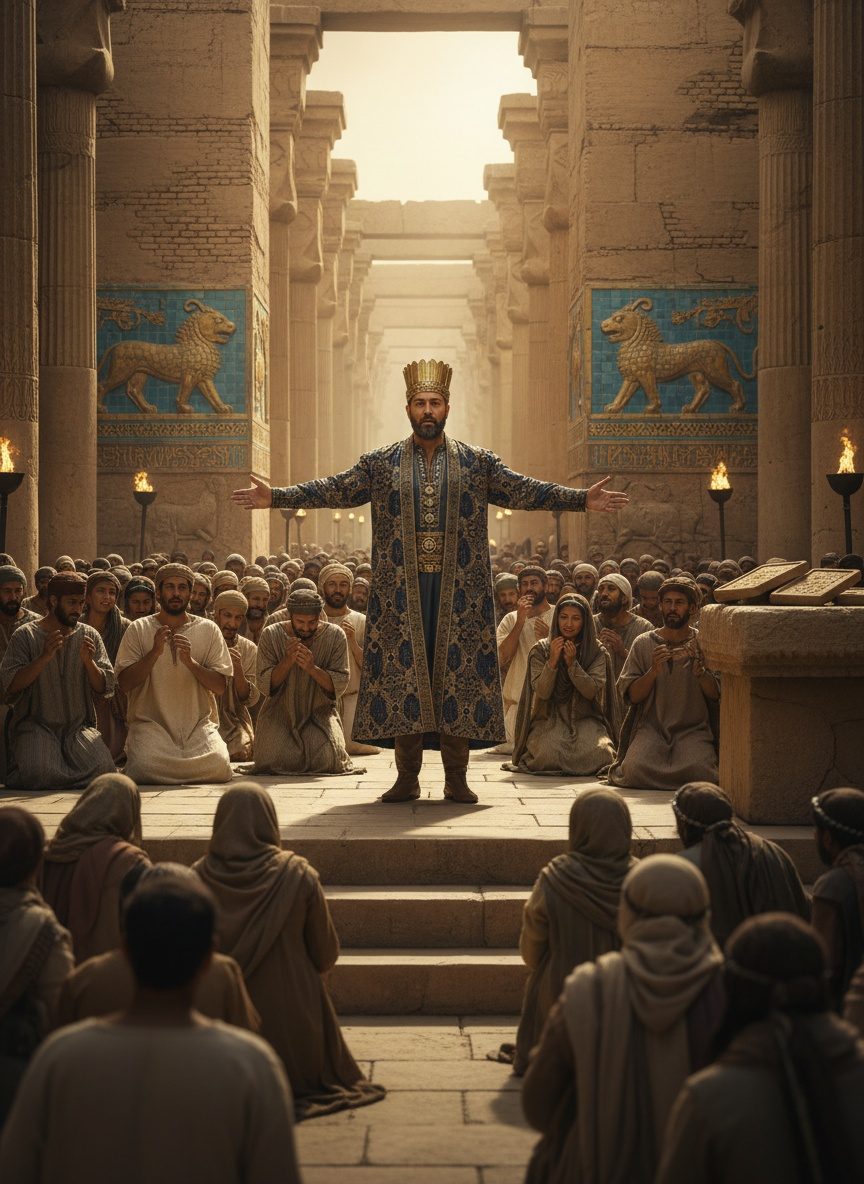
The air was charged with the anticipation of morning, yet within the confines of Babylon, the pervasive quiet expanded as an invisible wave. Warriors accustomed to the raging cacophony of armed conflict found this invasion unusually silent, almost surreal in its execution. Cyrus entered Babylon not with the clamor of weaponry but with the stillness of inevitability. His name carried an aura that preceded him—revered, respected, and now, as Gobryas had whispered to expectant ears, fused with the essence of liberation.
Inside this fortress, everyday lives threaded through the expanding threads of the empire under a new ruler. The marketplace continued to hum with the banter of merchants, unaware or perhaps indifferent to the coup in divine protection overhead. For many, the affairs of kings were but the distant thunder in their collective existence. Yet, impact and essence constantly trickled down to alter the course of their lives in ways subtle and profound.
What most astonished those chronicling this era was the very simplicity with which Babylon changed hands—not a sword drawn or a clash of shields witnessed in this transformation. The messenger reached the heart of Cyrus' camp the next day, bearing news that seemed almost inadequate for the magnitude of its truth: the gates had swung open, Babylon was taken, and the world spun a different tale now.
The records often dwell in the technicalities of military victories, highlighting strategies as the key architects of success, overshadowing the emotive roots that spurned such acts. Yet here, underneath the politics and geographical conquests lay a narrative driven by the human spirit, a narrative not just about losing a city but winning over the hearts that had longed for change. Gobryas, in his silent revolt, had not merely betrayed a city but had reshaped the very understanding of what conquest could mean—peaceful, surgical, powerful.
And so, the invasion was complete. The might that Babylon once signified became history, swallowed by the sands of time and human design. Cyrus the Great’s dominion expanded, his legacy building on layers of diplomacy and alliances as much as by the broader strokes of military might.
Thus, the story of how Gobryas opened Babylon to Cyrus invokes a compelling question about the nature of power: is it determined solely through might, or does true strength lie in the knowledge of when to open a gate and let the tides of change wash through?