Freydís Eiríksdóttir's name is often overshadowed by her father's legacy. But in the forests of Vinland, she carved her own legend with far fewer men.
The Shores of a New World
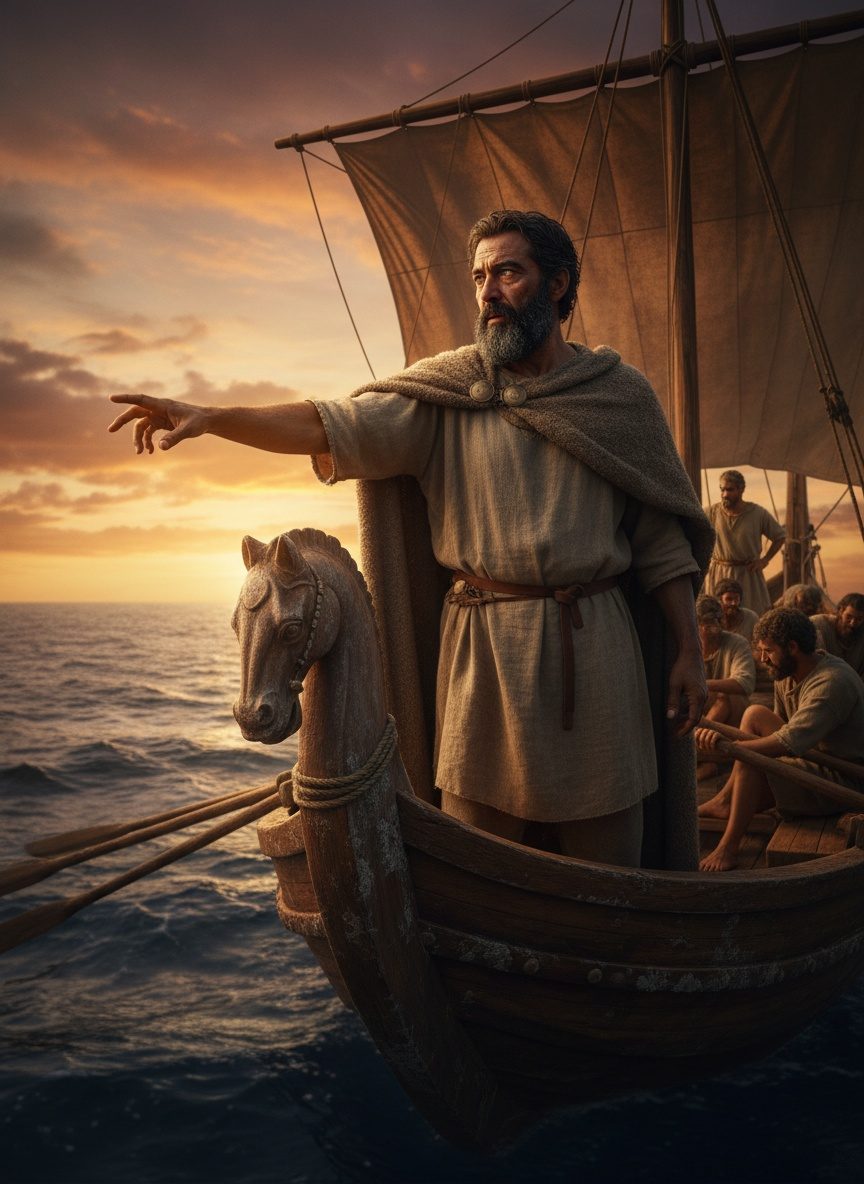
In the early 11th century, the Vikings, renowned for their fearless exploration and seafaring mastery, reached the shores of a land they called Vinland—what we now know as North America. Long before Columbus's fabled voyage, these Norse settlers had crossed the frigid Atlantic, their dragon-headed ships cutting through icy waters to explore and settle these unexplored territories. This lush, remote land offered rich resources and untapped potential, but it wasn't the untouched paradise it might have seemed.
The Norse settlers faced challenges they hadn't anticipated, not least among them the indigenous people who already called this land home. It is within this burgeoning settlement that Freydís Eiríksdóttir, daughter of Eiríkr the Red, emerged as a testament to resolve and courage that would become part of Norse legend.
The Gathering Storm
As the Norsemen set about establishing their foothold in Vinland, tensions with the indigenous population began to rise. The Norse referred to these indigenous people as the "Skræling," a term shrouded in mystery and often used to depict a foreign 'other.' These tensions eventually escalated into conflict, forcing the Norse to assess whether they would stay and fight or return to the familiar shores of Greenland.
One particular incident would cement Freydís's place in history. The Norse settlers were caught off guard by an indigenous attack, prompting a frantic evacuation. Armed Norse warriors, who had previously shown no hesitation in facing combat, turned and fled, overwhelmed by the suddenness and intensity of the assault. Yet in the midst of the retreat, a solitary figure held her ground.
Beneath the Forest Canopy
Freydís Eiríksdóttir, pregnant and seemingly vulnerable in that moment of chaos, refused to join the retreating men. Her mind flashed to her unborn child, her inner strength burning brighter than any candle. She picked up a sword discarded by one of the fleeing warriors. Here stood not the daughter of a legend but a resolute force amid the clamor of battle.
The primitive forest surrounding them fell eerily silent as she lifted the weapon. Her fierce cries echoed through the trees, a chilling testament to bravery unmatched by any of her male compatriots. The indigenous warriors, perplexed by this unexpected challenge, hesitated. Her audacity rooted them to the spot, halting the attack as they grappled with this unforeseen defiance.
Fearless in the Face of the Unknown
Freydís’s nerve, showcased in that crucial moment, was writ large in the sagas that recounted the Norse exploits. Although differing in certain details, both tales celebrate her stand as a pivotal moment in Vinland’s turbulent story. But how did this lone woman's audacity alter the course of an entire settlement?
The warriors' retreat was arrested not by fear of the indigenous attackers but by the reproach of a single woman’s unparalleled defiance. Leadership among the Norse had been momentarily redefined not by conquest but by the obstinate wall Freydís presented to the invaders. Her actions were a tipping point that forced even the proudest of Norsemen to reevaluate their courage and commitment in the shadow of the unknown.
A Legacy Written in Timber and Tales
The story of Freydís Eiríksdóttir emerges from the pages of sagas famed for blending fact and fiction—a remarkable narrative of tenacity. In a time and place where the notion of gender roles was both rigid and narrowly defined, Freydís shattered expectations. Her defiance proved pivotal, forcing those around her to stay and stand ground, at least a moment longer in Vinland.
Why does her story matter today? Because even in the face of the mightiest adversities, a lone figure—courageous and indomitable—can challenge the course of history. Her stand, immortalized in tales whispered and retold across generations, offers a timeless testament. Freydís Eiríksdóttir’s legacy is eloquent, carving her place not just in Viking saga but in the enduring narrative of resilience against formidable odds.