The air in Vinland was thick with tension. The dense forest hugged the Norse settlement with an almost stifling presence, its tall pines whispering secrets to the northern winds. The light filtered through the canopy, casting angular shadows that danced upon the soil and hinted at the mysteries hidden within. As cries of birds rang through the crisp air, the trees bore witness to an unfolding drama that would be recounted through the ages. Vinland was on the brink—not of discovery or triumph, but of a struggle for survival, hemmed in by hostilities both human and elemental.
Amid the chaos of a collapsing camp, where the frenzied shouts of retreating warriors clashed with the haunting calls of their adversaries, a formidable figure stood out against the backdrop of fear and disorder. Freydís Eiríksdóttir, daughter of the infamous Erik the Red, was not swayed by the tumult or trepidation enveloping her kin. With the sea behind her and the treeline threateningly close, she found herself in an arena of desperation that few have ever dared enter.
It was an uncommon scene, even in the adventurous chronicles of the Vikings. The Norse had ventured to these new shores, seeking riches rumored to be just beyond the horizon. Vinland was supposed to be a place of opportunity, a Norse haven carved into the wild contours of the New World. Yet here, far from the snow-bound fjords of their homeland, they'd confronted not just the unfamiliar terrain but also the 'Skraelings'—as they called the indigenous peoples who regarded these intruding strangers warily.
The Norse camp, resilient but fragile, had perhaps met its match not only in Vinland's indigenous peoples but also in the delicate balance they sought to maintain in such a foreign land. Supplies were scarce, allies scarcer still, and tempers ran hotter than the midday sun. Freydís watched as seasoned warriors, men who had weathered the storms of the North Atlantic and emerged unperturbed by the sea's fury, faltered at the sight of the approaching Skraeling force.
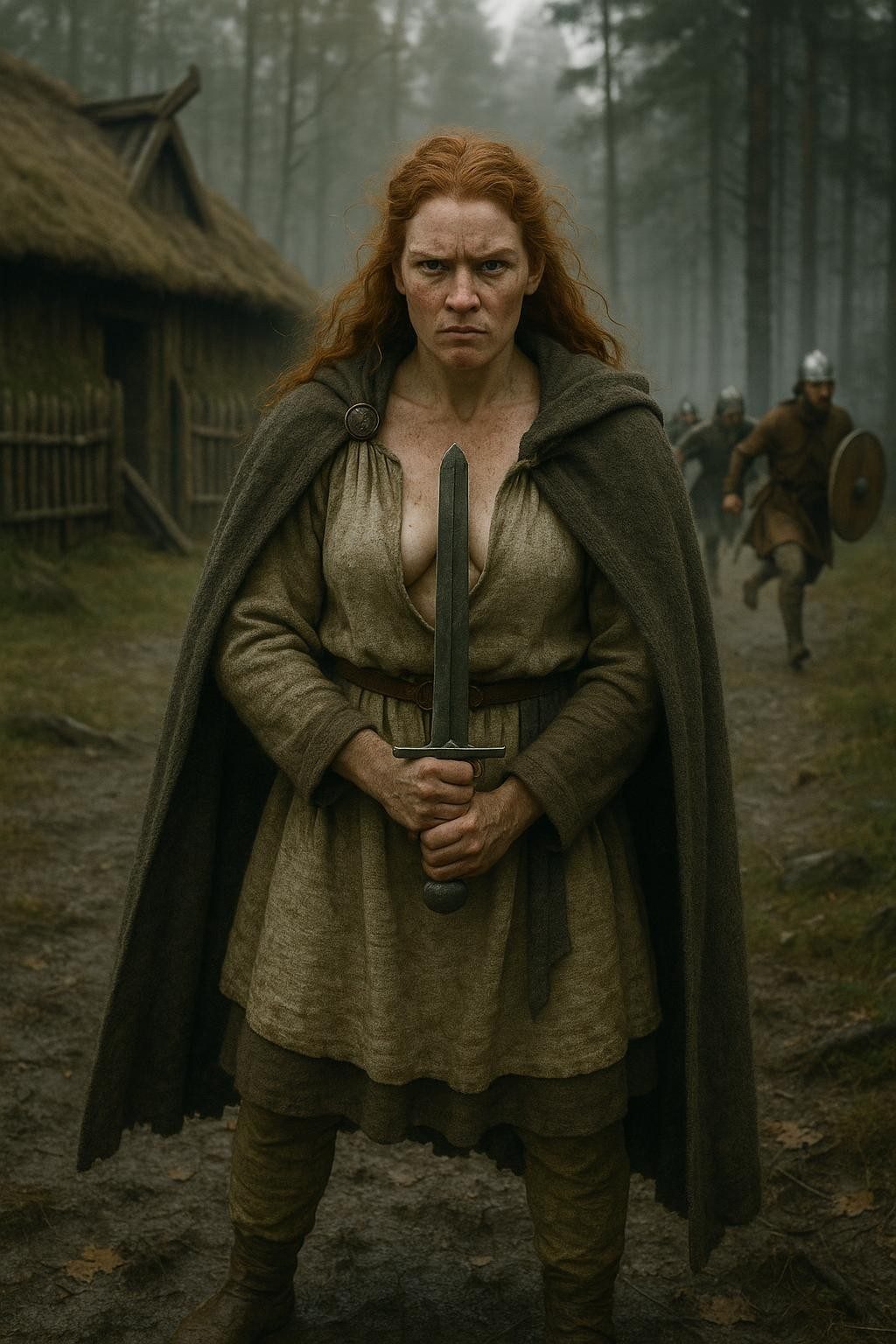
In that instant, Freydís became something more than her father's daughter or a member of their fraught expedition. As the Skraelings advanced, her mind dismissed the impracticalities of hiding or retreating. Instead, she grabbed a sword, its familiar weight balancing the gravity of her decision. With a grip as unyielding as the rugged Norse homeland, she prepared for a different kind of engagement.
Enraged, yet calculated in her audacity, she turned to face the advancing Skraelings. Her voice cut through the din like a sliver of ice—a scream, primal and defiant. She struck her own breast with the flat of her blade, a gesture both desperate and dominantly symbolic. This was no mere threat to an enemy; it was a challenge, a gauntlet thrown at the feet of fate itself.
The noise of the camp fell silent, the clamor of flight arrested by the audacity of Freydís's heart-stopping cry. The Skraelings, who had expected to find an easy advantage among the fleeing, stumbled to a halt, bewildered by the sight before them. It was an image so incongruous, so pregnant—literally so, for Freydís was with child—that even their seasoned warriors hesitated. In that fractional moment, the outcome of this encounter lay suspended in the echo of her defiance.
And then, as swiftly as tensions had mounted, they abated. Whether it was the shock of her brazenness, the unpredictability of her gesture, or a captivated respect for a foe who did not falter, the Skraelings turned back toward the trees, disappearing once more into the expanse of their lands. Freydís's scream, echoing even as it faded, had punctuated the narrative of Vinland with a message later generations struggled to comprehend.
This incredible encounter did not preserve the Norse settlement indefinitely or convert the land into the Viking foothold in North America they had dreamed it would be. Indeed, the challenges that accumulatively defeated Freydís’s kin were too great, the grip of the old world too strong to sustain their hope. Yet in that moment of daunting strength, she had laid claim to something greater than territory—she had etched courage into the annals of human history.
The story of Freydís Eiríksdóttir is a beacon traversing the darkness of unremembered time. In the sagas that followed, her name was inscribed among those who dared to stand when others would flee. A pregnant viking woman armed not with decorated armor but with resolve, her tale transcends its setting in the dire wilderness of Vinland. It speaks not only to the audacity of the Vikings but to the universal human spirit—a determination to be unyielding when faced with the implacable veracity of the world.
How history chooses its protagonists is oftentimes a mystery. Freydís Eiríksdóttir was neither kin to kings nor conqueror of lands. Hers was a legacy written in the vulnerable heat of determination and captured in the stillness of an autumnal forest. She may have been a silhouette against a dwindling day, but hers is a story reborn with each telling, its testament a haunting question to us all: when faced with retreat or resistance, what will we choose to run toward or from?