The Codex Command
In 367 AD, a pivotal moment unfolded within the early Christian Church—a moment that would decisively shape the future of Christian doctrine and its sacred texts. That year, Athanasius, the zealous Bishop of Alexandria, released his annual Easter letter. In a bold and authoritative move, he listed 27 books, among them the Gospels and the Pauline Epistles, as the definitive canon of Christian scripture. But there was another, darker dimension to his list: a strict, almost draconian order. All other texts, those not contained within his sanctioned list, were to be considered heretical.
Athanasius’ proclamation resonated through the monasteries of Egypt, reverberating like a crack of thunder. In a region as devout as it was diverse, housing myriad communities of monks and believers, this edict was more than a mere guideline. It was a clarion call, an unyielding directive that other Christian writings, no matter how revered in certain circles, were to be expunged from the libraries of the faithful. Many obeyed without question, kindling flames of destruction that devoured these texts, turning centuries of theological exploration to ash.
A Desert Secret
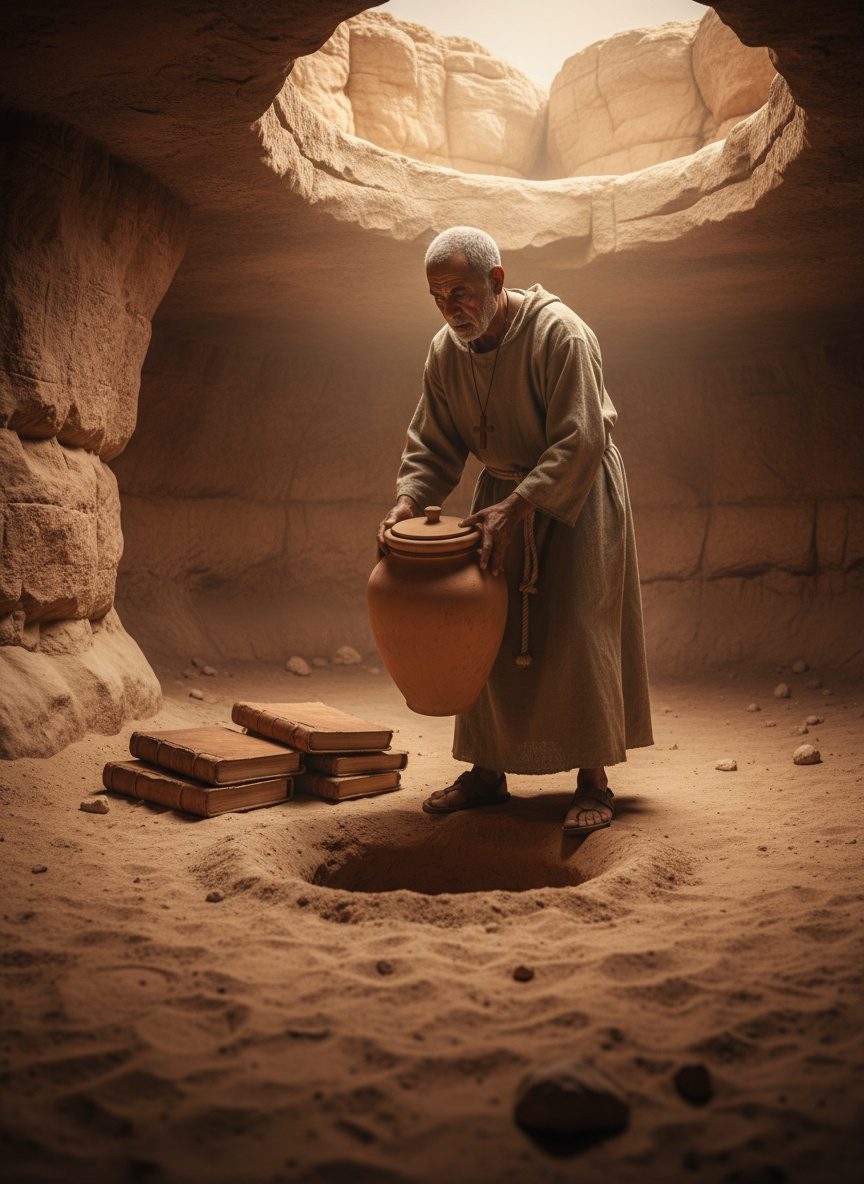
Yet, there are always those who resist the tide, and it was amid the silent sands and isolated sprawl of the Egyptian desert that a small band of monks chose defiance over destruction. To them, the spiritual wealth contained within these pages was invaluable. Rather than capitulate to the demands of orthodoxy, they undertook a secret, sacred mission. Deep in the desert near Nag Hammadi—the remnants of ancient Thebes—they gathered 52 of these outlawed texts and sealed them in a large clay jar.
The Nag Hammadi Codices, as they would come to be known centuries later, encompassed a diverse range of writings. From Gnostic gospels like the Gospel of Thomas to philosophical treatises and mystical hymns, each document was a window into the rich tapestry of early Christian thought. The monks possibly perceived their task as a preservation of truth, trusting that some future generation might once more unearth and appreciate the treasures they hurriedly buried.
In the Grip of Time
For nearly 1,600 years, these texts lay entombed beneath the shifting sands, their existence all but forgotten. Their survival was a testament to both the forethought and the boldness of those anonymous monks who had dared to protect their spiritual heritage. While the world changed dramatically above, as kingdoms rose and fell and new faiths spread and took root, the clay vessel sat undisturbed, its secrets locked away within the embrace of the earth.
The world into which these texts were finally unearthed was one drastically different from the era of their burial. By the time the jar was discovered, the Christian world had long since canonized Athanasius' list, and any challenge to the New Testament’s sacred number had seemingly been extinguished. Yet, the Nag Hammadi jar's opening offered not only a wealth of historical insight but also presented the tantalizing question of what Christianity might have embraced had these texts remained in circulation.
The Accidental Discovery
It was a chance encounter, a serendipitous twist of fate, set against the backdrop of an arid desert landscape in 1945. The Egyptian farmer, digging for soft soil for fertilizing his fields, unwittingly revealed the jar. Inside lay the papyrus-bound volumes that, when translated, would rekindle scholarly debate and intrigue worldwide. Across the globe, academics and theologians would eagerly dissect these texts, piecing together the philosophical and theological currents that characterized early Christianity.
The discovery would expose modern readers to voices and perspectives that were once condemned to silence. It painted the early Christian centuries as a time of vibrant and often contentious spiritual exploration. The Nag Hammadi texts shed light on more mystical and esoteric dimensions of Christianity, inviting readers to contemplate the faith's diverse origins and questioning what might have been consigned to oblivion. Gnosticism, with its emphasis on personal spiritual knowledge over orthodoxy, suddenly had a tangible connection to a period often presented as uniformly orthodox.
Unveiled Treasures
These texts have since spurred intense scholarly study and broader questions about the forces that shape religious expression. The Nag Hammadi library offers an unparalleled glimpse into the debates, struggles, and fervent spiritual quests that characterized early Christian communities. Reading them today, we sense the palpable tension between orthodoxy and heresy, authority and rebellion, explicit faith and concealed wisdom.
This serendipitous discovery serves as a poignant reminder of the possible worlds we might have lost to fear and conformity—hidden treasures sealed away because they did not fit into a prescribed narrative. In this way, the clay jar symbolically stood as a guardian of human curiosity and the pursuit of alternate wisdoms. It reminds us that beneath the sands of history, there lies buried potential for new understandings and invites us to consider how the narratives we embrace define our reality and belief.