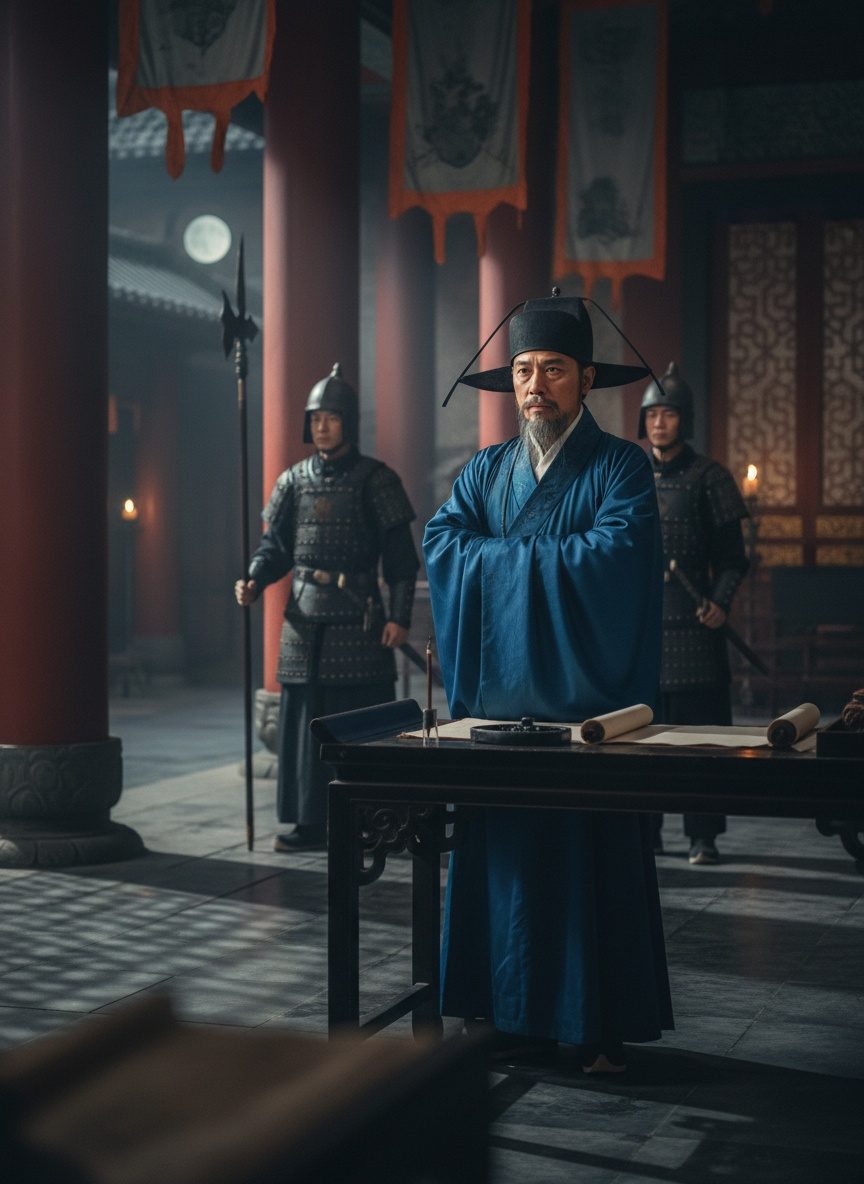
The afternoon sun cast long shadows across the cobblestones of the imperial courtyard, shifting the hues from golden to a solemn gray as it faded behind the palace walls. The air was thick with the scent of incense, mingling with the anxiety that pervaded the atmosphere. The fate of a dynasty hung in the balance, waiting for the tipping stroke of a brush held by a man with unwavering resolve. In the silence of the Grand Secretariat, the scratch of quills and the distant murmur of courtiers were inconsequential against the decision that would determine the future of the Ming Dynasty.
The Scholar's Stand
Fang Xiaoru, a Confucian scholar, stood alone against the tide of change. His eyes, hardened by the knowledge of history and the weight of responsibility, met the crisp parchment awaiting his inscription. For over a decade, Fang had served the Hongwu Emperor and his successor, the Jianwen Emperor, with a dedication forged from deep Confucian principles. His role now seemed deceptively simple: to validate the reign of an emperor whose path to the throne was paved with deceit and blood. The Yongle Emperor, a usurper and the fourth son of the founding Hongwu Emperor, had secured power through a coup known as the Jingnan Campaign.
The dust of conflict had settled, and all that remained was the endorsement of the realm’s most learned man to cement the new rule. However, Fang Xiaoru's allegiance lay with justice and loyalty, not power. As a staunch disciple of confucianism—emphasizing integrity, moral courage, and righteous governance—he refused to imbue the new regime with legitimacy.
A Deadly Defiance
With the palatial halls echoing with the ghosts of those betrayed, Fang faced an ultimatum. He was granted a singular opportunity: the preservation of his life in exchange for penning the official edict to announce the Yongle Emperor as the legitimate ruler. Discussions behind lacquered doors veiled in shadows could not sway him. The metaphorical knife to his throat that was the execution of his family did not falter his hand. The threat over Fang's life and livelihood was a tempest he stood against with solemn calm.
Emboldened by his convictions, he defied the imperial command, his refusal louder than any weapon of war. Fang Xiaoru was undeterred even when threatened with a diabolical punishment unheard of—the execution of his entire extended family, reaching ten generations. Such drastic retribution sent ripples of terror through the scholars and bureaucrats of China, for just one person’s signature carried the weight of dynastic continuity.
The Price of Principle
The execution of Fang Xiaoru's family, termed "extermination of ten familial lines," was an unparalleled act of retribution designed to obliterate not just the genes but also the memory of a lineage associated with defiance. The Yongle Emperor’s pronouncement reflected both paranoia and the desire to intimidate all who might resist his newfound authority. The waves of grief emanating from the purpling of family ties shook the roots of scholarly circles across the nation to their core. However, even with this grim sentence, the emperor did not achieve the complete eradication he sought. History whispered of some who might have eluded this horrific fate, keeping alive the seeds of resistance in minds across lands.
In refusing to legitimize the man who had rocked the foundation of imperial succession, Fang cemented his stature as a symbol of integrity. He became both martyr and a posthumous beacon highlighting the virtues Confucius espoused—the refusal to yield to tyranny, the bravery to maintain the moral high ground, and the legacy of standing firm in truth under duress.
The Echo of One Resounding "No"
Years swept by, yet Fang Xiaoru’s story resonates beyond the whispers of time, reminding us of the profound impact that one voice, firm in its ethical resolve, can have against overwhelming odds. His dramatic execution became a cautionary tale of moral rectitude clashing with unchecked ambition, a stark reminder of the cost of unassailable integrity in an era where power could redraw the contours of right and wrong.
Even now, Fang Xiaoru's defiance serves as a powerful narrative through which we can understand the immense pressures faced by advisors and counselors in tyrannical regimes. His sacrifice transcends the historical confines of China, echoing universally through stories of resistance, of standing against prevailing winds when they carry injustice and tyranny. He chose righteousness over self-preservation, leaving not only a lesson etched in the annals of history but an enduring call to recognize when power detracts from justice—a call to never lift the brush if it means writing away one's soul.