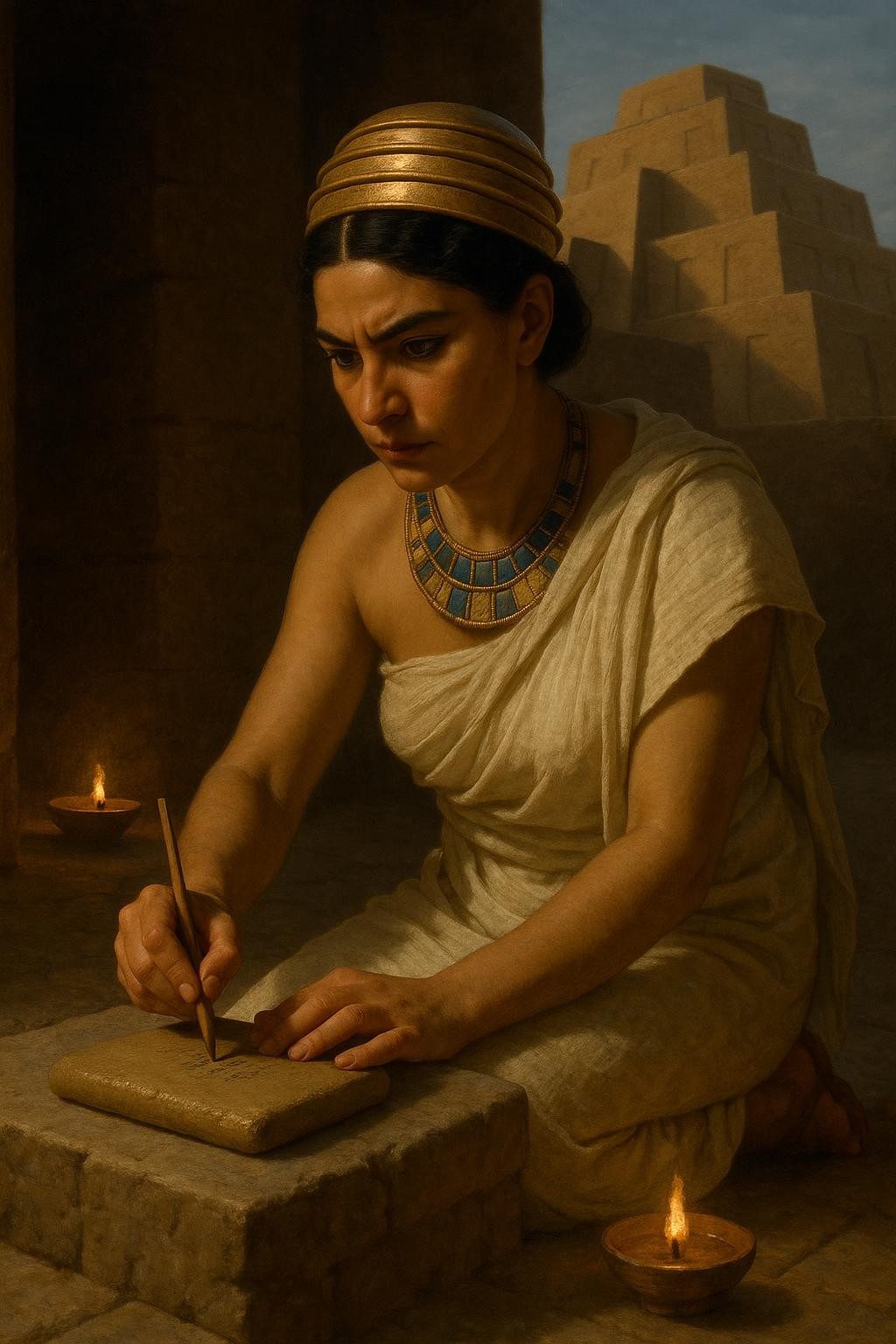
2285 BCE. A lone figure approached the steps of the ziggurat of Ur, shadowed by the distant silhouette of the moon-capped temple. The air had cooled under the first touch of the lunar deity Nanna's moon, its silver glow casting ghostly reflections across the ancient city of Sumer.
The Voice of Sumer
The woman who ascended the steps that night was Enheduanna, a name that echoes across the millennia as humanity’s first author known by name. Her presence was formidable, casting a long shadow over the religious and cultural tapestry of ancient Sumer. As high priestess at the temple of Nanna, she served as the intermediary between the city-state's rulers and divine will. Dressed in ceremonial garb, she was both a spiritual leader and a political figure, a trusted confidante of her father, the Akkadian King Sargon of Akkad.
Born into a world where names were often forgotten except those of kings and gods, Enheduanna did something unprecedented. Her body of work, particularly the hymns composed for her deity, went beyond mere repetition of invocations. Her compositions included personal reflections, charges, and praises written in stunning poetic form, marking an artistic leap forward in a world where oral tradition dominated. She inscribed her name on these works, a deceptively simple act of authorship that forever altered history’s narrative.
Standing before Nanna’s altar, she crafted hymns that resonated like the echo of age-old psalms. In doing so, she wielded the power of the written word, not simply as a tool, but as a conveyance of personal truth and identity. Her most celebrated work, the "Exaltation of Inanna," showcases her remarkable ability to convey complex emotions and theology, reflective of personal experience and divine inspiration.
Though the physical clay tablets of her works have endured the ravages of time, her voice still resounds with the clarity of conviction. This was more than a mere religious duty; it was a declaration of existence.
An Intimate Dialogue with the Divine
In the labyrinthine cities of Sumer, where the hum of communal life intertwined with the sacred, Enheduanna's hymns formed an intricate tapestry of devotion. Her words offered an unprecedented inner glimpse into the spiritual dimension of both gods and humans. The hymns provided not only praise but an introspective dialogue, almost conversational with the divine pantheon, enriching the spiritual and cultural life of Sumerian society.
When Enheduanna addressed Inanna, the goddess of love and war, she did so with a familiarity and reverence that was rare for her time. Her lines are not mere reverberations of divine omnipotence but expressions of vulnerable humanity touched by the divine. She characterized Inanna with emotions and complexities, encompassing both wrath and compassion, which made the deity intricately relatable to the worshippers.
The depth of Enheduanna's poetic prowess is seen in her vivid imagery and deeply rooted spirituality, painting the divine narratives with broad and bold strokes. Her hymns portray a divine world profoundly interconnected with the human experience, suggesting an equality that transcended the societal hierarchies of her era. Her texts included themes of crisis and conflict, moments of profound devotion, and ultimately the triumph of divine order over chaos, providing hope and structure to those who sought it.
Beyond the aesthetic beauty, these hymns held political significance. As the high priestess of Nanna, Enheduanna's role required balancing spiritual authority with political allegiance to her father’s empire. Her writings supported her father’s rule and honored his patron deities, thus spreading his influence through divine favor artfully captured in her texts.
The Echoes of Her Name
To imagine Sumer in Enheduanna’s time is to envision bustling cities driven by trade and divine worship, framed by the fertile banks of the Tigris and Euphrates. In this thriving civilization, the first seeds of modernity took root, unfurling into writing systems and architectural advances that formed the cornerstone of the ancient world.
Throughout the ages, Enheduanna’s legacy lay dormant, her works surviving as echoes etched into clay, uncovered by the hands of modern archaeologists. They stumbled upon a world where a woman claimed her agency, inscribed in clay with a deft hand that still sings across the millennia. The fact that this first known author was not a king, a conqueror, or even a patriarch is testament to the nuanced complexities of historical narratives and the often-overlooked arenas where women have exercised power.
As her hymns were unearthed and studied, Enheduanna’s influence became evident. She is an icon of the silent voices that endure beyond stone and time, asserting their place in the narrative tapestry of human history. For modern scholars and enthusiasts alike, her life and works have become a resilient beacon highlighting the power of the written word—how it can transcend centuries to shape, inspire, and affirm identities, both individual and collective.
Enheduanna’s life challenges modern perceptions of ancient roles and asks us to revisit whose stories history is built upon. Her enduring voice reminds us that women have always been storytellers and visionaries, even when society chose to forget. In this forgotten high priestess of Ur, we find an indelible symbol of humanity's first attempt to capture essence and identity in writing—a testament to the longevity of human thought sculpted into language, whispering through time with every whispering stroke of chisel on clay.