The cradle of civilization is silent. Or so we're told. In reality, it echoes with the voice of Enheduanna, the first author to dare inscribe her name in history.
In the city of Ur, around 2285 BCE, Enheduanna stood before the temple of the moon god, Nanna. The world around her was vibrant with the hum of an ancient metropolis: the rhythmic pulse of the Euphrates, the whispers of trade on bustling streets, and the solemn chants from sacred enclosures. Civilization itself was in its adolescence, tantalizingly distant from the grandeur of later empires, yet unmistakably alive and electric with potential. Mesopotamia, often feted as the birthplace of urban culture, was an intricate tapestry of city-states, each vying for divine favor and earthly power. Amidst this rich and restless backdrop, Enheduanna would etch her indelible mark.
The daughter of Sargon of Akkad, a man renowned for forging the first great empire known to human memory, Enheduanna was no mere spectator in history’s unfolding drama. Instead, she navigated the intricate web of political and religious dynamics with a poise that belied her gender and time. Appointed as the high priestess, or En, of the temple of Nanna, she wielded spiritual and ceremonial authority with the ardor few could command. Her position served not just as a religious fulcrum but also as a pivotal point in Sargon’s imperial strategy, bridging the Akkadian might with the religious sinews of Sumer. Here, Enheduanna's pen – or rather, her stylus – birthed something astonishing.
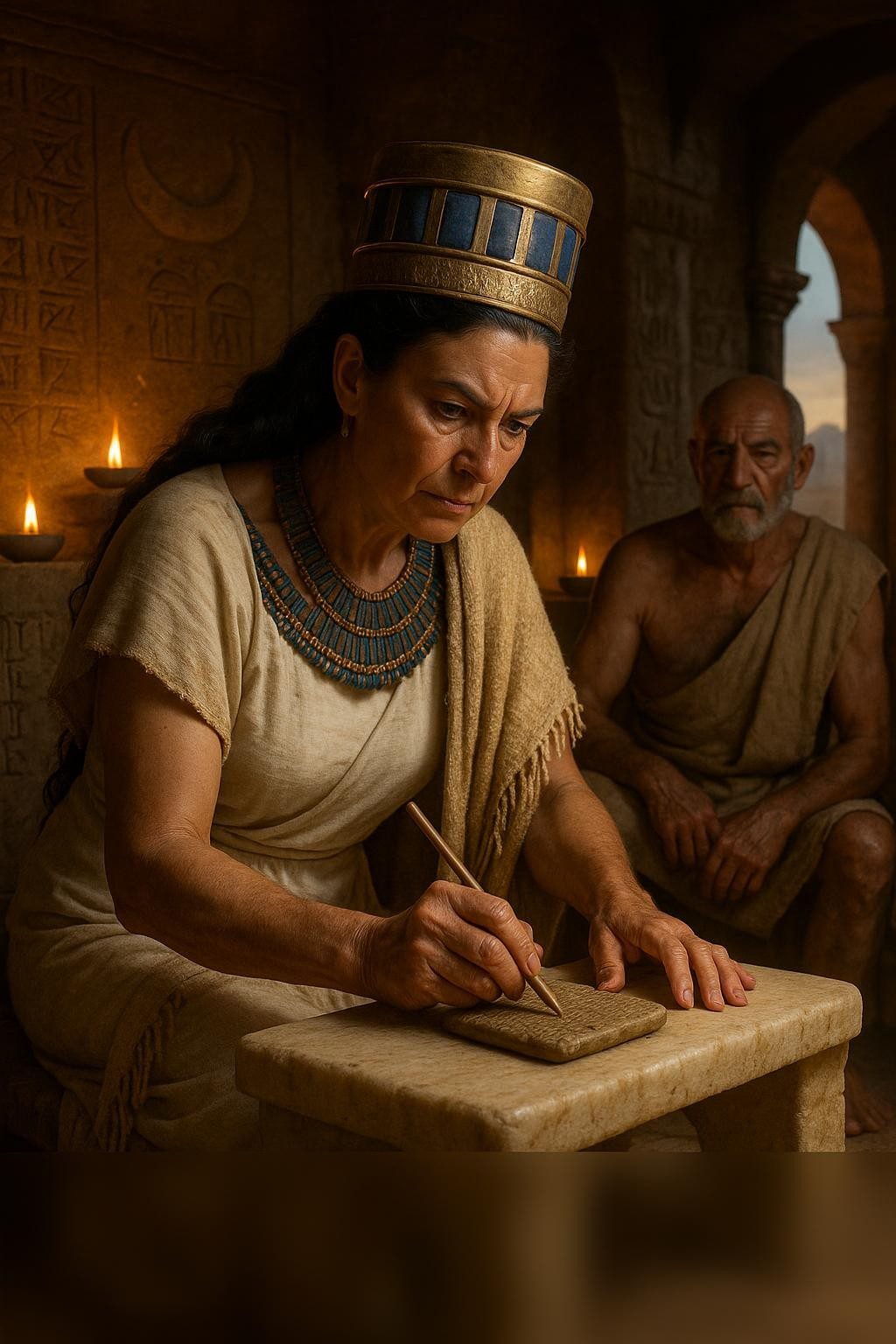
Within the temple, under the ivory glow of the moon, Enheduanna began her compositions, an act of creation that transcended mere ritual. She wrote hymns—the Sumerian Temple Hymns—which were to serve both spiritual and political purposes. These were more than simple offerings of devotion; they were intricate tapestries of divine allegiances and earthly entreaties. The hymns did not just praise the divine; they dared to chronicle them, attribute virtues and flaws, and consequently held sway over the hearts and minds of the Sumerian peoples. Beyond devotion, they reflected an astute awareness of the socio-political landscapes, hinting at strategic realignments in divine hierarchies that echoed the political aspirations of her father’s empire.
What set Enheduanna apart from scribes and poets was her audacious act of self-assertion: she inscribed her own name into her works. The phrase "Enheduanna" graced clay tablets, a self-declaration of authorship that was unprecedented. Until that moment, written records were annals of kings, cities, and gods, cloaked in anonymity. She was not content to be a mere vessel of divine messages; she demanded recognition as the creator of these works. This single act was nothing short of revolutionary—it placed a human identity within a text, anchoring it firmly in a real and personal authorship. For the first time, history had a signed name of someone who wove the stories of gods and kings.
As Enheduanna, she immortalized herself beyond priesthood, beyond power, as an artiste—one who gave words to the divine. To imagine her standing amidst the flickering light and towering shadows within that ancient temple is to recognize not just a moment of personal upheaval but a symbolic leap into the human narrative we inherit today. It isn’t merely that she named herself; she defined her essence through the invocation of celestial beings whose whims shaped destinies—a role unabashedly human yet divinely inspired.
Yet, the path she tread was fraught with challenges. Enheduanna faced not only the weight of her role but also the turbulent tides of political unrest that followed her father’s death. A riveting episode unfolds in a deeply personal poem she authored, The Exaltation of Inanna. Here, she writes of her own exile, likely during a period of rebellion or political maneuvering. The vivid depiction of displacement and longing in her writing signifies more than spiritual supplication; it is an appeal to the very goddess she served, a plea woven in the quiet agony of her own experience. Her mastery lay not just in her divine communications but in a remarkable ability to render her own emotional and corporeal struggles into an art form that has echoed across millennia.
What we grasp from Enheduanna’s narrative is immensely instructive. She redefined the boundaries of language and power, challenging the very constructs of authorship and the societal roles permitted to women of her age. Her voice, carved into clay tablets, resonates across the chasms of time, offering modernity an ancient archetype of intellectual agency and resilience. Her legacy is not merely that of spirituality or heritage but also of identity and legacy, confronting present and future narratives with the eloquence of those first inscribed words.
In the vast expanse of history, Enheduanna emerges not solely as a figure of literary ingenuity but as a symbol of the audacity required to define oneself amidst the constellations of gods and men. Her presence reminds us that history doesn't just entomb names in forgetfulness—it echoes them. Echoes that remind us that our stories, our voices, matter, just as hers did over four millennia ago, urging us to listen and perhaps to dare similarly.