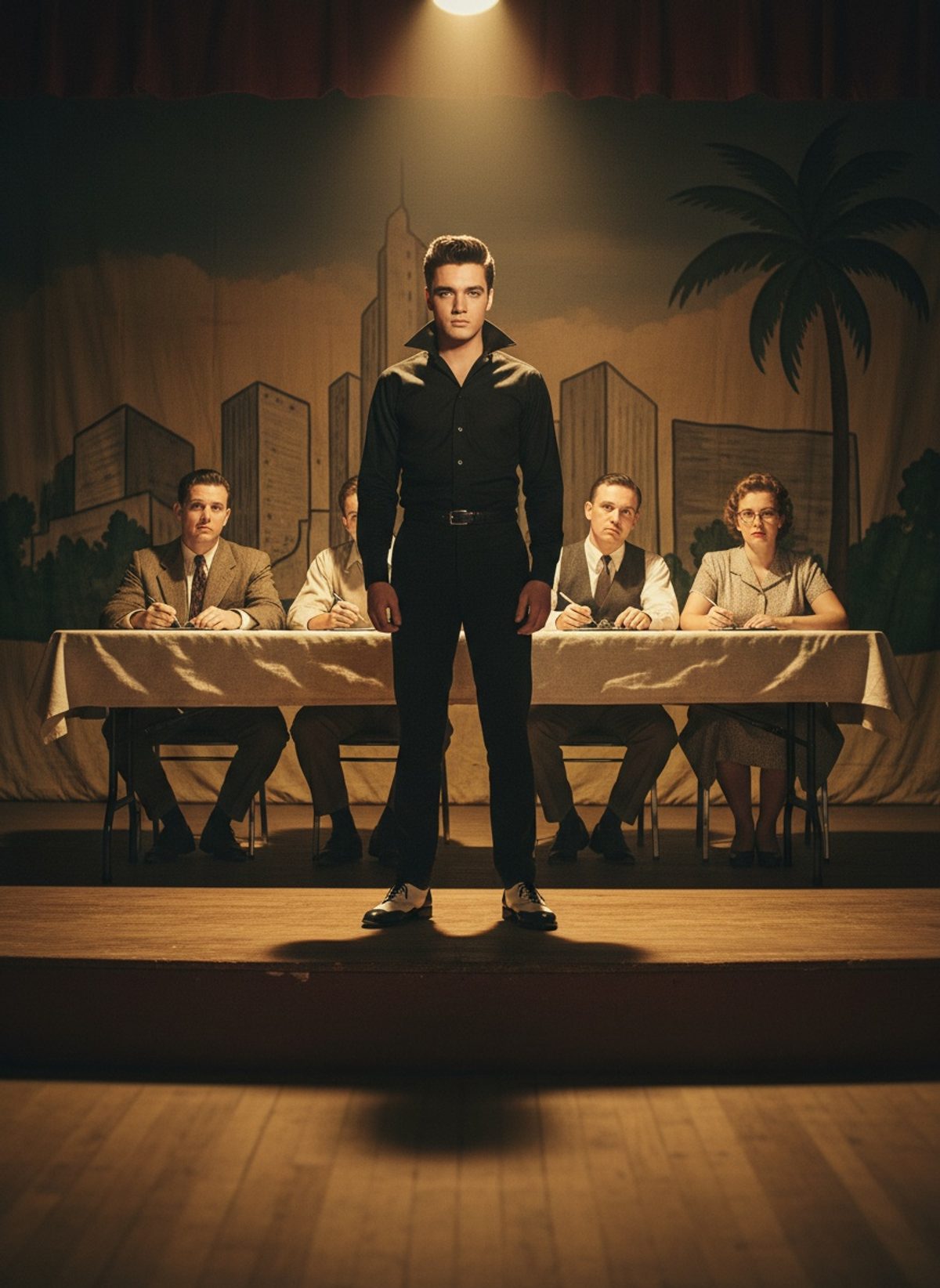
The spotlight sliced through the dense haze of cigarette smoke, painting a lone figure onstage as he swiveled his hips with a flair so exaggerated it bordered on parody. Beads of sweat glistened on his brow under the harsh glare, dribbling down his temples. The crowd's murmurs ebbed into an almost uncomfortable silence, ripe with anticipation. Was this a joke? The judges exchanged skeptical glances. Across the packed Memphis nightclub, the performance felt oddly familiar yet disorientingly flawed. How could this impostor think he embodied *the* Elvis Presley, the newly crowned king of rock and roll?
The King Among Commoners
1956 was a year when Elvis Presley was igniting imaginations and stirring passions across America. It was impossible not to be swept up in the frenzy of his rebellious charm, with his slick pompadour and unforgettable voice. Yet, here in Memphis, the line between myth and man was about to blur in an unexpected spectacle. Elvis, ever the prankster and ever curious about his burgeoning fame, decided to enter a local talent contest, quietly themed around himself, without fanfare or fuss. His motive? Perhaps it was an experiment to gauge the hysteria surrounding his persona or an earnest attempt to poke fun at the madness of his own creation.
With his naturally good looks subtly masked by a touch of theater grease and a borrowed jacket to adorn his famously lean frame, Elvis walked unrecognized through the crowd of hopeful contestants. On stage, he deployed his signature moves: the knee-quivering gyrations and that sly, subversive sneer, moments previously reserved for television audiences and stadiums teeming with fans. But here, stripped of the mystic aura and modern media apparatus, he seemed curiously ordinary. It was a fleeting insight into the chiseling effect of fame, how it can deify the banal when wrapped in the right narrative.
As the contest progressed, applause for other contenders swelled. One by one, more audacious imitations took the stage, each straining to outdo the last with acrobatic spins and exaggerated winks. Among them strode men with theatrical puffs of the same styled hair and others donning glittering facsimiles of the flamboyant costumes that became synonymous with Elvis. Ironically, when faced with the authentic article, judges dismissed him quickly—here, in disguise, was a man so seamlessly Elvis and yet not enough, a victim of his own escalating legend.
The Unmaking of an Icon
In the smoky backroom of the crowded venue, Presley watched the parade of his imitators with bemusement. It was a session of existential theater; the man who embodied Elvis was rendered invisible by the shimmering, exaggerated reflections of his public image that twirled about the stage. For judges, bewitched by the caricatured versions, he was too understated, too genuinely himself to cut through the hyperbole of his myth. And so, Elvis was unceremoniously eliminated in the very first round, devoid of the glory he had effortlessly commanded on grander stages.
The irony would have made for a compelling narrative had it not felt so personal. Presley, whose image surged toward deity-like iconicity, was confronted with the realization that the pin-up posters and television broadcasts had created an illusion more potent than reality. Stripped of the trappings of celebrity, Elvis was—as the public saw it—a mere imitation of his own invention. He was no more special in that room than any of the hopefuls starstruck by the illusion of what Elvis Presley had come to symbolize. It was a humbling insight into the power of media and legend, detaching public perception from simple truth.
Yet for Presley, the clandestine venture was an affirmation wrapped in rejection. His alter-ego, carefully crafted and globally celebrated, had proved bigger and bolder than the man himself, a Frankenstein of adulation running rampant across airwaves and newspapers. For Elvis, that night was a lesson in the double-edged sword of fame, casting a shadow longer than he would ever anticipate, a complex dance between authenticity and artifice.
The Legacy of True Identity
For Elvis Presley, the man immediately who treaded back into the anonymity of the night was no less potent for his newfound understanding of the disparity between man and myth. It was a paradigm shift, a perceptual twist in the tale of one of Rock and Roll’s most enigmatic figures. As the judges continued their assessment of the remaining contestants that evening, oblivious to their brush with the genuine article, Presley quietly exited, leaving behind a resonant question about the nature of authenticity in an age of idolization.
Beyond the dim light and smoke of that Memphis venue, the memory of the unexpectedly humbling night might have faded into anecdotal oblivion had it not shed light on the powerful machinery of American pop culture. The Elvis mythos thrived precisely because it was larger than the truth, magnified by adoration's glamour-glinted mirror. It was a poignant reflection of the media’s role in sculpting reality, one where the line between fact and fiction, truth and entertainment could be elegantly—and perilously—blurred.
Ultimately, the story of Elvis losing his own lookalike contest haunts us with its cautionary layers, even decades later. It underscores the way in which identity is continually constructed, deconstructed, and reconstructed within the nexus of public consciousness and personal truth. Elvis might have lost the contest, but in doing so, he gained an insight that would remain relevant throughout his career, a surreal encounter encouraging us to ponder: when the legend becomes larger than life, what remains of the man behind it?