Rodrigo Díaz de Vivar was a fierce warrior who earned his fame conquering lands. Yet, he extended compassion to a beaten foe.
The Conquest of Valencia
The year was 1094, and the siege of Valencia had reached its harrowing conclusion. Under the relentless command of Rodrigo Díaz de Vivar, famously known as El Cid, the fortified city succumbed to his strategic brilliance and martial might. El Cid's legend already loomed large over the Iberian Peninsula—a mercenary hero to some, a fearsome adversary to others. He had carved out an indelible mark across the plains of al-Andalus, filled with battle cries and the clang of swords. Yet, as the dust settled over Valencia, the victorious conqueror chose empathy over cruelty, defying the typical warrior narrative of the era.
Valencia was a prized jewel, envied and contested by both Christian and Moorish forces. Its conquest not only underscored El Cid's tactical acuity but also reinforced his status as a formidable leader. The city’s opulence and strategic significance now lay under the banner of the legendary Cid. Yet, amidst victory, a peculiar and unexpected event unfolded—one that spoke of El Cid's character beyond the battlefield.
A Rival Defeated, Yet Spared
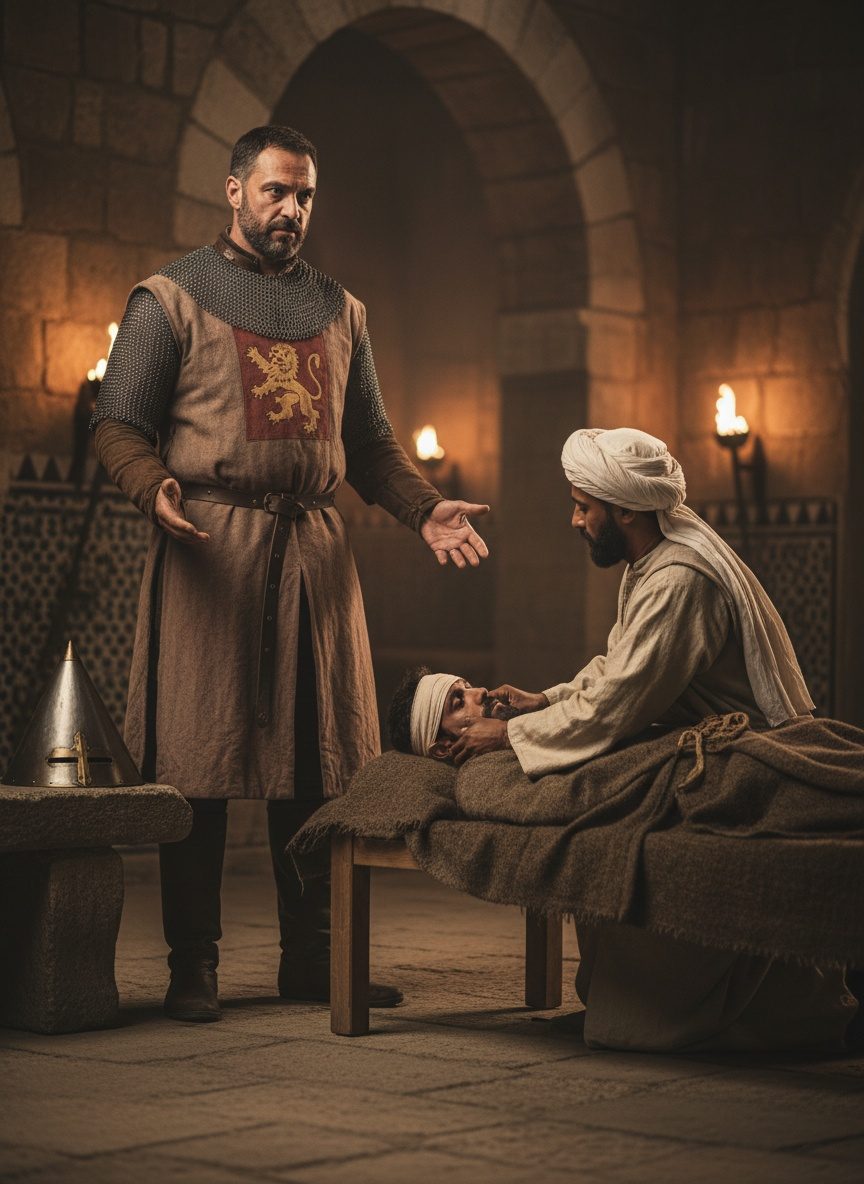
El Cid’s greatest Moorish rival lay within his grasp, wounded and captured. Though his name was whispered with reverence and fear across the lands, he expected the customary end: chains or death. However, instead of punishing his long-time adversary, El Cid made an unorthodox choice. In an era where mercy was often seen as weakness, El Cid dispatched his personal physician to tend to the beleaguered foe.
It was a decision that confounded his men. Why would a revered warrior extend his own medical resources to an enemy who sought his destruction? The answer lay not in weakness, but in a complex web of chivalric values and pragmatic foresight. Such acts of generosity and respect for worthy foes were not unheard of but were certainly rare. El Cid’s magnanimity could also be seen as a strategic gesture—an offering of honor that transcended the immediate victory, potentially sowing seeds of respect and future alliances.
A Healing Gesture
The physician attended to the rival’s wounds with the same dedication he would offer El Cid himself. The painstaking effort to nurse an enemy back to health spoke more profoundly than any military triumph. It was a gamble on humanity, extending grace in the time of war.
The act exhibited a unique bridge between conflict and compassion. The doctor’s work saw the once proud rival rise again, an occurrence that echoed through the narratives of both friend and foe. El Cid’s decision might have been steeped in notions of honor or perhaps a tactical play to cultivate a reputation as a just and noble leader. The confluence of strategy and humanity ensured that El Cid’s act was retold, beyond mere campfire tales.
The Story Beneath the Armor
While the granular details of this specific exchange may escape our records, the essence of the gesture reverberates. El Cid, whose name conjures images of battle-hardened valor, demonstrated a facet of leadership not typically highlighted in tales of conquest. By extending his hand to a rival’s survival, he subtly redefined power not only as dominion over lands but as influence over hearts and minds.
In a world often defined by the sharp divisions of sword and faith, El Cid’s actions were a reminder of the unpredictable paths of history—where empathy played an unanticipated role on the chessboard of power. This episode refused to fit neatly into a simplistic narrative of heroes and villains, hinting at the more profound, tangled tapestry of the era.
As we reflect on El Cid’s seemingly paradoxical decision, we are reminded that the stories untold in school hold the keys to understanding the complexities of human nature. The narrative of El Cid and his healing gesture beckons us to reconsider how history could shape our understanding of courage, compassion, and the human spirit. It invites us to ponder the enduring strength of mercy amidst victory, a tale as relevant now as it was on the bloodied fields of medieval Spain.