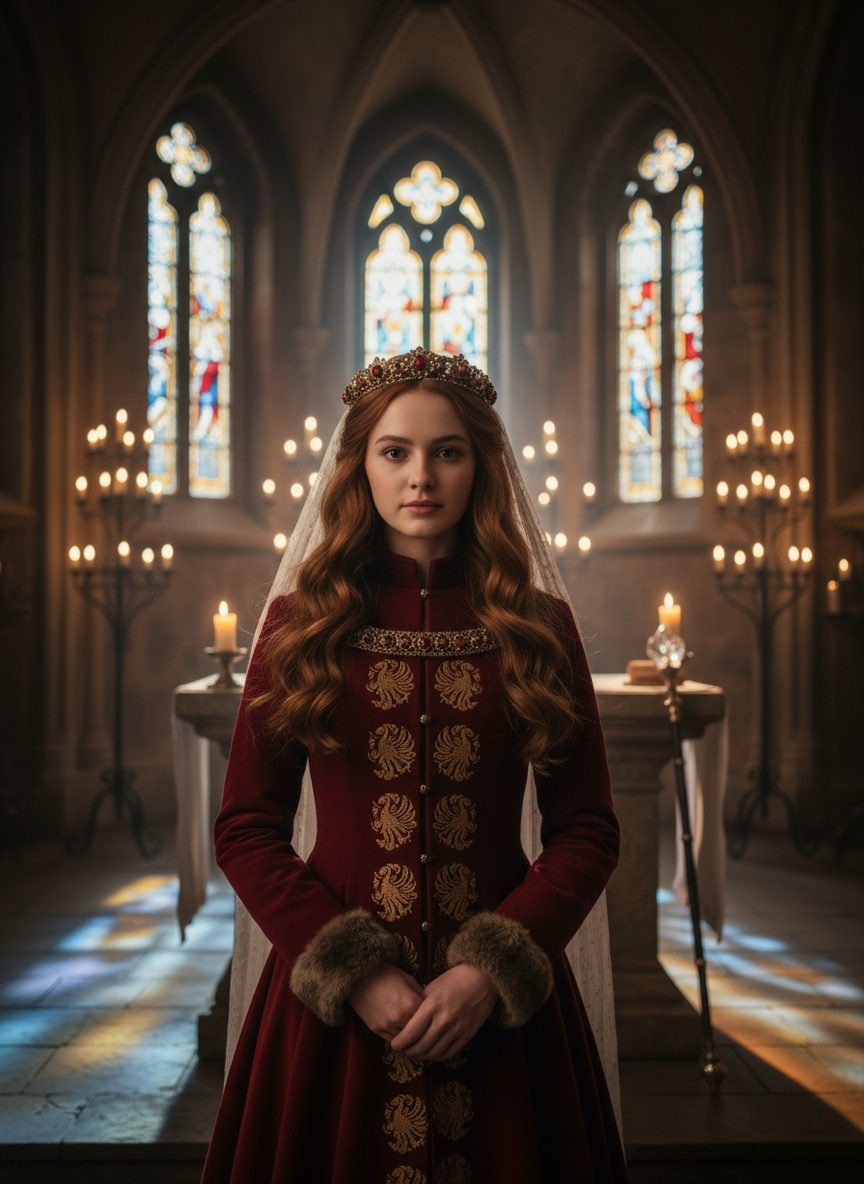
She transformed an entire kingdom at an age when most are just beginning to understand themselves. Jadwiga of Poland was crowned at fourteen, tasked not only with wearing a crown but shaping a nation’s destiny. Born into a world where politics often clashed brutally with personal desires, she became a queen who sacrificed love for the welfare of her kingdom, leaving behind a legacy that would echo through centuries.
Before Jadwiga’s feet touched Polish soil, the political landscape of Eastern Europe was a roiling sea of shifting alliances and dynastic schemes. Her family, the Angevins, ruled Hungary, and it was from these lands she was summoned to take the throne of Poland in 1384. A duchess before adolescence, Jadwiga brought with her a royal lineage that promised stability. However, stabilizing a nation did not come without sacrifice.
Already a queen by birthright, Jadwiga had been betrothed to William of Habsburg in her youth and the two had formed a bond that, by all accounts, was genuine affection. Yet, the intricate dance of medieval politics dictated a different path for her—a path that would see her marry Jogaila, the Grand Duke of Lithuania. For Poland’s nobility, the union presented a tantalizing opportunity: a chance to ally with and convert a vast pagan land to Christianity, strengthening both the religious and political power of Poland. Consequently, young Jadwiga faced an agonizing choice between personal happiness and dynastic duty.
In 1386, forced to relinquish her first love, Jadwiga married Jogaila, who was baptized Władysław (Ladislaus) before ascending as king. The Catholic conversion of Lithuania heralded a new era, one that would shape the region’s identity well into the future. Jadwiga's sacrifice forged the Polish-Lithuanian Commonwealth, a formidable entity in medieval Europe. Yet, even within this grand political terrain, it was her contributions off the battlefield that truly destined her for greatness.
Jadwiga's marriage to Jogaila did more than merely amalgamate territories; it marked the beginning of Poland's rise as a European cultural and educational hub. As queen, she was known not just for her inherent leadership and poise but her piety and wisdom. Her reign was characterized by a compassionate vision, and one of her most remarkable gifts to Poland was her commitment to education.
In a world largely dominated by male voices, it was Jadwiga’s persistent resolve that revitalized Kraków’s university, originally founded by her great-grandfather, Casimir the Great, in 1364. Under her guidance and with her endowments, it blossomed into a vibrant center of learning that attracted scholars from across Europe. What would become known as the Jagiellonian University nurtured the minds that would sculpt the Renaissance and beyond, offering degrees in law, medicine, and theology. Her dedication to academic flourishing didn’t only provide immediate intellectual capital but established a legacy that has reached beyond the centuries to educate leaders, creators, and thinkers.
Jadwiga’s philanthropy was not limited to the academic world. Known for her austere lifestyle despite her royal riches, she donated extensively to ecclesiastical and charitable projects. Churches and convents founded with her support became centers of spiritual and social outreach. Despite being queen, she wandered through cities, attending to the poor and sick with humility and care—an act that magnified her motherly moniker in the eyes of her people.
When Jadwiga passed away in 1399, her legacy was mourned not only in public sermons and courtly lamentations but in the quiet prayers of ordinary citizens who were beneficiaries of her kindness. The university she fortified would carry her vision forward, nurturing intellects that included famed astronomer Copernicus and many others who would challenge and illuminate the human understanding of the cosmos and the world.
Today, Jadwiga’s deeds are interred among Poland’s most cherished historical narratives. Her canonization in 1997 by the Roman Catholic Church attests to her profound spiritual and moral impact. There remains an enduring question about the boundaries of personal sacrifice for public good—a question she undoubtedly faced at every turn of her short life. At each fork, she chose the path that favored her people's well-being over her own desires, sculpting a legacy far richer than any crown could promise.
Jadwiga's story resonates across the ages as a powerful testament to the potent blend of duty and vision that defines true leadership. In our contemporary time, her actions encourage reflection on the sacrifices behind the institutions and values we inherit. She shows that the legacies of those who choose to lead lie not merely in their sovereignty over lands but in their sovereign capacity to envision and enact a greater good. Poland remembers not just a queen’s reign but the profound impact of choices made from a throne of compassion and foresight.