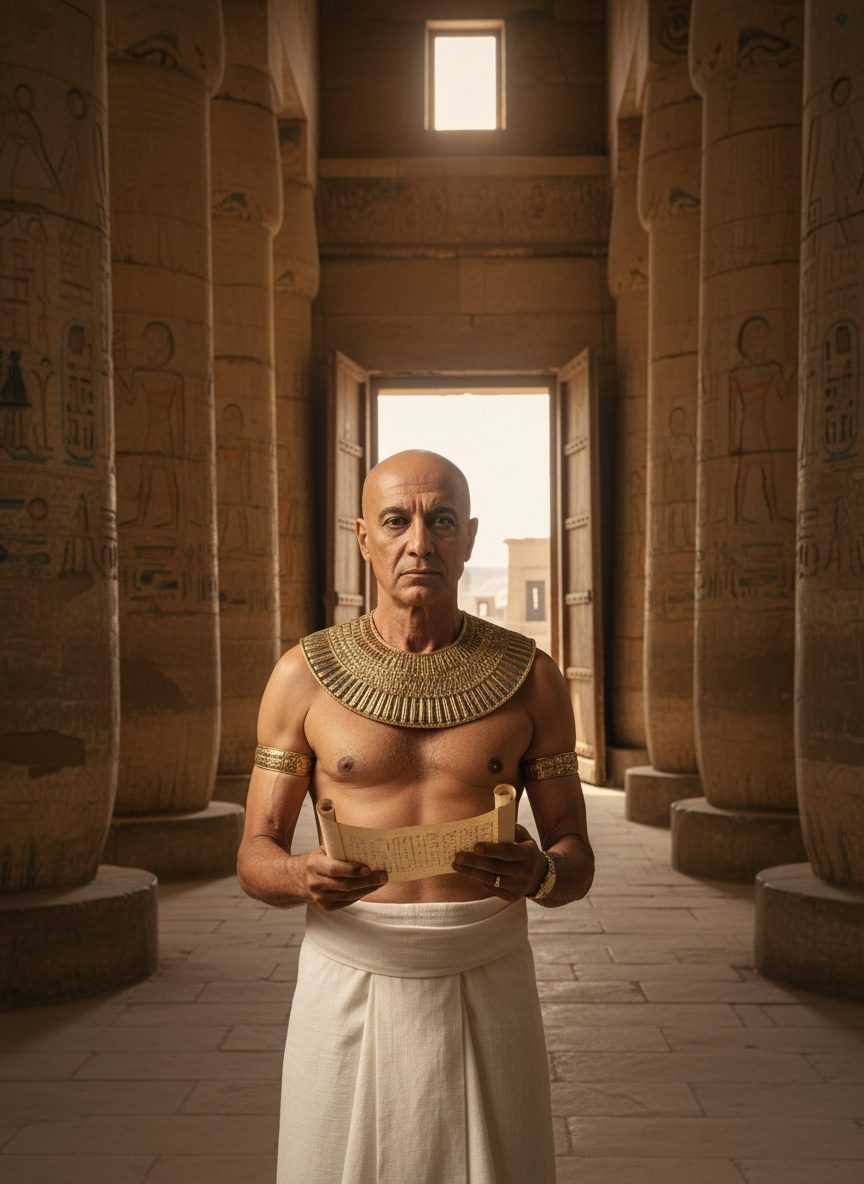
A small eddy of dust spiraled up as Amenhotep Son of Hapu stepped into the vibrant court of the Pharaoh Amenhotep III. The air hung heavy with the perfume of incense and the murmurs of courtiers. Yet, when this man, once simply a scribe’s son, spoke, the entire room fell silent. This was not merely the silence of anticipation, but a rapt attention reserved only for the most revered of figures — the words of a man who held no royal title, no military command, but carried wisdom honed from a life spent in service to the people.
The Unlikeliest of Leaders
Amenhotep Son of Hapu hailed from the bustling banks of the Nile Delta, a region brimming with life and the hum of endless labor in the heart of ancient Egypt. This was a world defined by rigid social structures, where a scribe’s son was destined for a life that mirrored his father’s. But Amenhotep was different. He navigated the complex hieroglyphs with a dexterity that set him apart, capturing the attention of those who would see him rise through the ranks.
As he climbed the ladder of responsibility, Amenhotep’s reputation expanded beyond his administrative prowess. He was known not just for his intellect but for a sensitivity to the needs of ordinary citizens. In an empire at its zenith, where the gap between the gilded halls of the elite and the earth-stained hands of the workers widened daily, Amenhotep became the voice they could not otherwise hear. It was rare for such a figure to catch the attention of a pharaoh who ruled the known world, but Amenhotep’s ability to articulate the struggles of the common people resonated with Amenhotep III.
A Voice for the Voiceless
Standing in the shadow of Amenhotep III’s towering presence, Amenhotep frequently found himself in the delicate position of advocating for the disadvantaged. Underlying the grandeur of Egypt lay the lives of those who toiled from dawn till dusk, crafting the bricks that built the temples, harvesting the fields that fed the empire, yet living with little acknowledgment of their essential contribution to the pharaoh’s abundant coffers.
Again and again, Amenhotep Son of Hapu took these concerns to the court, his voice unwavering as he pointed out inequities and proposed reforms. He understood that for Egypt to truly thrive, it must be a kingdom built not only on the might of its armies and the splendor of its buildings but on the well-being of its people. What made Amenhotep’s approach so revolutionary was his belief that a pharaoh’s glory was inherently linked to the prosperity and satisfaction of even the humblest subject — a perspective that defied the contemporary norms of near-divine pharaonic authority.
The Pharaoh’s Ear
The relationship between Amenhotep Son of Hapu and the Pharaoh transcended the typical bonds of ruler and subject. Amenhotep III, known for his grandeur and vision, found in this man an advisor unlike any other. He was not merely a figurehead who nodded in agreement; he was a provocateur of thought, a man who could look a king in the eye and tell truth to power without fear.
Perhaps it was the pharaoh’s own wisdom that recognized the treasure he had in Amenhotep Son of Hapu. In a moment that might seem surprising in the context of a civilization that placed pharaohs on a continuum with the gods, Amenhotep III honored this trusted advisor not just with riches or titles but with a form of immortality — deification. Amenhotep Son of Hapu was elevated to a status rarely granted, signifying the profound respect and influence he wielded at the height of his career.
The Making of a God
The decision to render Amenhotep Son of Hapu a god was as momentous as it was rare. Not since the earliest days of ancient Egyptian civilization had a commoner been raised to such celestial heights during his lifetime. Temples bearing his image sprang up, and he was invoked in prayers, revered alongside the traditional pantheon. His wisdom became legendary, associated with healing powers and oracular guidance, a testament to his enduring impact.
This deification was not merely a political maneuver. It was an acknowledgment of the unique seat Amenhotep held in the annals of Egyptian history, a testament to the living memory of a man who had served his king and country with unparalleled fidelity and insight. The man who spoke for the poor continued to do so from the realm of the divine, symbolizing hope and justice beyond his mortal years.
A Legacy of Justice
Amenhotep Son of Hapu’s life serves as a resonant reminder of an unusual truth from an epoch where such tales are rare. His story underscores the timeless narrative that true leadership often comes from unexpected quarters, that influence is not born solely from lineage or force but from wisdom and compassion. At a time when Egypt soared to unprecedented heights, it was the insight of a humble scribe’s son that helped elevate even the lowliest voices to the throne of the pharaoh.
This narrative of a commoner reaching the divine remains a compelling testament to the power of advocacy and the enduring quest for justice, reminding us that sometimes the most powerful storms of change stem from the softest whispers of reform.