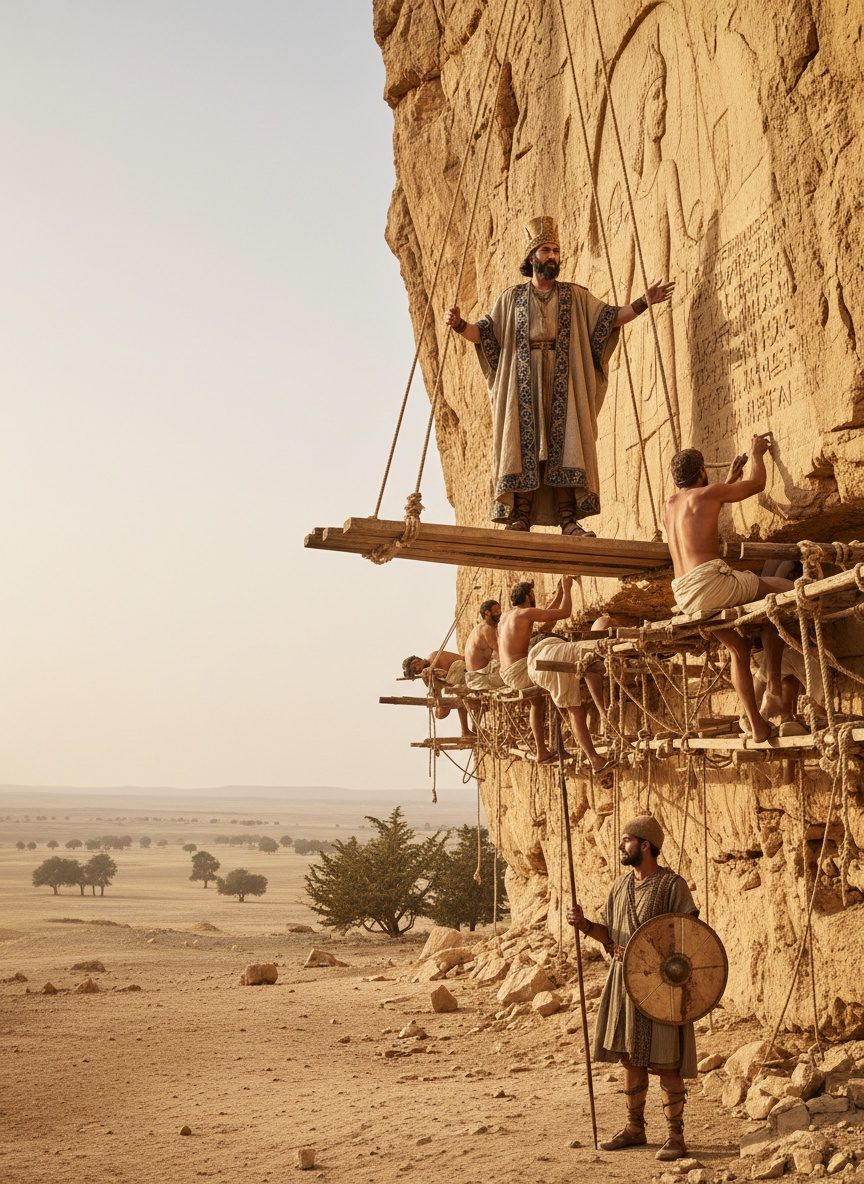
522 BC. The wind howled against the sheer cliff face of Behistun, a solitary bastion of the Persian Empire's might.
The Rise to Power Amidst Chaos
In the heart of ancient Persia, a storm brewed as Darius I seized the throne of the sprawling empire. Cambyses II, the previous ruler, had died under mysterious circumstances, leaving a void filled by chaos and intrigue. Darius's ascension was less than uncontested; many saw him as a usurper rather than the legitimate emperor. In a realm as vast and diverse as Persia, spanning from the Mediterranean through the Hindu Kush peaks, the stakes could not have been higher. The empire's stability teetered on the brink of collapse, threatening to unravel the tapestry woven together by Darius's predecessors.
Faced with dissent and suspicion, Darius understood that mere proclamations backed by military might would not suffice to secure his dominion. He needed to cement his authority through a narrative so powerful and enduring that it would outlast any upheaval. Thus, he turned to the rock of Behistun, a natural billboard in a sea of political uncertainty. This towering limestone cliff was to become the testimony of his power, a tool of propaganda carved into stone.
The Carving of a New Reality
High above the ground where only eagles dared to soar, artisans and stonemasons chiseled the words of the king's decree into the living rock of Behistun. This thousands-strong workforce labored tirelessly, carving meticulously under Darius's direct orders. The final inscription, a staggering display of ingenuity, was a multilingual masterpiece in Old Persian, Elamite, and Babylonian cuneiform. By its completion, the narrative had transformed from an account of a bloody coup to a heroic tale of divine right and rightful reign.
Darius claimed that Ahura Mazda, the supreme deity in Zoroastrian belief, had granted him kingship, thereby bestowing a divine legitimacy that no other could contest. The narrative wove tales of false kings and treacherous rebellions quashed by his divine-guided hand. Darius was not merely the ruler of empires—he was the chosen of the gods, and Behistun stood as the indelible token of this celestial mandate.
A Mystery Locked in Stone
The cliff at Behistun did more than solidify Darius's rule; it immortalized his version of events far beyond the reign itself. For centuries, the inscriptions loomed high above, a testament both visible and inscrutably out of reach. Travelers passed, gazing upwards at the mysterious characters, unable to decipher the story etched there. The languages depicted had been lost to time, turning the once-defiant statements into silent enigmas.
The script was a key to understanding one of the world's most significant ancient empires, yet it remained hidden by height and forgotten languages. The message Darius had carved so forcefully was, ironically, locked away from comprehension even as it stood in plain sight. For two millennia, nature and time kept these secrets safe from prying eyes, resting quietly in their lofty perch, a puzzle for future generations to solve.
The Intrepid Soldier's Quest
Enter Henry Rawlinson, a British army officer who, in the 19th century, became captivated by the hidden tale of Darius I. Rawlinson saw the inscriptions not merely as linguistic puzzles but as doors to ancient knowledge. At a time when the world was feverish with the drive to uncover its history, Rawlinson took on an endeavor most deemed insane. Equipped with ropes and sheer determination, Rawlinson dangled perilously from the cliff’s edge, risking life and limb to transcribe the ancient text.
Over multiple seasons, through dogged persistence, he painstakingly copied each character. His work provided the modern world its first in-depth look at one of history's lost scripts and served as a significant breakthrough in understanding cuneiform writing. Rawlinson’s efforts miraculously unencrypted the stone-carved propaganda of Darius, revealing the story's nuances and its mesmerizing blend of half-truths and myth-making.
The Record That Reshaped History
With Rawlinson's transcription, history took a momentous turn. The Behistun inscriptions unlocked the secrets of one of the greatest empires of the ancient world, providing invaluable insights into Persia's culture, politics, and religion. It also laid the groundwork for deciphering other ancient texts, contributing profoundly to the field of Assyriology.
Ultimately, what Darius carved in stone was more than a message to pacify his contemporaries; it was a declaration that withstood the erosion of time, providing future generations a touchstone to the world that was. In an era where information flickers momentarily on screens before being forgotten, the lasting presence of Darius's inscription offers a profound reflection on the power of narrative and the enduring human endeavor to understand the past.