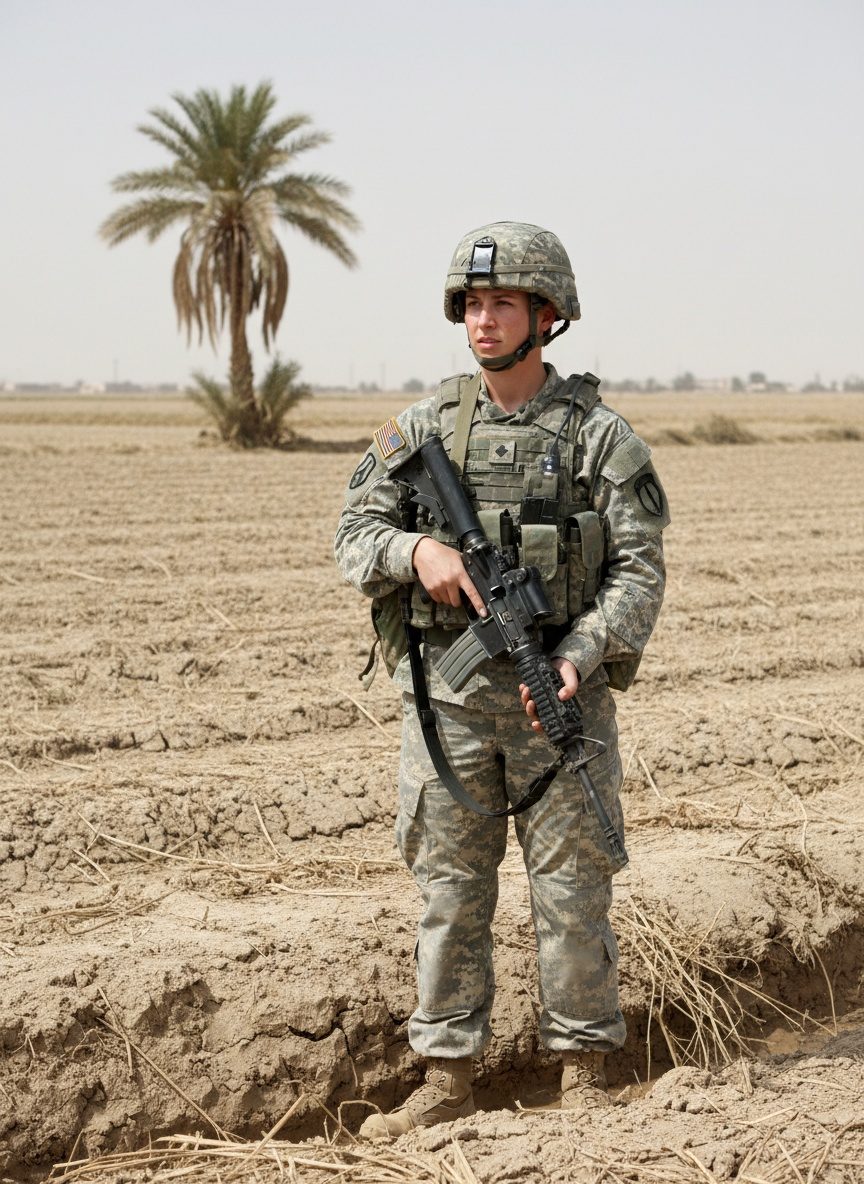
The vast desert plains of Iraq stretch endlessly, shimmering under the unforgiving sun as March winds breathe a faint, sandy whisper across the landscape. In the faint morning light, the contours of Baghdad recede into the horizon, replaced by an eerie stillness. Yet, it is against this backdrop of quiet that the heart-pounding drama of an ambush unfolds, forever changing the course of military history. The stakes were high: about fifty insurgents waiting in shadowed anticipation to strike fear into the hearts of their enemies. But the desert, like its inhabitants, holds secrets—surprising reversals of fate that defy the expected.
In this hostile environment, vehicles moved cautiously. Among them was the convoy, weaving its way through the streets near Salman Pak, bracing for the possibility of facing the unexpected. Minutes seemed to tread heavily as they entered the kill zone. The first strike erupted with an eruption of gunfire, drowning the air in a cacophony of violence, mingling the sharp notes of crossfire with the low thuds of impact. Insurgents capitalized on the element of chaos, synchronized attacks raining from the sandy mounds flanking the road. The battlefield was commandeering its own rulebook, where iron-plated ambushes replaced formalities and policy boundaries.
Into this turmoil drove Sergeant Leigh Ann Hester, defiant against both the enemy and traditional constraints. Attached to the 617th Military Police Company, Hester, along with her team, spring into action. The hiss and clangor of rapid-fire was nearly tangible. Fear was a ghost here, fleeting and irrelevant amid the need for survival. Rather than retreat, Hester and her crew counteracted, maneuvering their Humvees to provide cover and coordinate defense. It was a scene of precision and raw courage that had not been mapped out by her superiors or outlined in any standard military protocol of the time. This was a soldier's impulse—honed by training but infused with personal resolve.
Amidst the rattle of rifles and the snap of bullets biting into surfaces and bodies alike, the air charged with the acrid taste of confrontation. Hester's task was not merely to withstand but to hit back. Abandoning the relative security of her vehicle, she and a small team mobilized on foot to flank the insurgents. Each step was deliberate against the unpredictable terrain. As they advanced, they knew every instant brought the potential of another deadly surprise. The strategy to disarm those who threatened was steeped in danger; trenches were meant to shield, not invite counter-assaults.
That morning, the trenches spoke a language of battle starkly different from policy papers far removed from this dust and blood. Hester navigated the serpentine lines, her weapon an extension of her resolve. It was here, in these narrow confines, that she encountered and eliminated three insurgents at close range, each engagement a testament to her training, her audacity, and a refutation of the notion that women should or could not fight alongside men in direct combat.
This engagement, remarkable yet rooted in the day's uniqueness, culminated in Sergeant Leigh Ann Hester being awarded the Silver Star. For the first time since World War II, this decoration graced a woman for direct combat actions. The Army's commendation was more than just a symbol of individual valor—it was an acknowledgement of a burgeoning shift in the landscape of military service. Her actions on that battlefield challenged preconceptions and laws that had been shaped by historical precedent and societal norms rather than by the realities on the ground.
Behind this extraordinary moment lay an intricate web of lesser-known influences. Hester's courage broke an unspoken barrier, her actions underscoring the variations between institutional policy and in-field necessities. The Army's practice of excluding women from direct combat, ostensibly for protection, neglected the practicalities and complexities of modern warfare, where lines are blurred and roles flex with circumstantial demands. In no uncertain terms, Hester's path forward was paved by those who had quietly shouldered the contradictions of these rules, proving again and again that capability is not defined by gender.
As we reflect on Hester’s remarkable story, one cannot help but acknowledge the evolution that followed in the years after 2005. Her fight was just the pinnacle of a mountain of voices rising through the ranks, eventually compelling policy changes and molding a more inclusive vision of soldiering. The decision to award Hester was not just a nod to individual bravery but a pivot towards recognizing and rectifying the gender biases that limited potential. The story resonates beyond its borders, speaking to a larger narrative about equality, capacity, and the relentless shape-shifting nature of true progress.
In the broader schema, this confrontation transcends its immediate events, compelling societies to reexamine and often dismantle archaic beliefs about gender roles—not solely within military contexts but across all dimensions where women's capacities have been historically minimized or overlooked. Sergeant Hester's actions reframed a moment in history, demonstrating that sometimes, the written rules must bow to the empirical evidence born on the battlefield. As the sun set on that fateful day, the unrelenting desert held within it one unchangeable truth: bravery knows no bounds, and history, like those trenches, makes space for those who dare to redefine its course.