Under the starlit sky of Europe, a secret pursuit unfolded night after night. Charlemagne, the powerful ruler who dominated the continent and commanded legions, returned to his chambers. There, away from the scrutiny of his court, he engaged in his most challenging battle—not against an external enemy, but against the letters of the Latin alphabet. Despite his supreme power and every resource at his disposal, Charlemagne never mastered the art of writing. This humble struggle of a great emperor, chronicled by his biographer Einhard, offers a personal glimpse into the fascinating daily life of the early Middle Ages.
The Emperor's Unseen Hand
Throughout history, Charlemagne's reign stands as a beacon of cultural rejuvenation known as the Carolingian Renaissance. The grandson of Charles Martel, Charlemagne, whose name Karl der Große literally means "Charles the Great," ascended the Frankish throne in 768 AD. By December 25, 800 AD, he sat crowned as the Emperor of the Romans, an unprecedented unifier whose influence spanned modern-day France, Germany, the Low Countries, and beyond. With such command, you might imagine that Charlemagne’s grasp extended to every affair of the empire—including literacy. Yet, as Einhard revealed in his Vita Karoli Magni, the emperor was bound by an unexpected limitation: the inability to write his own name.
Charlemagne, however, was no stranger to learning. He surrounded himself with illustrious scholars and fostered an environment where education thrived. He instigated the establishment of a palace school at Aachen and summoned learned men from across Europe, including the great English scholar Alcuin of York. His reforms introduced the Carolingian minuscule, a clear script that revolutionized medieval writing and laid the groundwork for modern European scripts. Irony stirred deep as the world's most advanced early medieval literacy program was established by a man who could scarcely write a single letter.
Lessons Under the Pillow
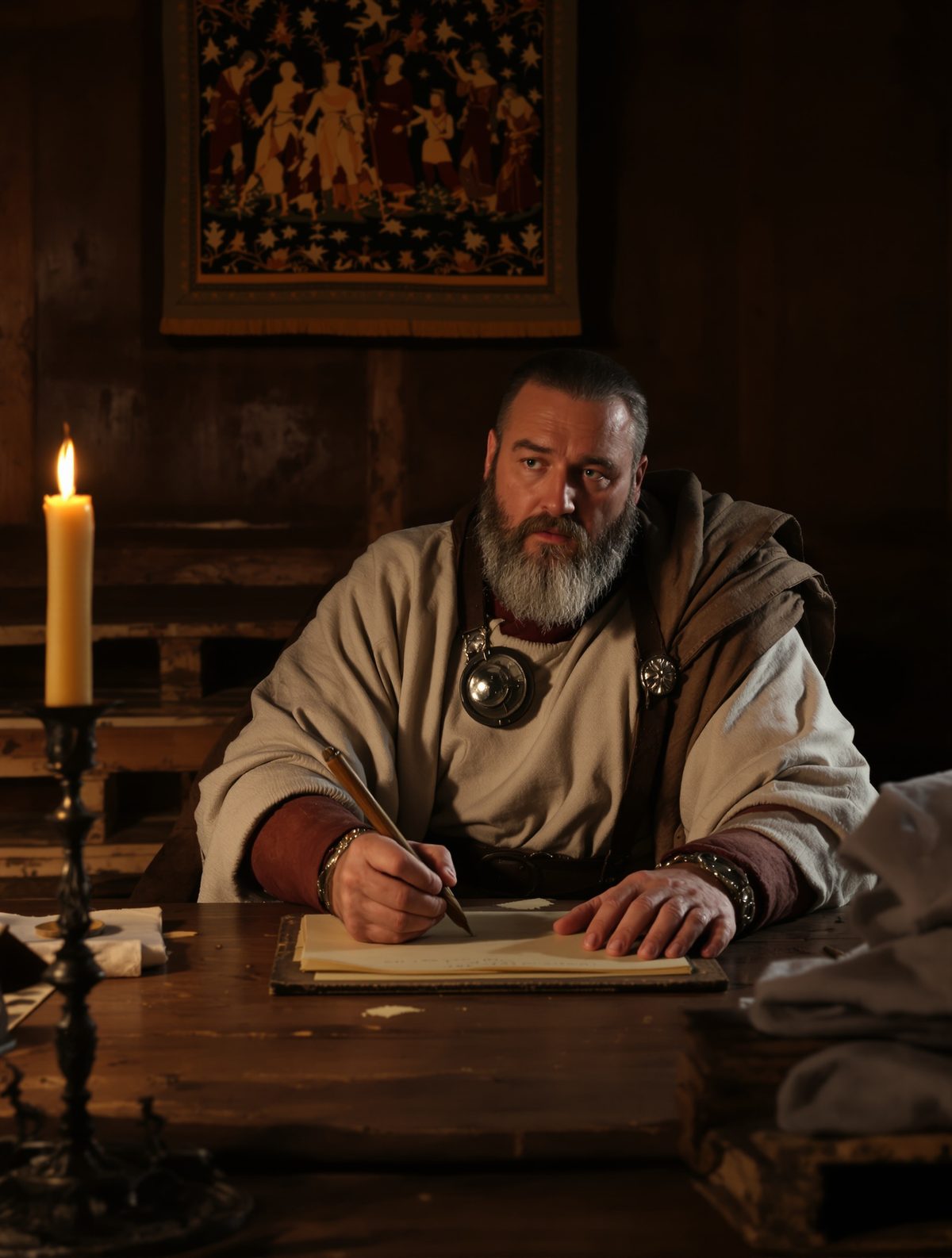
Charlemagne was not content with merely issuing edicts through scribes; he yearned for the refined skill that would allow him to pen his own words. As Einhard recounts, the emperor kept writing tablets—the wax surfaces typical of the era—under his pillow and practiced repeatedly. This method was whispered to be Charlemagne's nightly ritual, a persistent effort to conquer the script of his learned entourage.
That Charlemagne never became a literate writer does not diminish his legacy, yet it provides a poignant look at his humanity. Imagine the dim candlelight in a sprawling palace, the quiet scratching of a stylus as the ruler of Europe ends his day in a personal exertion that refused to yield. It paints Charlemagne not as an omnipotent giant towering above his era but as a man, steadfast in his pursuit of self-improvement despite an unworthy foil.
The Oral Tradition of Governance
The medieval world relied heavily on orality, a tradition Charlemagne mastered with undeniable skill. Contrary to modern presumptions equating literacy with intelligence, the ability to articulate, command, and inspire through speech was paramount. Charlemagne's auditory memory was exceptional; he effortlessly commanded his scribes and retained an encyclopedia of legislative and scriptural knowledge.
This proficiency allowed Charlemagne to function seamlessly within the ruling framework of the period. He issued capitularies—royal legislative orders—and oversaw judicial reforms that carved a united identity for his diverse domains. By commanding verbal authority, Charlemagne ensured his voice resonated throughout Europe, reaching into its farthest villages and remotest cloisters.
The Scholar King: A Paradox of Learning
Despite his thwarted personal literacy, Charlemagne's intellectual curiosity and reverence for knowledge were unbounded. His court was a hive of classical learning, and his reverence for the written word manifested in various ways. He made the revolutionary decision to streamlining the Latin language, establishing standards that served to unite religious and secular texts across his empire.
Charlemagne's policies on education and scholastic expansion were groundbreaking. Never before had a European ruler made such strides to ensure the perpetuity of learning. He decreed that monasteries must establish schools accessible to both clergy and laypeople, facilitating a movement towards universal education—a radical concept for his time.
A Timeless Lesson in Leadership
Charlemagne died in 814 AD, leaving behind an indelible legacy of expansion and cultural reawakening. Today, we find it fascinating that such a transformative leader was incapable of writing, a facet of his persona that challenges our conventional understanding of leadership and governance. Charlemagne’s life and reign are a testament to the fact that literacy, while influential, is merely a part of a broader spectrum of capabilities.
In an era where literacy is often seen as a barometer of intelligence and merit, Charlemagne's story reminds us that the ability to lead, innovate, and inspire transcends beyond academic mastery. His relentless dedication to learning, despite his obstacles, offers an insightful commentary on the essence of personal growth and leadership—a narrative as powerful now as it was over a millennium ago. In a world continuously chasing education and development, Charlemagne’s journey affirms that the breadth of one's influence is not solely measured by the proficiency in writing alone, but by the indelible impact one leaves on the chronicles of history.