He survived an ancient brain surgery. It happened 5,000 years ago in Neolithic Britain.
A Hole Through Time
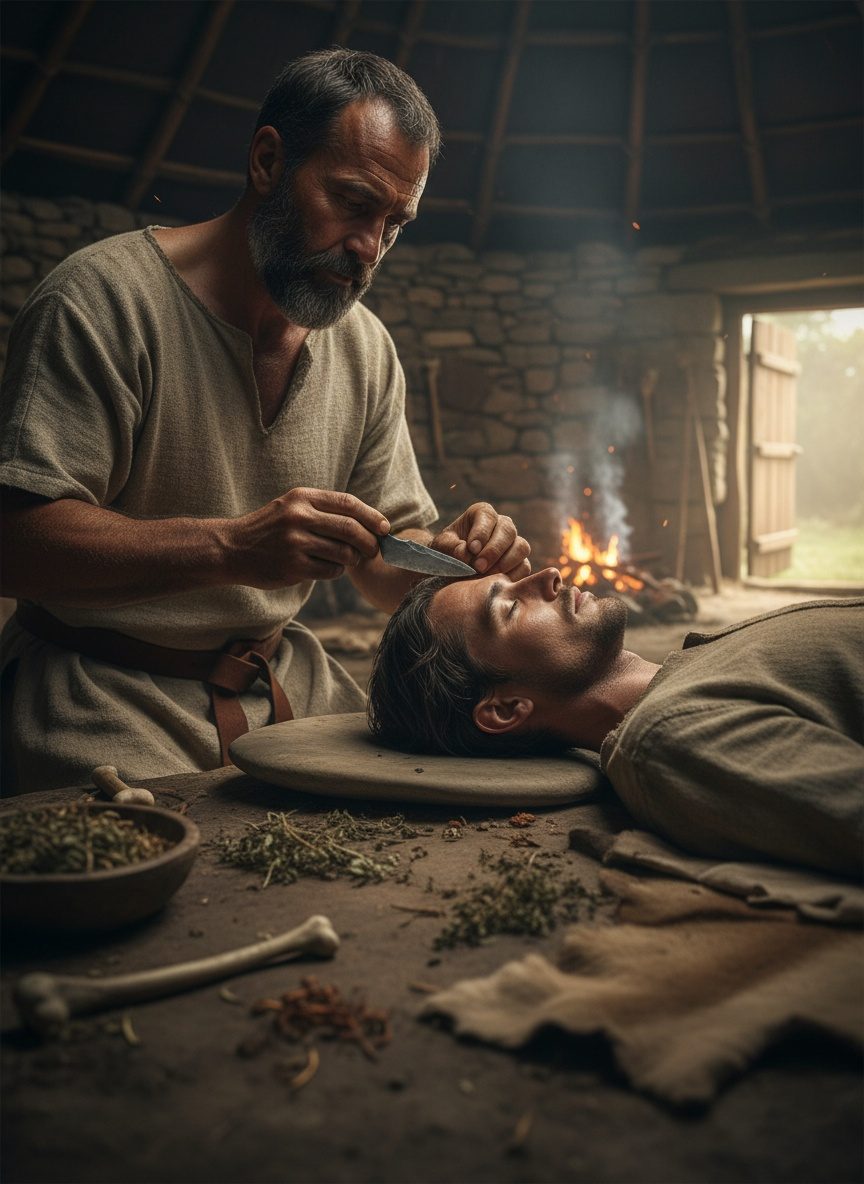
Deep beneath the gentle, rolling grasslands of Crichel Down, Dorset, lies a revelation that challenges everything we assumed about our distant ancestors. In a world where life was largely governed by the cycles of the sun and the whims of nature, one remarkable event sets itself apart: a surgical procedure that echoes through the millennia. Evidence suggests that someone, five millennia ago, performed what is now considered to be Britain's oldest known surgery. A neatly carved hole in a human skull, displaying unmistakable signs of healing, confirms beyond doubt that the individual survived this prehistoric intervention.
This discovery invites us to reconsider how we view the so-called "primitive" societies of ancient Britain. The skull provides concrete evidence that early humans on the British Isles were much more sophisticated than previously thought, possessing not only the anatomical knowledge to perform such a surgery but also the tools—flint, perhaps expertly knapped—to execute it with precision. But what drove such a risky endeavor? Why would someone living in a time of rudimentary survival tactics dare to cut into a human skull?
Mysteries Encased in Bone
The practice uncovered at Crichel Down hints at a procedure known as trepanation—the ancient practice of drilling or scraping a hole into the human skull. While trepanation has been observed globally, the fact that it was performed successfully 5,000 years ago in Britain astonishes scholars and captivates imaginations. The purpose of such an operation, however, remains elusive. Was it a desperate response to cranial injury? A ritualistic venture, believed to exorcise evil spirits afflicting the patient? Or might it have been an experimental curiosity of its time?
The healing around the edges of the trepanation site implies that this was not a crude incision or an act born out of desperation or violence. Rather, it was a considered and careful decision made with an intent that spanned beyond immediate survival. The patient lived days, weeks, or likely even years post-surgery—a testament to the skill of the practitioner and perhaps to the resilience of the human body and spirit.
The Surgeon and Their Tools
Picture, if you will, the individual who embarked on this daunting surgical task. The tools at their disposal were rudimentary by today’s standards yet were likely honed to an exceptional degree of sharpness. Flint tools, native to the region and ubiquitously used in daily life for tasks ranging from hunting to crafting, were potentially adapted to medical purposes. These hand-picked surgeons, the earliest pioneers of their craft, must have possessed not only intuitiveness but also an ingrained understanding of human anatomy.
In this prehistoric era, knowledge was passed down orally, an invaluable tapestry built on generations of experience. The person wielding the flint likely stood at the precipice of science and superstition, an embodiment of early human innovation. This blend of observational acumen, tactile skill, and perhaps spiritual guidance gave rise to an operation shrouded in both enigma and practicality.
A Glimpse at Neolithic Life
Though the specific details of this surgery remain open to interpretation, this astonishing find enriches our understanding of Neolithic life in Britain. Communities during this era were primarily agrarian, living in simple dwellings and relying heavily on the land for sustenance. They constructed impressive stone structures such as Stonehenge, indicating both sophisticated organizational skills and a cultural penchant for monumentality and ritual.
Social bonds were likely strong, with communities revolving around the collective effort of survival and growth. Within this societal framework, the presence of healers or shamans is plausible. These figures may have served as custodians of both spiritual and medicinal knowledge, providing insight into the mental and physical realms alike. The surgery at Crichel Down sketched a faint line between what we perceive as scientific inquiry and spiritual necessity, showing us that ancient people were complex thinkers and skilled practitioners in their own rights.
Revisiting the Past to Understand the Present
The Crichel Down skull is a poignant window into a time when human capabilities constantly sought to defy the limitations imposed by nature and circumstance. It reminds us to challenge our preconceptions about our ancestors. This single act of surgery, executed with prehistoric tools in an era far removed from modern medicine, underscores the perpetual human quest for healing and knowledge—a quest that has driven humanity forward through the ages.
As we consider the implications of this ancient surgery, we find ourselves linking hands with the past, humbled by the ingenuity and resilience of our forebears. What other secrets does the earth hold, waiting patiently to share the stories of those who walked long before us? And how might these ancient narratives continue to shape our understanding of what it means to be human? These are questions that drive historians and archaeologists to dig deeper, ever curious about the unwritten chapters of human history lying just beneath our feet.