A mist clings low over the chalk downs of southern England as the first light of dawn breaks over the horizon. The air is crisp, and the only sound is the whisper of the wind brushing against the endless expanse of grassland. It is a serene and ancient landscape, where history lies deeply embedded in the earth beneath. Hidden here, beneath the quietude, is a storied relic of human passage. This place, known as the Ridgeway, has provided a path for generations upon generations, tracing a line that stretches back into the mists of time, long before Rome was even a thought.
Walking Into History
It is difficult to grasp the sheer enormity of the timescales involved with the Ridgeway. Imagine a ribbon of land that has felt the tread of countless feet for over 5,000 years. The Ridgeway, a chalk ridge threading across the hills of southern England, was not carved by monumental feats of engineering or ordered into existence by kings. Instead, it emerged organically through the simplest of actions: walking. The continuous passage of traders, travelers, and animals etched a path that the earth itself came to remember and preserve.
For ancient peoples, the Ridgeway was more than just a path; it was a lifeline. Functioning as a trade route, it enabled the movement of goods and ideas long before the arrival of paved Roman roads. The Ridgeway offered a vantage point that was not only strategically advantageous but also physically practical, allowing travelers to move across difficult terrains with relative ease. Beyond its utilitarian function, this ancient path also served as a cultural conduit, fostering interactions between disparate tribes and communities of the Neolithic and Bronze Age Britons.
The Ancient Travelers
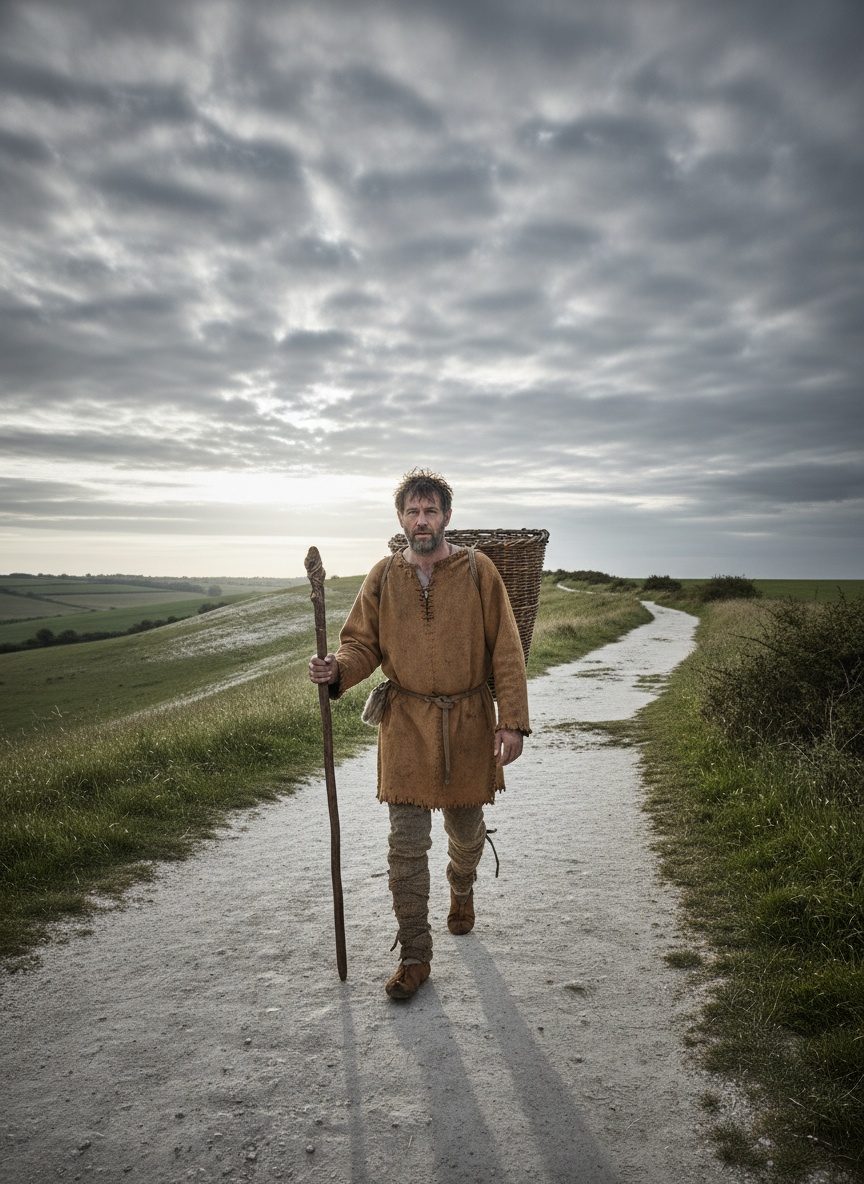
Who were the people that traversed this timeless path? Centuries before the Roman conquest, it was the early tribes of Britain who navigated these chalk ridges. To them, the Ridgeway was a route etched in memory as much as in chalk. You could picture these ancient Britons adorned in simple, earthen-toned garments, carrying woven baskets filled with regional commodities such as flints, hides, and perhaps even tin from the famed Cornish mines. They spoke languages long vanished — their voices leaving no trace except for the artful stone monuments they left along the way.
Archaeological digs along the Ridgeway have yielded intriguing insights into the life of these early travelers. Flint tools, pottery shards, and the remnants of fire pits provide a tangible connection to these distant ancestors, whispering stories of their journeys and gatherings. The presence of barrows and ancient hill forts alongside the trackway hints at the importance of this route and the settlements that once thrived around it. Each artifact speaks to a landscape alive with the comings and goings of the prehistoric world.
A Path of Continuity
As the centuries rolled on, the Ridgeway evolved yet retained its significance. While the Romans brought their own roads that crisscrossed the island, the Ridgeway persisted. Its enduring presence speaks to its intrinsic value and irreplaceable role in the landscape. This path was neither the most direct nor necessarily the easiest, but its high-lying nature kept it above the lowland marshes and bogs, providing a reliable route during even the dampest of British weather. It was continuity amidst change, a fixture as empires rose and fell around it.
The adaptability of the Ridgeway stands as a testament to human resilience and the unwavering continuity of life. Even as newer routes emerged and the landscape transformed, the Ridgeway held its ground, surviving unfettered by the constraints of civilization's rise and fall. Today, its course covers a stretch of the modern-day counties of Wiltshire, Oxfordshire, and into Buckinghamshire and beyond, still mirroring the path first worn by those from eons past.
Why It Matters
If one were to close their eyes and listen closely, they might almost hear the echo of footfalls long gone. The Ridgeway is more than an ancient path; it is a chronicle of human persistence. It serves as a bridge connecting our distant past to the present, a reminder of how our ancestors navigated their world and left indelible marks without ever lifting a single stone. It is a profound legacy of human movement — a testament to how a simple act, repeated over millennia, carved a path into history.
Understanding the Ridgeway invites us to reflect on our own journey within the larger narrative of history. It challenges us to consider the traces our daily steps leave behind and how we too shape the world unknowingly. This age-old path, older than the stone circles of Stonehenge and the mighty pyramids of Giza, demonstrates that history is not solely confined to grand monuments or recorded scripts — sometimes it is written by the quiet persistence of footsteps across the land.