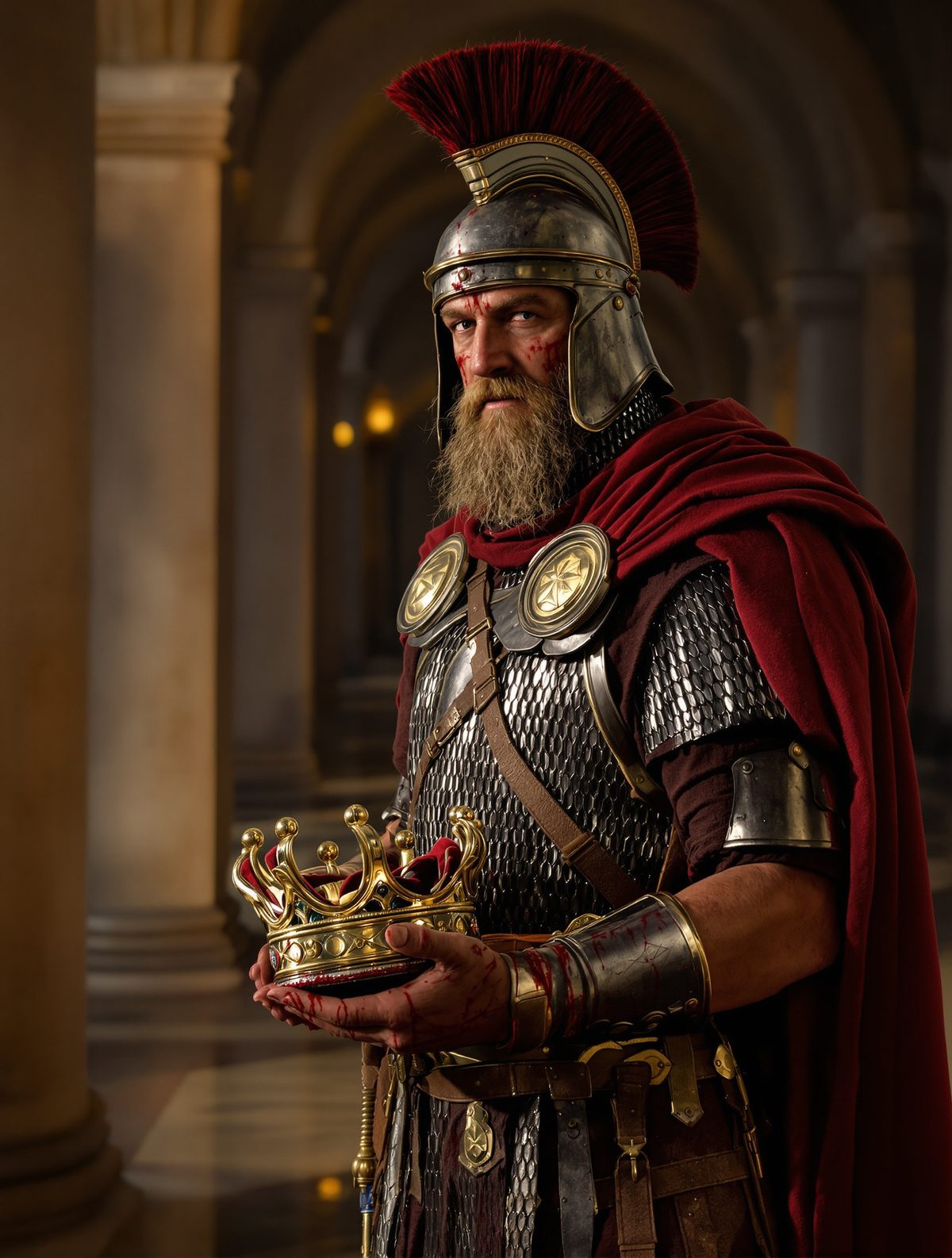
The morning sun cast long shadows across the cobblestones of Syracuse as Roman legionaries poured through the city's breached walls like water through a broken dam. After three grueling years of siege, the jewel of Sicily was finally falling. Soldiers ran through streets slick with blood, their armor clanking as they searched for treasure, slaves, and any remaining defenders. But in a quiet courtyard near the harbor, oblivious to the chaos around him, an elderly man with wild white hair knelt in the sand, tracing perfect circles with a bronze compass.
When a Roman soldier finally found him there, sword drawn and ready to claim another trophy of war, the old man didn't even look up. "Don't disturb my circles," he said simply in Greek, his weathered finger continuing to trace geometric patterns that had consumed his brilliant mind for hours. The legionary, illiterate and battle-drunk, saw only an obstinate old fool. He raised his gladius and struck.
With that single blow, Rome had just executed the greatest scientific mind of the ancient world—a man whose inventions had terrorized their armies and whose mathematical discoveries wouldn't be matched for nearly two thousand years.
The Siege That Changed History
To understand why Archimedes died clutching his calculations, we must first understand the extraordinary siege that had made him both Syracuse's greatest defender and Rome's most wanted man. The year was 212 BC, and the Second Punic War was tearing the Mediterranean apart. Hannibal had crossed the Alps, crushed Roman armies at Cannae, and was marching toward Rome itself. In this chaos, Syracuse—the most powerful Greek city in Sicily—had made a fateful decision to abandon their Roman alliance and side with Carthage.
Rome's response was swift and merciless. Consul Marcus Claudius Marcellus arrived with a massive fleet and army, expecting to crush Syracuse within days. After all, what could one Greek city-state do against the military machine that was conquering the world?
They were about to find out exactly what a 75-year-old mathematician could do when his home was threatened.
As Roman ships approached Syracuse's harbor and legions massed outside the walls, Archimedes emerged from his workshop like a ancient mad scientist. For decades, he had been lost in the pure world of mathematics and theoretical physics. But now, faced with the destruction of everything he loved, this absent-minded professor was about to become history's most innovative military engineer.
The War Machines of a Mathematical Genius
What happened next reads like science fiction, but it was documented by multiple Roman historians who witnessed it firsthand. As Marcellus's ships sailed confidently toward Syracuse's walls, expecting easy victory, they were met by mechanical horrors that seemed to defy the laws of nature itself.
Giant mechanical claws—which the Romans dubbed "Archimedes' Claws"—suddenly erupted from the city walls. These massive iron hands, operated by an intricate system of pulleys and levers, reached out like the fingers of some metal god, grasped entire Roman warships, lifted them clean out of the water, and then either dashed them against the rocks or dropped them from great heights, shattering their hulls and drowning their crews.
But that was just the beginning. Archimedes had also constructed a series of catapults so precisely calibrated that they could adjust their range with mathematical precision. Roman ships that thought themselves safely out of range suddenly found massive stones crashing through their decks. When they moved closer to avoid the long-range bombardment, smaller machines hurled a deadly rain of arrows and spears with mechanical efficiency.
Most terrifying of all were the bronze shields that appeared along Syracuse's walls—polished to mirror brightness and arranged in perfect mathematical formations. As Roman soldiers squinted against the Mediterranean sun, these mirrors focused its rays into concentrated beams of searing heat that could ignite ships' sails and wooden siege engines from hundreds of yards away. The Roman fleet, pride of the Mediterranean, was being destroyed by mathematics.
Plutarch, writing centuries later, described the Roman reaction: "Marcellus's soldiers became so fearful that whenever they saw a rope or piece of wood projecting from the wall, they would cry 'There it is! Archimedes is training some engine upon us!' and would turn and flee."
The Mind Behind the Mayhem
Who was this man who had turned an entire Roman army into a collection of terrified superstitions? Born around 287 BC in Syracuse, Archimedes was already legendary throughout the Greek world as the greatest mathematician since Euclid. He had discovered the mathematical relationship between a sphere and cylinder (so important to him that he had it carved on his tombstone), calculated pi to unprecedented accuracy, and invented the mathematical concept of infinity—nearly two thousand years before European scholars would rediscover it.
But Archimedes wasn't just a theoretical mathematician locked away in an ivory tower. He was history's first true physicist, a man who understood that mathematical principles could be applied to the physical world with devastating effect. He had discovered the law of buoyancy while taking a bath (leading to his famous "Eureka!" moment), invented the Archimedes screw for moving water uphill, and developed the mathematical principles of leverage that he summarized with typical confidence: "Give me a place to stand, and I will move the Earth."
Now, with Roman legions literally at his door, Archimedes was proving that mathematics wasn't just about abstract beauty—it was about power. Raw, practical, world-changing power.
When Genius Meets Treachery
For three years, one old man's mathematical brilliance held the entire Roman war machine at bay. Marcellus, one of Rome's greatest generals, found himself stymied by an elderly Greek who probably couldn't have lifted a sword with both hands. The siege that was supposed to last days stretched into months, then years. Roman soldiers who had conquered Gaul and Spain found themselves afraid to approach the walls of a single city.
But Archimedes had a weakness that his war machines couldn't protect against: human treachery. In 212 BC, during a festival celebrating the goddess Artemis, a group of Syracusan conspirators opened the city's gates to the Romans. As Plutarch recorded, "The city was taken while the inhabitants were drunk and asleep."
Marcellus, who had developed a grudging respect for his mathematical nemesis, gave strict orders that Archimedes was to be taken alive. The Roman general wanted to parade the brilliant Greek through Rome as the ultimate trophy of his Sicilian campaign. But in the chaos of a city being sacked, such orders often go unheeded.
As Roman soldiers poured through Syracuse's streets, most citizens fled or hid. But not Archimedes. According to multiple ancient sources, the 75-year-old mathematician was found exactly where he had spent most of his life—lost in the pure world of mathematical thought, oblivious to the messy, violent reality crashing down around him.
The Final Proof
The exact details of Archimedes' death vary slightly between ancient sources, but they all agree on the essential tragedy. Some say he was working on a mathematical proof, others that he was studying a mechanical problem. But every account describes him as completely absorbed in his work, drawing diagrams in the sand or dust, when a Roman soldier approached.
According to Plutarch's version, the soldier initially intended to arrest the old man, but Archimedes refused to come until he had finished his problem. "Don't disturb my circles," he reportedly said—words that have echoed through history as the ultimate example of a mind so devoted to truth that it couldn't be distracted even by mortal danger.
The soldier, illiterate and impatient, saw only defiance. His sword fell, and with it died the greatest scientific mind antiquity would produce. When Marcellus learned what had happened, he was reportedly furious. He had lost his greatest prize—and the world had lost something infinitely more valuable.
Archimedes was buried with honor, his tombstone carved with the sphere and cylinder that represented his proudest mathematical discovery. Centuries later, the Roman orator Cicero would search for and find this tomb, overgrown and forgotten, a symbol of how quickly the world forgets its greatest minds.
The Equations That Outlasted an Empire
Today, the Roman Empire that killed Archimedes is nothing but ruins and tourist attractions. The legionaries who stormed Syracuse are nameless dust. But Archimedes' mathematical discoveries form the foundation of our modern world. Every engineer who designs a bridge uses his principles of leverage. Every physicist studying fluid dynamics builds on his law of buoyancy. Every mathematician working with calculus follows paths he first blazed.
Those circles he was drawing in the sand as Rome burned around him? They represented the kind of pure mathematical truth that transcends empires, outlasts civilizations, and continues to unlock the secrets of the universe long after the swords that silenced their discoverer have rusted away.
In our age of anti-intellectualism and declining respect for expertise, Archimedes' story carries a sobering message: civilizations that destroy their greatest minds may win the battle, but they lose something far more precious. Rome conquered Syracuse, but in killing Archimedes, they silenced a voice that could have advanced human knowledge by centuries. The circles he died protecting were worth more than all the gold in the Roman treasury—they were the building blocks of human understanding itself.
Perhaps that's why his last words have resonated across the millennia: in a world too often ruled by force, Archimedes chose to spend his final moments defending something more powerful than any army—the eternal, beautiful, indestructible truth of mathematics.