In the bloody business of warfare, a soldier's shield is his honor. Yet, for Archilochus of Paros, abandoning his shield was liberating.
The Poet Soldier of Paros
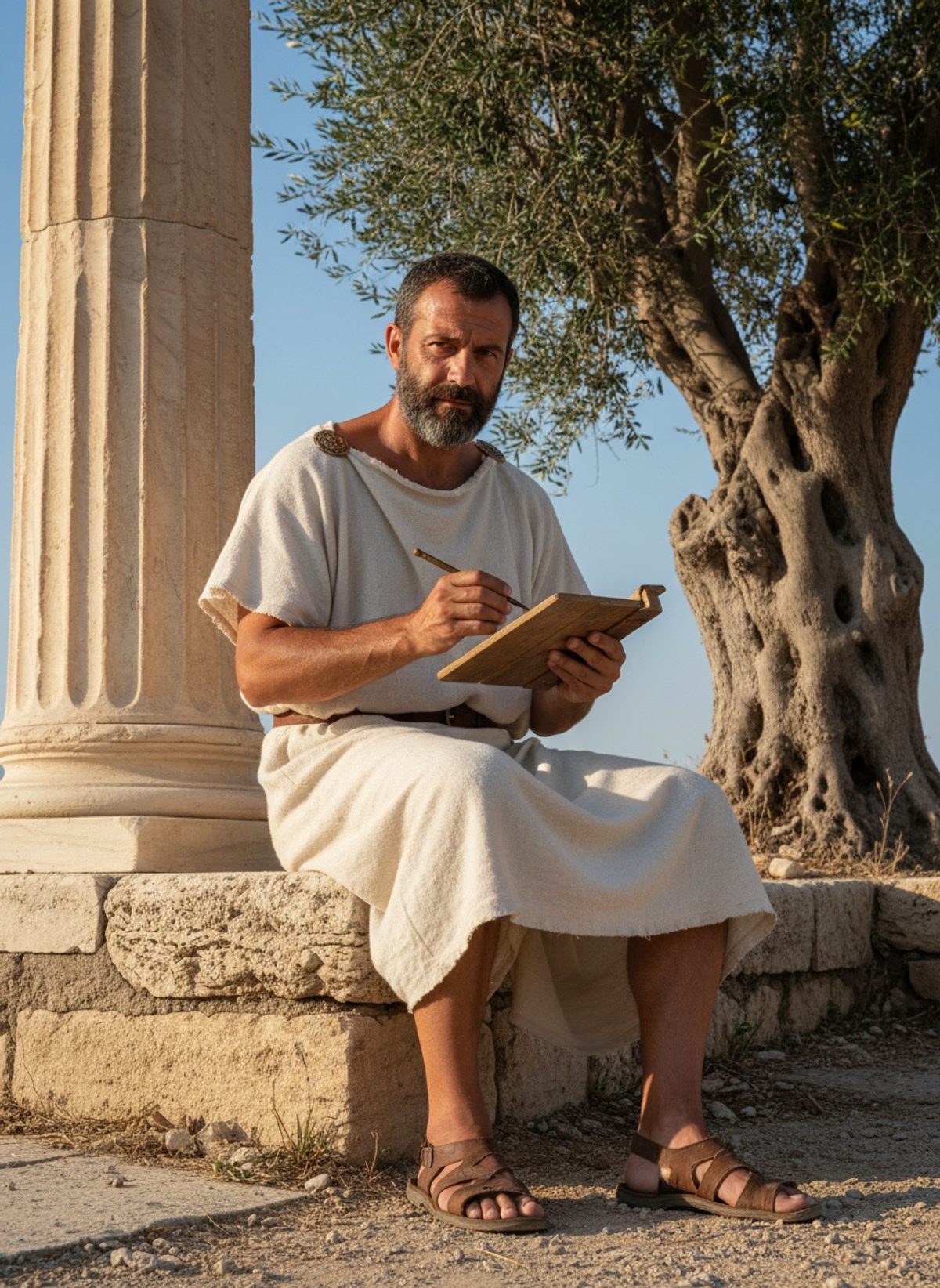
Born on the island of Paros in the 7th century BCE, Archilochus was no stranger to conflict. His life intertwined with an era of fierce battles between Greek city-states, and he earned his place not only as a warrior but as one of the most provocative poets of his time. His verses resound with the clashing swords of a soldier’s life yet echo the subtler battles of a man's heart. Our knowledge of Archilochus is largely pieced together from fragments of his work and accounts by later admirers, who considered his raw honesty and poignant literary style revolutionary.
Warriors of the era were expected to carry their shields through all hardships; losing one was synonymous with disgrace. However, Archilochus dared to defy this age-old tradition, not just by the act of leaving his shield but by the even bolder act of immortalizing the loss in verse. His acknowledgment of retreat was not a mark of shame but a profound declaration of the complex reality of human survival.
The Swamp of Decision
It was a day like many others that Greece has seen — sun scorching, winds carrying the sour scent of approaching conflict. Archilochus found himself embroiled in a brutal skirmish. As the battle raged around him, an encroaching swamp became the defining divider between life and death. With the ground sucking at his feet and danger enveloping the air, he chose life over the hollow honor of a shield.
Though details of the exact battle elude historians, the significance of his choice resonates throughout time. Archilochus left behind his shield to save his own skin, walking away from expectations and carrying not disgrace but a sharp instrument that would cut deeper than any sword: his pen. In the aftermath, he penned one of his most famous lines, declaring that his shield was resting valiantly by a tranquil shrub, while he himself had survived to forge brighter days.
Writing Against the Grain
The daring poem that followed his act of retreat did more than chronicle cowardice; it shook the very foundation of what it meant to be a hero. In a world that lionized stark bravery and stoic valor, Archilochus celebrated survival and the human condition. His verses brimmed with satire, self-examination, and a crude honesty that was both scandalous and revelatory. He peeled away the bravado that often masked the terror of battle, shedding light on the gritty essence of warfare that others preferred to veil.
Archilochus’ work served as a counter-narrative to the heroic epics that dominated Greek literature. Unlike Homer’s idealized warriors, whose tales were grand and deeds unquestionable, Archilochus painted a complicated picture — one where running could be as noble as standing ground, if living to fight another day meant living at all.
A Legacy Carved in Words
Over time, the ripples of Archilochus’ actions spread across the wide ocean of Greek culture. While warriors' ethos prized strength and valor, Archilochus’ candidness became celebrated, perhaps because it was so unexpected and jarring. His work influenced generations of poets and writers, encouraging them to compose with raw, unobscured emotion. The fragments of his poetry that survive bear testament to a complex man who wove humor and hurt into his lines — a man who saw strength not just in the sword, but in the quill.
As much as his poetry stands out today, it encountered resistance and criticism during his lifetime and in the years that followed. Ancient Greece did not easily forgive what it perceived as cowardice. Yet, Archilochus' refusal to hide from his humanity ensured his works resonated long after lesser stories of faceless, nameless warriors faded into the forgotten dust of history.
A Story of True Survival
Archilochus was a soldier-turned-poet who dared to question the valor of valor itself. His experience offers a timeless reflection on the nature of courage, challenging the simplistic view that running from the battlefield equals cowardice. Instead, he presents survival as its own form of bravery in a world obsessed with glory. By choosing to live — and to write about his choice — Archilochus shaped the notion that a life worth living is not only one of great deeds, but of authentic, unflinching expression.
His story compels us to recognize the spaces between heroism and failure, to understand that wisdom often lies in choosing the lesser path so life may continue. In a modern world filled with its own battles, Archilochus’ tale of the pen over the sword echoes a simple truth: there are battles to be won by living to write another day.