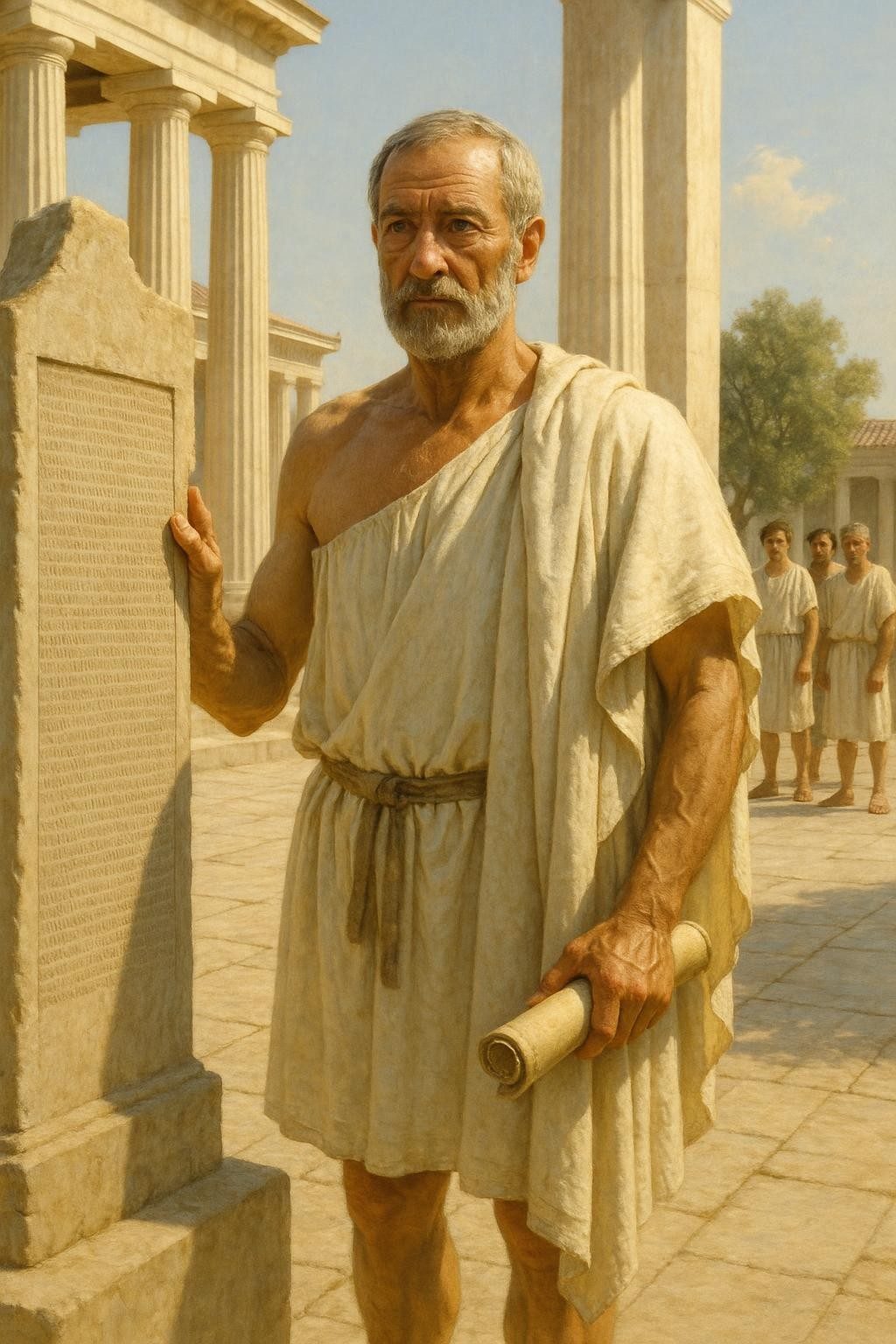
594 BC. A thin layer of dust settled over the bustling Agora, shadows stretching as the sun began its descent. In the heart of Athens, tension rippled through the crowded marketplace, where rich and poor jostled for space under the same unforgiving sky.
The City on the Brink
In the late 6th century BC, Athens stood precariously on the edge of a chasm it had long dug itself. Crushing societal tension simmered just beneath the surface, threatening to rupture into full-blown civil strife at any moment. The rich, a narrow aristocracy, held sway over the city's wealth and power. Meanwhile, the majority of Athenians found themselves ensnared by debts they could never hope to repay. For many, the price of default was steep, often resulting in the loss of their land, their freedom, and even their very lives. Debt slavery was a grotesque reality, rendering the poor not only dispossessed but voiceless — an existential threat to the Athenian ethos of citizenship and freedom.
Amid this turmoil, Athens made a radical choice: to entrust one man with the absolute power to rewrite its laws, its future. That man was Solon, a wise and respected statesman and poet whose reputation for justice and fairness had long been established. Solon faced an unenviable task: how to navigate the bitter divide threatening to tear his beloved city apart?
The Sweeping Reforms
Solon recognized that the very fabric of Athenian society was woven with threads at tension; thus, he embarked on his mission with pragmatism and caution. His approach was to level the playing field, to mend the schism between rich and poor without dismantling society entirely. In a series of sweeping reforms, he set Athens on a course of significant transformation. He abolished debt slavery outright, liberating all those who had been trapped in its cruel grip. In a resonant gesture, he canceled debts or "shaking off of burdens," as he termed it, allowing citizens to reclaim their autonomy and dignity.
But Solon did not stop at economic reform. He sought to empower the people politically, offering the disenfranchised a voice unprecedented in Athenian history. He established new laws that reorganized Athenian society into four classes based on wealth rather than birth, thereby allowing even the poorest citizens a say in the assembly. This restructuring was meticulous, granting access to political involvement, even as it ensured that the reins of power remained in experienced hands.
In rewriting the laws of Athens, Solon's vision was clear: balance. He aimed to temper the authority of the wealthy with a more equal distribution of opportunity, all the while maintaining order and stability. It was a delicate dance on a knife's edge, an ambitious gamble that sought to quench the brewing fires of discontent. And with these new laws in place, Solon had crafted a framework that would enable Athens to thrive, setting the stage for its eventual flowering as the cradle of democracy.
The Self-Imposed Exile
Yet, perhaps the most extraordinary chapter of Solon's story is not the reforms he enacted, but the choice he made after. Rather than staying to rule in the power that was now richly his, Solon chose instead to walk away. He deliberately exiled himself from Athens, an act as bewildering as it was significant. For ten years, he traveled, leaving behind the city he had labored to save, sailing to distant lands — from Egypt to Lydia — on a journey of exploration and reflection.
This self-imposed exile was a strategic retreat. Solon understood the nature of power and its corruptive potential. By removing himself, he resisted the temptations of tyranny that so frequently followed reformers in the ancient world. Furthermore, by stepping aside, he forced the Athenians to embrace his laws of their own accord, encouraging them to foster a sense of civic responsibility and ownership over the system he had built.
The absence of Solon was a conspicuous void, yet it served as a catalyst for ensuring the longevity of his reforms. As Athens solidified these new structures, Solon's detached but watchful eye from afar allowed the city to grow, adapt, and finally breathe in the liberating air of civic equality and justice.
The Legacy of a Lawgiver
Solon's reforms laid the foundational stones for the great democratic experiments that would ultimately define Athens. The birth of democracy, albeit embryonic in Solon's laws, came not as a placid evolution but through the birthing pains of crisis. His legacy was not written in the halls of power, but in the heartbeat of a city quick to remember the cost of imbalance.
Why does this story matter more than two millennia later? Solon's decisions echo through the annals of history as a testament to the enduring struggle between power and equity, a reminder of leadership that values restraint over control, and wisdom over ambition. His choice to eschew authoritarian rule for the path of inclusivity and reform resonates even now, a poignant narrative on the virtue of guiding principles over personal gain. In this, Solon leaves us with a profound truth: it is not enough to build a society; one must also trust the people to carry it forward. As Athens held firm against civil chaos, it was not under the thumb of a single man but through the collective strength of its newly-empowered voices.