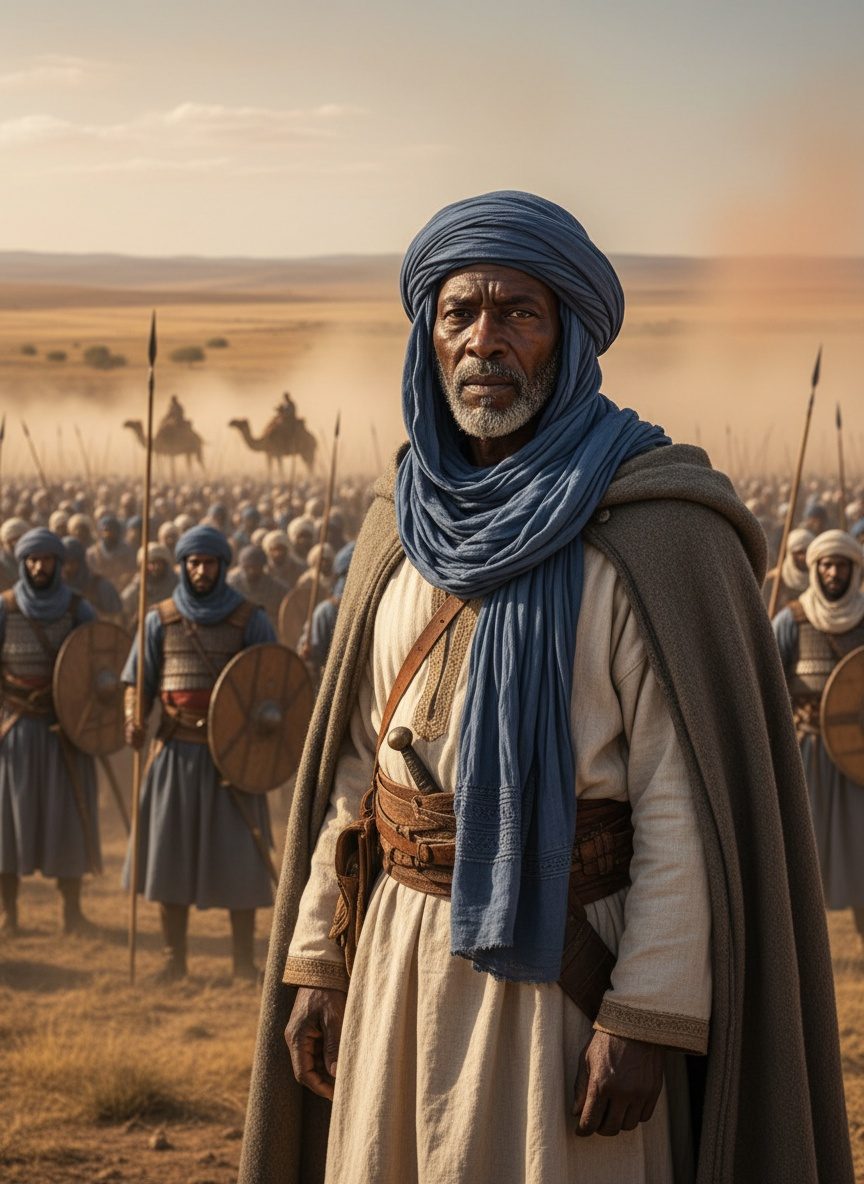
Chains clinked with every step Ahmad Baba took, metal scraping against the sun-baked earth of Timbuktu. Each breath he drew was thick with dust and degradation, the once-lofty scholar now reduced to a prisoner under the blazing African sun. Soldiers surrounded him, their faces grim and unreadable, their mission clear: to extract from this ancient city not just its treasures but also its finest minds. But if they expected submission, they did not know the man they had captured.
Ahmad Baba’s mind was a library of knowledge, his words repositories of wisdom passed down through generations and expanded through his own genius. Born into a family that valued learning in the city known as a center of scholarship, Ahmad Baba was destined for greatness. By the time of his capture, he had authored over forty books and influenced countless students who hung on his every word, eager to drink from the deep well of his insights.
Yet here he was, in chains, a prize for Moroccan forces who sought to crush the moribund Songhai Empire and annex Timbuktu, its crown jewel. In 1594, the sacking of this storied city, known far and wide as a beacon of knowledge in the Sahara, stripped not just its abodes of bounty but its people of pride. Scholars and scribes, erased from their lecterns, became spoils of war destined for foreign courts. But for Ahmad Baba, captivity did not equate to silence.
As he was dragged through the streets and into exile in Marrakech, a bitter wind buffeting against his face, the flames of defiance stoked within him. The city that awaited was a tapestry of opulence and grotesque decadence, a fitting captor for a scholar of such magnitude. Beneath its minarets and within its courtyards, however, a greater triumph was in motion — one that would see Ahmad Baba rise above his circumstances through the very force of his intellect and spirit.
His captors, initially enraptured by the simplicity of conquest, soon found themselves entrapped in a different kind of campaign, one not of land or power, but of knowledge. Ahmad Baba, undeterred by chains, began to lecture his guards, challenging their assumptions and broadening their horizons in spite of themselves. Amidst the clamor of the medina and beneath the vaulted ceilings of Marrakech, lessons emanated forth, akin to the soft murmur of a river weaving through a parched valley, bringing life to everything it touched.
It is said that the deeper Ahmad Baba delved into discussions of philosophy, jurisprudence, and theology, the more his audience grew, captivated as much by the spectacle of his mind as by the substance of his discourse. Moroccan nobility and laypeople alike, the same who had initially viewed him with suspicion and apprehension, now flocked to listen. His stature, rather than diminishing in captivity, soared, reaching corners he might never have touched had he remained confined to the sandstone walls of Timbuktu.
Ahmad Baba's impact was multifaceted, extending beyond imparted wisdom. His story, a testament to the power of resilience and knowledge, challenged the narrative of subjugation. For those under the yoke of foreign domination, his lectures served as a clarion call, revealing to oppressors and oppressed alike that shackles could bind the body, but never the spirit. His ability to transform captors into disciples recontextualized conquest, turning it into an arena for intellectual combat where he, unarmed and unyielding, reigned victorious.
Through the act of teaching, Ahmad Baba reclaimed his autonomy, his words floating beyond the confines of any prison, seeding ideas and expansive thoughts in the minds of those who would otherwise forsake their own intellectual prowess for blind obedience. In a world where information was often hoarded and gatekept, where the written word could change fates and futures, every utterance from Ahmad Baba became a weapon of peaceful rebellion, a testament to the indomitable nature of wisdom in the face of tyranny.
In time, Ahmad Baba’s captivity ended, yet the reverberations of his defiant teachings continued their march across the sands of time. His works and his resilience anchored a legacy that spanned continents and cultures, ensuring that the truths he espoused would persist far beyond any one lifetime. The city of his birthplace, Timbuktu, rebuilt itself and remained a testament to the endurance of education amid adversity. Ahmad Baba's story became woven into the intricate tapestry of African history, a story reverberating with the poignant truth that knowledge is both a shield and a beacon.
The narrative of Ahmad Baba serves as a stark reminder that the chains of oppression can be broken not by force alone, but through enlightenment and the sharing of knowledge. In a world ever at risk of forgetting the past, his journey provides profound lessons on resilience — an assurance that the pen does indeed hold greater power and sway than the sword. In the era of Moroccan conquest, amidst the ashes of Timbuktu’s libraries, one man stood unbowed, teaching that the human spirit is uncontainable and perpetually aflame with the fire of learning.