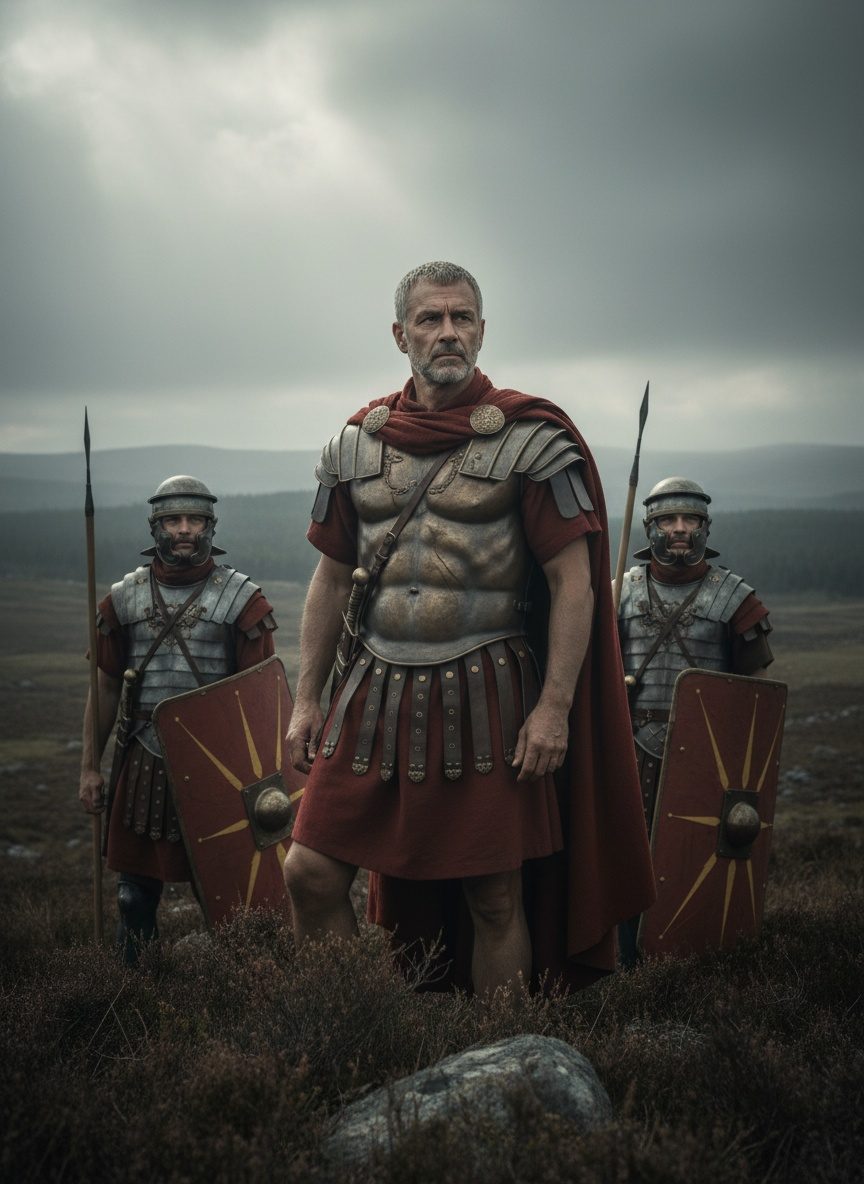
The chill wind swept across the barren highlands, a relentless whisper of the desolate expanse that lay before Gnaeus Julius Agricola. Standing at the northern tip of Britain, the Roman general peered into the mist that swallowed the horizon, where the land crumbled into the unforgiving waves of the North Sea. The grey sky hung low, heavy with the promise of rain, casting a somber shroud over the aftermath of the triumphant battle at Mons Graupius. Here, at what Roman maps deemed the edge of the world, Agricola had carved his name into the annals of history with sword and strategy. All of Britain seemed poised for conquest, the final notes of resistance fading with the retreating Caledonian tribes. Yet, at the pinnacle of his campaign, a missive from Rome would shatter the ambitions cradled in the conquest's shadow.
To comprehend the magnitude of Agricola’s achievement, one must step back into the pervasive fog of Roman Britain in 83 AD. It was a land both mysterious and untamed, its wild contours shaped not just by nature but by a fiercely independent people whose lives were woven into the aura of myth and legend. The Caledonian tribes, regarded by Rome as barbarians, carried the reputation of being ferocious and indomitable, known for their guerrilla tactics and intimate knowledge of the rugged terrain. In this formidable arena, Agricola not only displayed remarkable military acumen but also an acute understanding of psychological warfare. He had spent years consolidating power, fortifying strongholds, and forging alliances, gradually extending the reach of Rome across the island.
The culmination of Agricola’s efforts unfolded at the Battle of Mons Graupius, a contest that pitted Roman discipline against Celtic valor. The exact location of the battlefield remains a mystery, lost to time and shifting landscapes, yet its significance echoes loudly through history. Agricola's victory here was decisive—the Caledonians were broken, their ability to mount any serious opposition dismantled. Accounts suggest Agricola's forces comprised one-third auxiliary troops, complemented by Roman legions, their formation forming an impenetrable wall. Against them charged the Celtic warriors, their battle cries slicing the air, but they could not withstand the ordered chaos of Rome’s military juggernaut. As dusk settled, the landscape was littered with remnants of the fierce resistance.
Yet it was not merely military might that cemented Agricola’s success. He was known to administer with a fair hand, extending peace terms to those willing to submit and incorporating local customs into his administration. By promising infrastructure improvements and economic benefits, Agricola secured the loyalty of many tribes, a tactic Rome had perfected throughout its sprawling empire. This dual approach—a calculated blend of conquest and conciliation—was designed to weave a tapestry of Roman influence across Britain, establishing a legacy that would long outlast individual battles.
However, the broader context of Roman politics was as volatile as the distant lands Agricola sought to conquer. Emperor Domitian, seated far from the gusty battles of the frontier, viewed the unfolding events through a veil of suspicion and jealousy. Powerful generals often became political threats, and Agricola’s burgeoning success risked overshadowing the Emperor’s own achievements. It was amid this treacherous political landscape that Rome’s command came: Agricola was to be recalled. With his departure, the entire dynamic of Roman expansion in Britain shifted abruptly. Unbeknownst to him, his return to Rome marked the end of aggressive territorial expansion across the island.
The recall of Agricola is shrouded in speculation. Tacitus, Agricola’s son-in-law and biographer, insinuates it stemmed from Domitian’s envy. For centuries, historians have debated the nuances of this imperial decision. Was it purely political, or did logistical challenges also play a role? The Roman Empire was vast, resources stretched thin, and perhaps Rome saw the retention of current territories as a more prudent course of action. Whatever the reasons, Agricola never returned north, and his dreams of a unified Britain under Roman rule receded like the tide.
Agricola’s departure left a vacuum that was felt keenly by the clans and tribes that had briefly accepted Roman dominance, resulting in renewed skirmishes and raids. Rome fortified its western and northern defenses, concentrating efforts on protecting rather than expanding its frontier. The walls, forts, and roads constructed during Agricola’s governorship continued to testify to his impact on the landscape and the architectural legacy of Roman Britain, enduring symbols of a shielded empire.
This story matters not because of what was seized but for what remained just beyond the grasp. Agricola’s interrupted campaign poses a historical quandary—what might have transpired had Rome pressed onward? In the absence of his leadership, Rome’s ambitions in Caledonia dissolved, and the land would remain a contested hinterland, inspiring future legions and leaders with visions of conquest. Yet, the myths of the unconquerable North endured, becoming fodder for Celtic tales of defiance that would echo into the centuries. Thus, Agricola’s reach to the edge was immortal, a poignant reminder that history's course is shaped not just by victories achieved but also by those left unfinished.