She was a woman in a world ruled by men. Yet, she became one of the most successful pharaohs of Ancient Egypt.
The Unlikely Pharaoh
In an era defined by the might of kings, Hatshepsut rose to power and changed the course of Egyptian history. Born into privilege as the daughter of Pharaoh Thutmose I, her pathway to power was nevertheless far from assured. When her husband, Thutmose II, died prematurely, Hatshepsut took the unprecedented step of declaring herself pharaoh. Her ascent was shocking not only because she was a woman but because she chose to rule as king, adopting traditional male regalia and titles. In a time when women were expected to be seen and not heard, Hatshepsut provoked Egypt's centuries-old traditions by assuming full control of the throne.
Tradition dictated that her stepson, Thutmose III, would inherit the throne. However, Hatshepsut deftly side-stepped expectations. Initially appointed as regent due to Thutmose III’s youth, she held on to power, building a legacy that echoed through time. She redefined what it meant to be a ruler, refusing to let gender dictate her destiny.
A Golden Age Of Trade
Hatshepsut's reign was marked by prosperity and ambitious undertakings that set the stage for a thriving Egypt. One of her most notable achievements was the establishment of a monumental trade expedition to the land of Punt, a region thought to be located in what is now parts of Eritrea and Sudan. This expedition was significant not only for its scale but for the wealth it brought back to Egypt, enhancing its economy and enriching its culture with exotic goods such as incense, ivory, and gold.
This voyage was meticulously planned and executed, evidence of Hatshepsut's keen sense of leadership and diplomacy. The trade fleets that Set sail under her command returned laden with riches, solidifying her reputation as a ruler who could realize grand visions and bolster her nation's standing on the international stage.
The Monument Maker
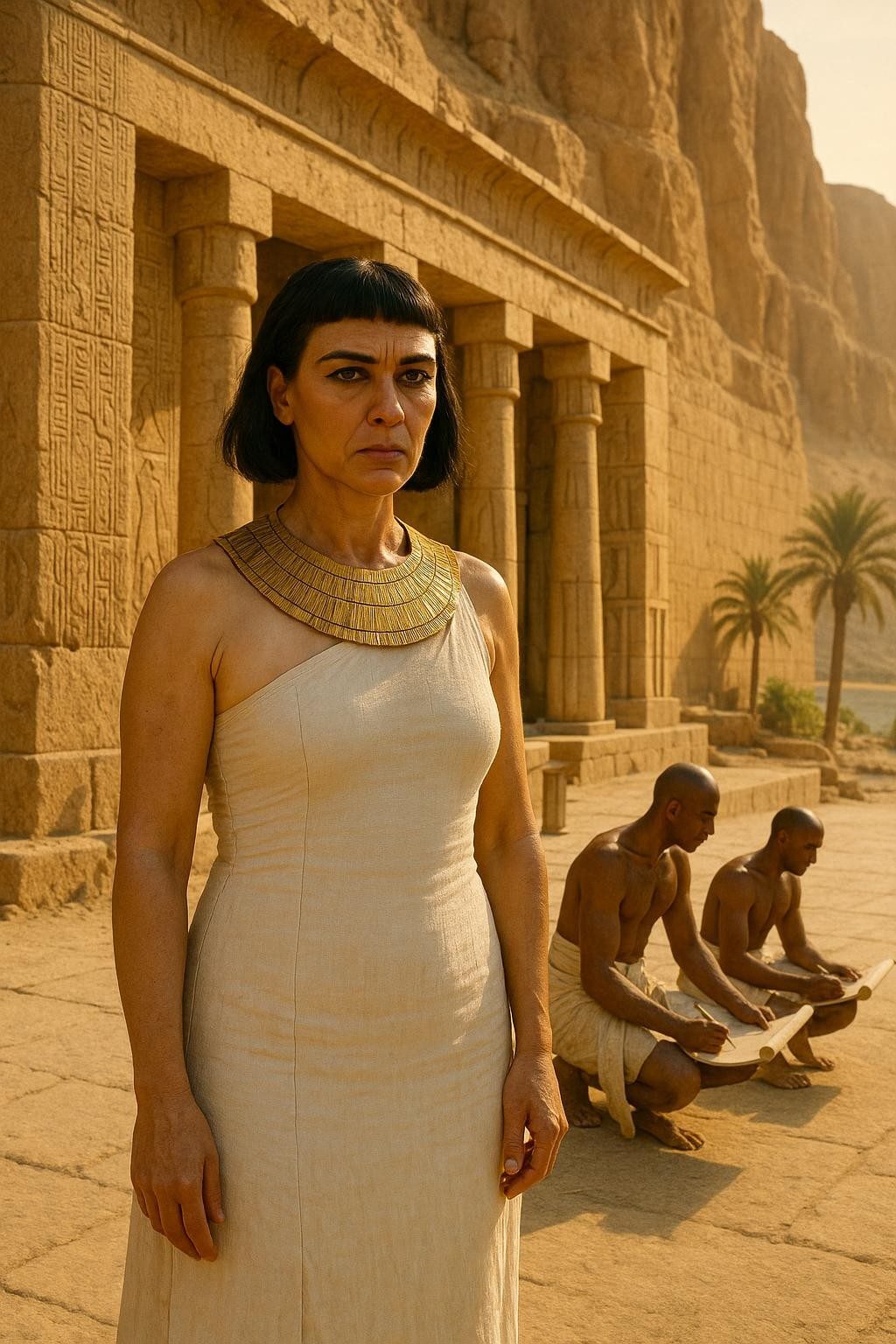
Hatshepsut was not only concerned with the voyage of ships across oceans; she also left her mark on the architectural landscape of Egypt. She embarked on ambitious building projects that would withstand the ravages of time. Among her most famous constructions are the towering obelisks at the temple of Karnak, symbols of divine power designed to pierce the heavens, and the splendid mortuary temple at Deir el-Bahri, which carved her legacy into stone.
The temple stands as a testament to her unique vision and unparalleled engineering skills of her era, blending perfectly with its natural surroundings in the rugged cliffs along the Nile. These projects revealed a more strategic and enduring approach to asserting her power and God's favor. Her constructions, characterized by their grandeur and intricacy, spoke to the continuity and stability she brought to her reign.
Erasure and Anonymity
Despite her triumphs, the end of Hatshepsut’s rule marked the beginning of another narrative—that of her erasure. Following her death, Thutmose III ascended to the throne, initiating a campaign to erase Hatshepsut's name from history. His efforts were systematic and far-reaching: statues of her were torn down, her name was chiseled from monuments, and inscriptions were altered to remove any mention of her rule.
The reasons for this act of obliteration remain a mystery. Was it an attempt to restore traditional male succession or a reaction to the unprecedented challenge her rule posed? Whatever the motivation, Thutmose III's actions nearly succeeded in erasing Hatshepsut completely from the annals of history, casting her much-accomplished reign into obscurity.
Rediscovering a Lost Legacy
For centuries, Hatshepsut's story lay buried under the sands of Egypt, her contributions overshadowed by history’s efforts to forget her. The remnants of her reign languished, largely ignored, until archaeologists uncovered her mortuary temple in the 19th century. This discovery reignited interest in her era and revealed a new narrative of ambition and power, one told not through the eyes of conquerors but through the achievements of a woman who dared to defy convention.
Hatshepsut’s story matters because it challenges the traditional narratives of history—those that seek to silence and erase inconvenient truths. Her reign underscores the complexities of power, gender, and memory, inviting us to reexamine the ways history is written and who gets to be remembered. Through her resilience and vision, Hatshepsut reminds us that the echoes of a determined ruler can never be entirely silenced, forever inviting curiosity and admiration across millennia.