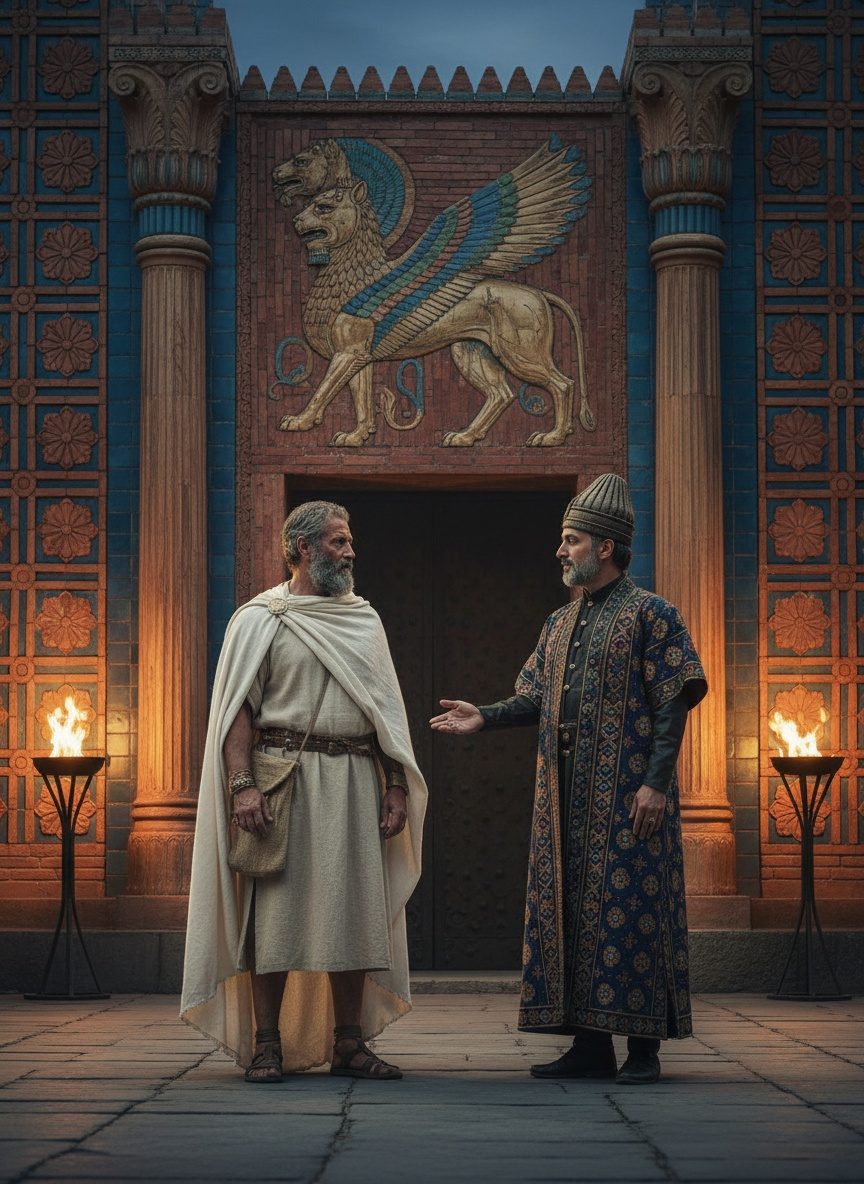
Themistocles was the savior of Greece from the Persian threat. Then he became a supplicant at the court of the Persian king. In 465 BC, Themistocles, lauded as the brilliant mind behind the Greek victory at Salamis, found himself standing at the border of the Persian Empire, seeking refuge from his own people. It was a remarkable twist of fate for the man whose strategic prowess had turned back the might of Persia just years before. Yet here he was, hoping that the very enemy he once vanquished might now offer him salvation.
The Battle of Salamis in 480 BC was Themistocles' crowning achievement. The narrow straits near Athens became a well-scripted theater of war, where his cunning tactics lured the Persian armada into a trap. The result was nothing short of historic: a humiliating defeat for the Persians that effectively ended their invasion of Greece. Themistocles was celebrated as a hero, his name sung throughout the Hellenic world. It is often the case, however, that fortunes found in war can be lost in peace. With the Persian threat abated, the inter-city rivalries and politics of Greece soon turned against their famed strategist. Charges of bribery and treason swirled, and the tide of public opinion shifted. Ostracized in 471 BC, Themistocles fled Athens, his achievements granting him neither clemency nor pause from political machinations.
His journey of exile was a testament to desperation, illustrating just how far a man might wander in search of sanctuary. As he meandered across Greece and into foreign lands, from Argos to the edges of Macedonia, Themistocles constantly faced threats from his pursuers, sent to extract vengeance on behalf of Athens. Despite his tarnished reputation, he remained a master of intrigue. Disguised and under assumed identities, he crossed the vast territories until he reached the borders of the empire he had once thwarted.
Imagine the scene when Themistocles finally arrived at the court of King Artaxerxes I of Persia. He was no longer the celebrated hero of Athens but a fugitive, weathered by the hardship of his travels. The Persian court, with its opulent displays of wealth and power, stood in stark contrast to the harried figure of the Greek wanderer. Artaxerxes, aware of Themistocles' historical significance, didn't respond with the wrath one might expect from a king whose father had been bested by him. Instead, he did the unthinkable: he laughed and welcomed Themistocles with open arms.
It was a strategic choice, not an impulsive act of empathy. For Artaxerxes, aligning with this seasoned adversary presented an opportunity. Themistocles was granted not just refuge but was gifted a palace and provinces to rule. This act of clemency was a powerful statement, a diplomatic coup that converted the once-great enemy into an ally—or at least neutralized a potential threat. Some might call it an inversion of power dynamics; others might see it as a compelling example of ancient realpolitik. Themistocles, now a guest-friend of the Persian king, lived out his remaining years far from the land he had once saved.
In literature, no hero's journey is complete without a fall from grace, a transformation, and, sometimes, redemption. Themistocles' life embodied each. In Persia, he was bestowed with the city of Magnesia, enabling him to lead a comfortable life. Here was an irony that only the capricities of history could conjure—the architect of Greece's greatest naval victory finding solace among the vanquished. Reports from antiquity suggest Themistocles adopted Persian customs and embraced his new life with a pragmatist's zeal. It is likely he understood the fragrant irony and the unique, almost poetic justice of his final chapter.
The historical narrative of Themistocles is instructive, not merely as a footnote in the annals of Greek and Persian conflict but as a case study in the fluidity of allegiance and identity. It challenges the monolithic views of heroism and betrayal, honor and pragmatism. Themistocles, constantly oscillating between two worlds, epitomized a consciousness that was ahead of his time—a recognition that survival often demands the shedding of past animosities.
This tale begs reflection on how we, too, navigate loyalties and identities. It stands as a testament that what is heralded as loyalty in one epoch can be redefined as treason in the next. The walls we build around our identities are more porous than we imagine, allowing unexpected narratives and transformations to emerge. Themistocles' odyssey from a celebrated commander to an exiled supplicant remains a story that defies the conventional constructs of ancient warfare and allegiance. Today, it prompts us to reconsider the complex textures of loyalty, enmity, and human survival in a world of relentless change.