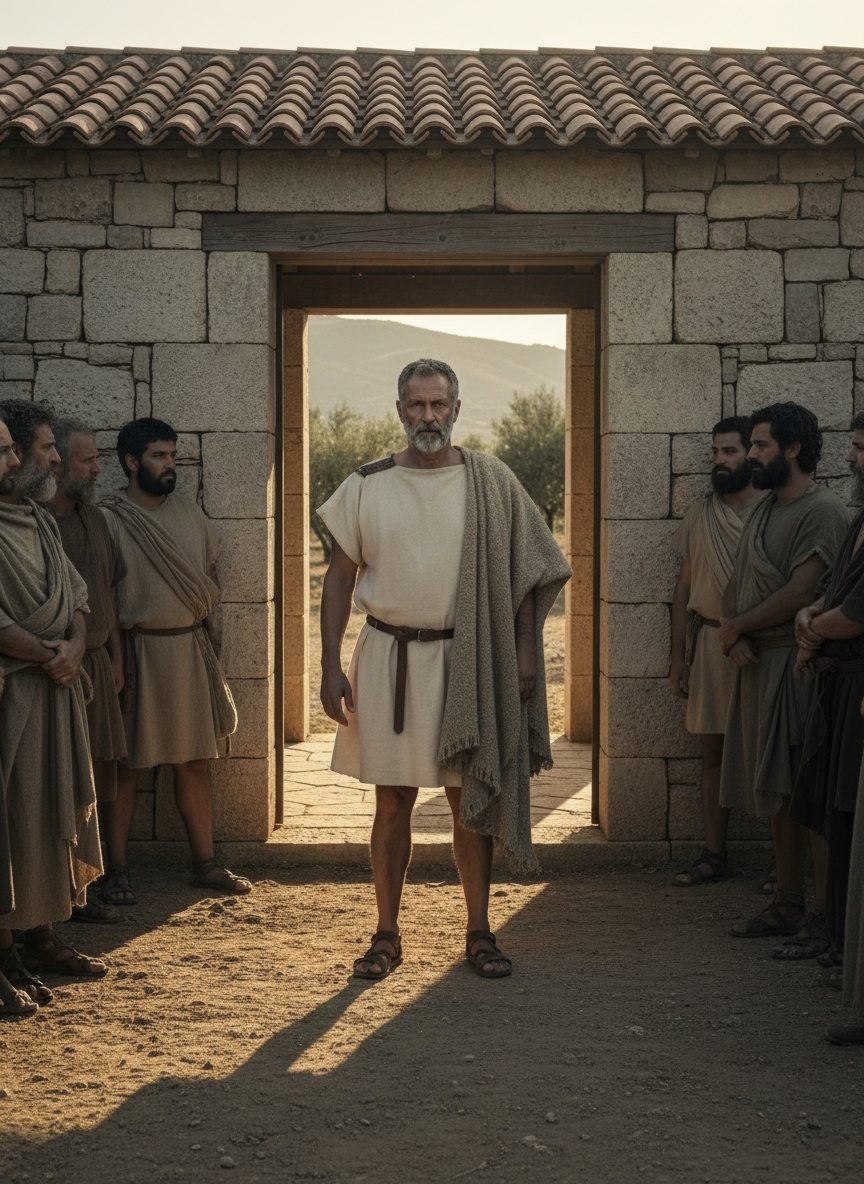
The dim morning light crept slowly into the crannies of Socrates' final dwelling. The window opened to a subdued light, pouring gently over the ochre walls of the Athenian prison. Outside, the muffled bustle of Athens waking up was the only intrusion into the quietude of the room. But inside, an undercurrent of somber anticipation filled the air, thick and heavy as if time itself hesitated, coiling itself around the events unfolding. In this stilled moment, the soft yet unbroken resolve of one of history's most profound philosophers stood against the unyielding verdict of the Athenian court.
It was the morning of 399 BCE, and Socrates, an iconic figure in Ancient Greece, awaited his imminent execution. Around him, his closest students and friends had gathered, their emotions laid bare — a swirling mix of grief, disbelief, and quiet desperation. Socrates, however, wore a demeanor paradoxically serene, an unwavering calm that belied the gravity of the situation. It was in such moments that the steadfastness of his philosophy shone through, providing an almost celestial clarity to those fortunate or unfortunate enough to share these last private hours with him.
Yet amid these figures stood a woman, her presence often overlooked in the annals of history. Xanthippe, Socrates' wife, was there with their youngest child cradled in her arms. Tradition hadn't needed the touch of a woman's sorrow at such moments, yet she was part of this tightly woven narrative. She wept not out of fear for herself, but for the love she had for her husband and the cruel incompleteness of their life together now drawing to an abrupt halt. Through her tears and the resignation in her heart, she bore witness to the philosophical composure of the man she loved.
The scene was part of a larger narrative, a fierce critique turned against the city he cherished. Socrates was condemned on the charge of impiety and corrupting the youth — accusations that belied the complexity of what he represented to society. His trial and subsequent sentence reflected the turbulent duality of Athenian democracy, both progressive and fiercely protective, ready to silence even its greatest advocates to quell the discomforts of self-reflection. In this grand theater of logic and rhetoric, Socrates' refusal to conform had sentenced him and unwittingly positioned Xanthippe as a silent witness to history.
When the time came to say farewell, there was an aching finality to her departure. Socrates’ request that she be led away was not out of callousness or cold philosophy, but rather through a wish to spare her the intensified anguish of his final moments — a message misunderstood by some as a depiction of a strained marriage rather than an act of tenderness. This was not the sepulchral silence of disdain, but the quiet defiance of a husband-heart, heavy with final goodbyes, shielding his family from the cruel spectacle of state execution.
Once his friends steadied themselves, easing from the tempest of their shared sorrow, they spoke of the soul and immortality, of life and death — prickly, complicated subjects that Socrates handled with the dexterity of a master craftsman shaping his magnum opus. To them, he imparted a serenity they could not muster on their own—a confidence derived from a life spent in relentless pursuit of truth and virtue. Here, the philosopher's final dialogue acted as both a farewell and a teaching, etching his thoughts indelibly into the memories of those he left behind.
As the hour of destiny approached, he took the cup of hemlock into his grasp, his hand steady, his resolve unbroken. As the poison worked its inevitable course, he seemed to embody the essence of his teachings. In the face of death, he became a living argument for the immortality of the soul, a man who met oblivion with pragmatic acceptance rather than fear's paralyzing grip.
Our vision blurs in imagining what Xanthippe must have felt in that moment, her universe forever altered by this mixture of philosophy and fate. She was a woman living in the societal shadows of Athenian female existence, yet through this tragic juncture, her role gains undeniable prominence. Her legacy, long overshadowed by her husband’s, reveals the finer threads of this historical tapestry — that of the quiet strength and dignity Stoic in the wake of seismic personal loss. Socrates' death comes across as the symphony of a thinker’s life, but Xanthippe’s is perhaps more akin to an unsung aria, reflecting humanity at its rawest edge.
And so, Athens, with its sun-drenched columns and vibrant agoras, witnessed a trial that resonated beyond justice, echoing questions of morality and the cost of dissent. Socrates' demise was not merely the end of a man's life but a dramatic chapter in the ongoing dialogue between society’s ethos and the individuals who dare to question it. Yet here, too, the story turns in deeper winds. Within the cauldron of philosophy, power, and mortality, lies an enduring testament to a quieter narrative — the quiet courage of Xanthippe, woven into the grander story of courage in the face of certain loss.