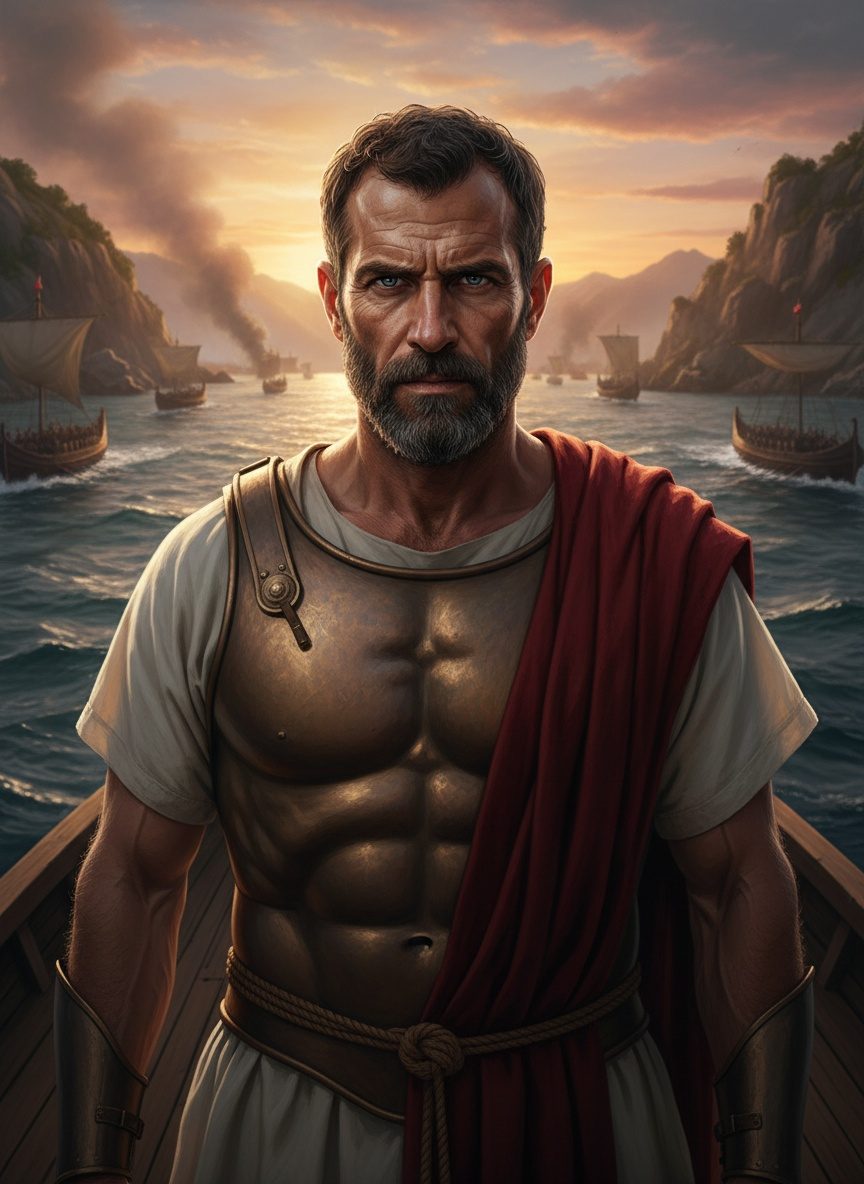
The early morning light of Greece glowed faintly over the Straits of Salamis. The sea, calm yet deceptively intricate with hidden currents, glistened under a sky that promised both hope and menace. The air was thick with anticipation as the sound of oars slicing through the water could be heard echoing against the rocky shores. It was 480 BC, and somewhere amidst the rising tension, Themistocles awaited the onslaught of an empire. What unfolded in these narrow waters determined the fate not just of Athens but of the entire Western world. Persia's mighty fleet was poised to snuff out Greek resistance, and yet, through unmatched cunning, Themistocles had set the stage for a confrontation that would swing the lantern of civilisation.
The Mind Behind the Stratagem
The scene at Salamis was the climax of a grand design by Themistocles. Born in Athens, Themistocles was known as a shrewd tactician, a man whose astuteness lay in his capacity to envision and execute strategies that others deemed reckless. By no means born into privilege, Themistocles rose through the ranks not by lineage but by sheer brilliance and resolute determination. He foresaw what many could not — the Persian threat demanded not just stalwart defence but a decisive, aggressive enterprise. Athens needed a navy.
Convincing his fellow Athenians of this vision was no small feat, for it required diverting attention and resources from traditional land forces. Thus, with foresight unmatched by most of his peers, Themistocles pushed for the construction of a formidable fleet. It was this navy that would lure the Persian king, Xerxes, into the straits of Salamis. Themistocles knew every curve and current of the Greek coast would favor smaller, more maneuverable Greek ships against the larger Persian craft.
The Deception of Xerxes
Under Themistocles' leadership, the Greeks executed a grand deception. Themistocles sent a message to Xerxes, feigning defection and suggesting that a part of the Greek resistance was willing to capitulate. It was this ruse that turned the tides of war. Xerxes, emboldened by what he mistook for Greek indecision, ordered his ships into the narrow confines of Salamis.
The morning sun rose over a sea transformed into a theater of combat. As the Persians advanced confidently, expecting a quick rout, they found themselves ensnared. Themistocles' strategy unfolded with meticulous precision. The smaller Greek triremes sprung forward from their hiding spots, cutting through the disoriented Persian lines. The chaotic maze became a slaughter, turning the tide of the Greco-Persian Wars and ensuring the survival of nascent Greek democracy and, eventually, Western civilisation itself.
Triumph and Turmoil
From the victorious aftermath of Salamis, Themistocles emerged as a hero. He had orchestrated one of history's most remarkable turnabouts. Yet, the fickle nature of democratic Athens became his greatest adversary. Despite his undeniable contributions, Themistocles became entangled in the complex web of Athenian politics. His reforms, which had dramatically shifted power to the naval class, made him a target in the eyes of the aristocracy, who viewed such changes with suspicion.
The years following the Persian Wars saw Athens grappling with internal strife. Themistocles, once Athens' favorite son, was now a man beset by political opponents exploiting citizens' restlessness. Accusations of undue ambition and allegations of corruption began to circulate. In a city state which valued its democracy, fears of tyranny never lay far beneath the surface. This growing animosity and envy culminated in his eventual ostracism in 471 BC. For a man of his stature, the decree was devastating — ten years of exile, a banishment from the very soil he had protected.
Exiled but Unbowed
From hero to exile, Themistocles found refuge not among his fellow Greeks but in a startling twist of fate, within the sprawling expanses of the Persian empire itself — the enemy he had once outwitted and outmaneuvered. Xerxes' successor, Artaxerxes I, offered him sanctuary, perhaps recognizing a sharp mind that could yet serve the empire. While the details of Themistocles' later life remain shrouded in the extraordinary contradictions of his world, it is believed he held favor at the Persian court until his death.
Ironically, in exile, Themistocles lived out his days in relative peace, far removed from the clamor of Athenian democracy, away from the city that owed him so much yet turned its back on him. It is said that he even governed some Persian cities, an indicator of the respect and trust he commanded, even from those he once opposed fiercely. His passing marked the end of an era where the cunning and passion of one man had protected the ideals of many.
The story of Themistocles serves as a sober reminder of the capricious nature of political power, a lesson on the precariousness of fame and favor not unfamiliar to the modern world. His life is a study of contrasts: the strategic genius who safeguarded democracy, yet whose dedication was rewarded with exile. It brings forward the perennial question: How do societies honor those whose vision reshapes the world? In Themistocles' case, the answer remains a complex blend of admiration and abandonment, echoing through the corridors of history like a cautionary tale.