80 BC. The aroma of pine and wild herbs drifted through the air of Hispania.
In this rugged, unforgiving landscape, a battle was being fought. Not just one of swords and shields, but a battle of wits, courage, and perhaps most importantly, belief. At the center of this struggle was Quintus Sertorius, a man whose story is as fascinating as it is improbable. Here was a Roman general declared an outlaw by Rome itself, yet he whispered tales into the wind that resonated with the tartness of an ancient myth. The Romans may have spurned him, but the people of Hispania revered him, taking him as a leader who walked hand in hand with the gods.
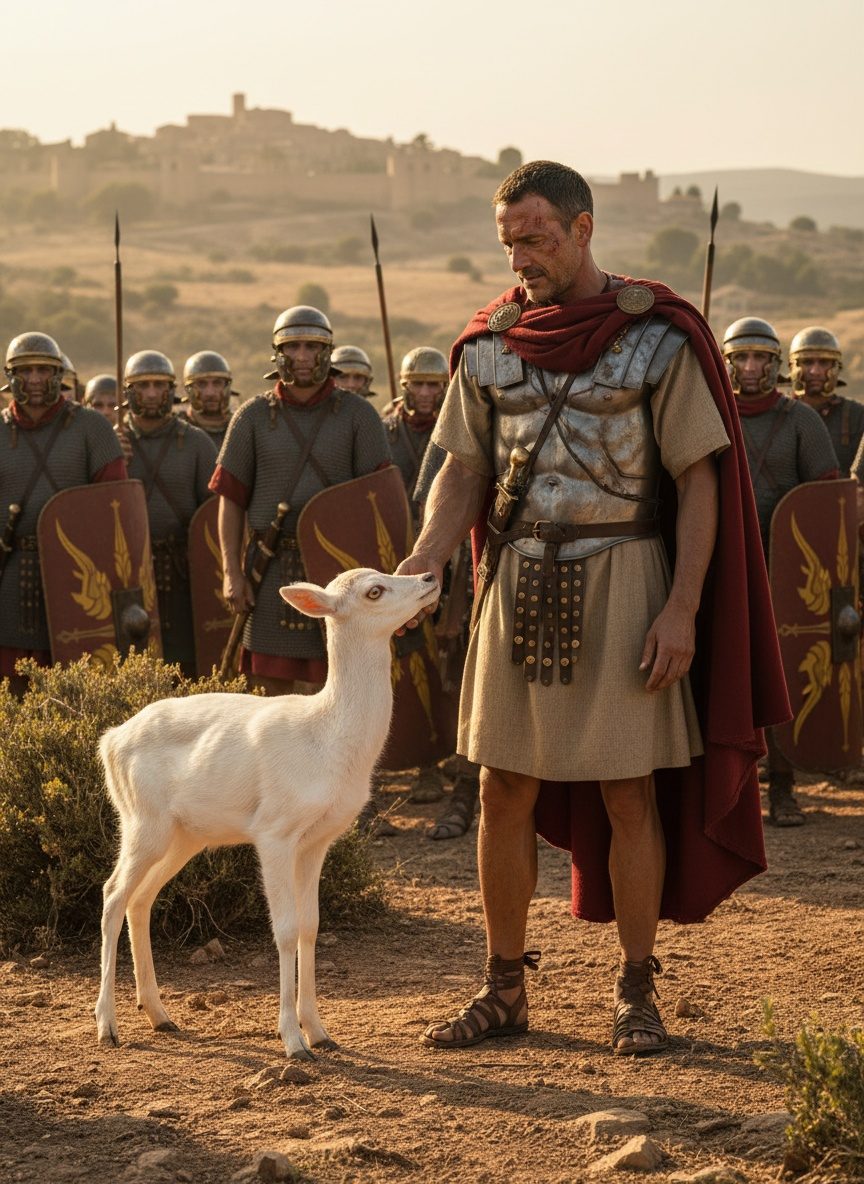
To understand Sertorius, you must first appreciate the enormity of his challenge. Stripped of a Senate, resources, and allies, he was a general in exile, yet unyielding in his pursuit for justice and a place in the annals of history. With Roman legions hot on his heels, he needed more than just military acumen—he needed enchantment. Enter the white fawn, a creature of delicate complexion and ethereal presence. Sertorius seized upon its mystique, weaving a tale that it was the voice of the goddess Diana, speaking divine truths only to him.
Picture the scene: His soldiers, battered and beleaguered, gathered in a makeshift camp. The fawn, a symbol of purity and divinity, pranced among them, a spectral apparition in the flickering torchlight. When Sertorius declared that the fawn brought him messages from Diana, it wasn't just a claim; it was a lifeline thrown to men adrift in an ocean of uncertainty. They weren’t just fighting for a renegade general—they were fulfilling a prophecy whispered by the gods themselves. In a world teeming with omens and portents, such a belief held power beyond the tip of any sword.
The tale of how his soldiers called it a god isn’t just about the credulity of the men; it’s about the potent force of faith. Against all odds, they managed to defeat armies much larger and better equipped than their own. It was as if the fawn, with all its grace, conferred upon them an unyielding spirit—or at least that’s what they believed. And belief, as any historian would agree, can be more formidable than any army arrayed on a battlefield.
Why did the Roman Senate, in all its grandeur and resources, continually fail to subdue Sertorius? It wasn’t just about the skillful guerrilla tactics he employed, nor the strategic highlands he adeptly navigated. His brilliance lay in uniting a motley crew of local tribes under a single banner of divine providence. Sertorius was a master of morale, weaving his narrative with the deftness of a seasoned orator, painting a picture of destiny that held his followers spellbound. Each victory, no matter how small, was embroidered into the larger tapestry of destiny, reaffirming to his men and the local population that they were marching with the blessing of the divine.
It wasn’t merely about tricking or deceiving; it was about inspiring. His narrative gave his men hope—something to cling to in the harsh realities of war. Rome’s attempts to send five armies against Sertorius failed not because they lacked strength but because they lacked spirit. The white fawn trotting alongside Sertorius was more than a symbol; it was a bearer of relentless hope. In its presence, the fires of Rome's omnipotence flickered ever so slightly, casting long shadows on certainties assumed if not by gods, then by men who dressed like them.
As he sat by campfires, regaling his companions with stories of ancient legends, his narratives also served as tactical devices. His men believed, and in that belief, they became invincible. His clever blend of divine storytelling with tactical genius created an embracing culture of shared purpose. Sertorius wove his myth so completely that it became an inseparable part of his strategy, like Hannibal's elephants and Caesar's wreathed head.
History often overlooks the cunning placed behind what is visible. People remember the battles, the commanding generals, the gleam of swords catching light under a Mediterranean sun. But the whispered words that travel before they become marches of unified ranks often remain in history's dimly lit corners. Yet, in Hispania, those whispers crescendoed into a symphony that reverberated through the halls of Roman power.
As with all stories entwined with the legacies of gods, mortals, and creatures that glide seamlessly between realms, the tale of Serginius and his white fawn reminds us of the lingering tension between logic and legend. It is not merely a story of a man at war or a general seeking glory. It is a narrative about the essence of belief, the heart's enduring thirst for that which lies beyond the tangible. The white fawn did not just leap between the trees of Hispania; it bounded too through the human psyche, transforming the improbable into history.
In this tantalizing interplay of myth and reality, one sees perhaps the most profound legacy of Sertorius and his ethereal companion. It was a bold assertion that even against the monolithic might of Rome, inspiration remains ungovernable. That when a thread of belief courses through the veins of the uncertain, it stiffens spines and gnashes teeth, turning the ordinary into the extraordinary. For in the hands of a born storyteller, even a simple white fawn can trample the might of empires, leaving behind not just hoofprints in the loam, but a story no less immortal than the marble statues lining Rome’s proud avenues.