Phocion was a man of influence. Yet, when offered greatness, he turned his back on it.
The Shadow of a Fallen Titan
The year was 318 BC. Athenian democracy had already been ruptured by the reign of Macedonian power following the death of Alexander the Great. Greece, once a proud collection of city-states, now wobbled under the weight of Macedonian oversight. In the city of Athens, one man stood between the Athenians and their Macedonian overlords — Phocion, the general. Known as "The Good," Phocion had the heart of a stoic philosopher and the mind of a strategic savant. He was a respected leader in Athens, a beacon of integrity blindingly bright in a world filled with self-interest and corruption. Yet his very honesty also rendered him one of the most reviled men in the city.
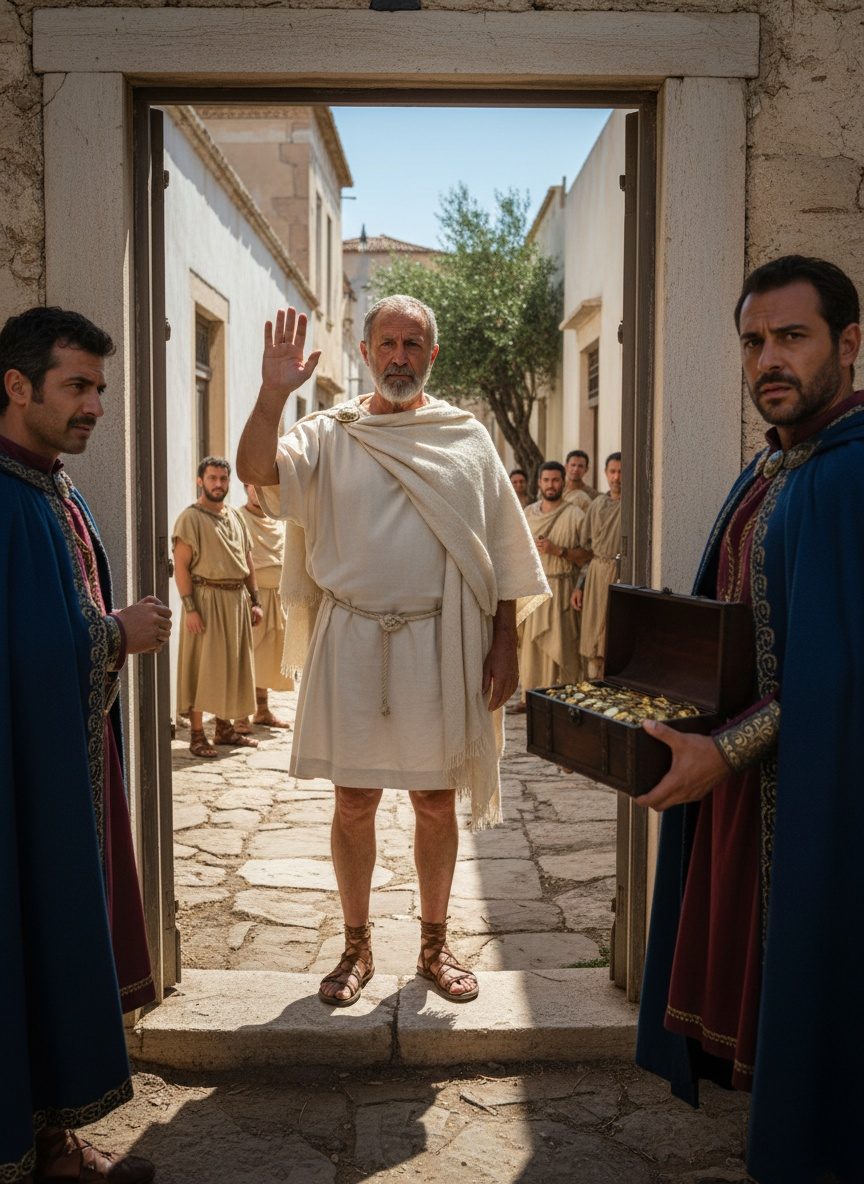
Amidst this backdrop of political turbulence, Antipater, the regent of Macedon, offered Phocion what many would consider the ultimate temptation—a fortune in gold. This gesture was not just an offering but a test of loyalties. Although Athens lay under Macedonian dominance, it still harbored resentments, rebel hearts whose beats craved liberty. Antipater's gift carried the weight of expectation, yet Phocion remained unperturbed by wealth, unmoved by the allure of comfort it could procure.
That fortune was enough to change destinies, but for Phocion, it was nothing but a distraction from the real troubles at hand — the struggles of the impoverished Athenian people. His refusal was not a slight against Antipater but a clarion call to the Athenian assembly. He turned his gaze towards his fellow citizens, whose hunger and hardship demanded attention far more urgently than political gamesmanship. His answer was simple, yet resounding: let those who need it more have this gift.
To some, Phocion’s rejection of shiny gifts looked like madness; to others, it was the epitome of a true patriot. This act of defiance, wrapped in a simple refusal, rippled through Athens like a stone cast into a still pond.
A City Held Its Breath
Athens' response to Phocion's decision was a tapestry woven with disdain and admiration. For those who thrived under the servitude of the Macedonian rule, Phocion’s act was an echo of treason. He was accused of insulting the benign regent and exposing Athens to danger by provoking Macedonian anger. In their eyes, Phocion had not merely refused gold; he had gambled with the fate of their city. Did he not understand that in refusing, he also risked the wrath of Macedon?
Yet in parallel, many saw Phocion’s gesture as a beacon of hope — a call to return to the principles that built Athens. Could they not once again rise from this Spartan-like austerity, not through external wealth but by holding steadfastly to inner virtue? Phocion's stance unearthed a reflection of Athens' own ideals, buried under layers of compromise and subservience.
The orators and thinkers, the very scholars for whom Athens was famed, engaged themselves in heated debates. The Agora buzzed with discussions on freedom, integrity, and power. Was Phocion a fool or a visionary who bravely risked it all for principles that had long been buried under the dust of conquest? The impoverished, whose needs had spurred Phocion’s decision, saw him as their champion—the embodiment of an Athens they could believe in, one that still cared for its people over its coffers.
Phocion, aware of the storm he had stirred, remained steadfast, never faltering from the simplicity of his conviction. He did not need to elaborate; every word beyond his initial refusal seemed extraneous. His choice was a silent challenge, hanging unanswered in the air, for were not those who looked down from high places the same ones blind to suffering below?
The Quiet Rebellion’s Loud Echo
Phocion’s story, a parable of character, resonates through time, not because of a grand battle that claimed countless lives, but because of a quiet rebellion that shook foundations. His rejection of wealth poses the question: What is true wealth? The lesson was not only for the stewards of power but for those struggling against its tide. Where others sought glory in conquest, Phocion found strength in resistance. He let his principles draw the boundaries of what he was willing to compromise—including his own safety.
As history unfolded, Phocion’s stance may have seemed folly to the reigning Macedonians and fellow Athenians who sought comfort in conformity. Yet, his steadfastness stands argued, perhaps in whispers, among the stone hallways where Western thought was birthed. What unfolded in 318 BC transcends the external conflict and speaks volumes about the eternal inner battle between wealth and virtue, convenience and principle.
The legacy of Phocion’s choice echoes beyond the marble pillars of Athens, serving as a reminder that integrity often demands a hefty price. And in those contemplative moments, as the world spins seemingly anew, we find grounding in the choices of those who walked before us, those like Phocion who illuminate the path with their quiet, relentless defiance in a world eager to compromise.