He was the ruler of a vast empire. He would never conquer again.
The Emperor Who Envied War
Born into the Maurya dynasty, Ashoka held dominion over one of the largest empires in ancient history, a realm that stretched across what we now know as most of the Indian subcontinent. A seasoned ruler versed in statecraft and conquest, Ashoka was a man raised on tales of glory earned on the battlefield. Before Kalinga, victory was measured by the extent of land acquired and the subjugation of people. Yet, for the emperor whose name would become synonymous with peace, violence was once his companion, his means to an end.
By the time Ashoka ascended to the throne, he was already a veteran of political intrigue and military campaigns. Possessing an indomitable will, he was determined to stamp out any threats that challenged his empire from within or without. His eyes were firmly fixed on expansion, and Kalinga stood as the tantalizing prize. The coastal region was rich, strategically advantageous, and fiercely independent. By waging war against Kalinga, Ashoka sought to bolster his empire’s wealth and consolidate his unmatched authority over the Indian subcontinent.
Kalinga's Day of Reckoning
The year 261 BCE marked the culmination of Ashoka’s grand campaign against Kalinga. The battle that unfolded was as ferocious as anticipated, resulting in an immeasurable human cost that would haunt history. Eschewing the romanticized ideals of war, the siege of Kalinga was brutal. A hundred thousand souls were claimed by the chaos, warriors and non-combatants alike. Where towns once thrived, silence reigned. What had been a vibrant civilization now lay in ruin, reduced to ash and scattered memories.
As the dust settled, Kalinga had been subdued, but the ground itself remained saturated with despair. This was more than a military victory—it was a humanitarian catastrophe of unprecedented scale. Ashoka, upon surveying the desolate aftermath, reached a fateful turning point. Walking amidst the carnage, he saw not just soldiers fallen in duty but innocents caught in the tide of destruction, entire families obliterated by the relentless advance of imperial ambition.
Confrontation With Conscience
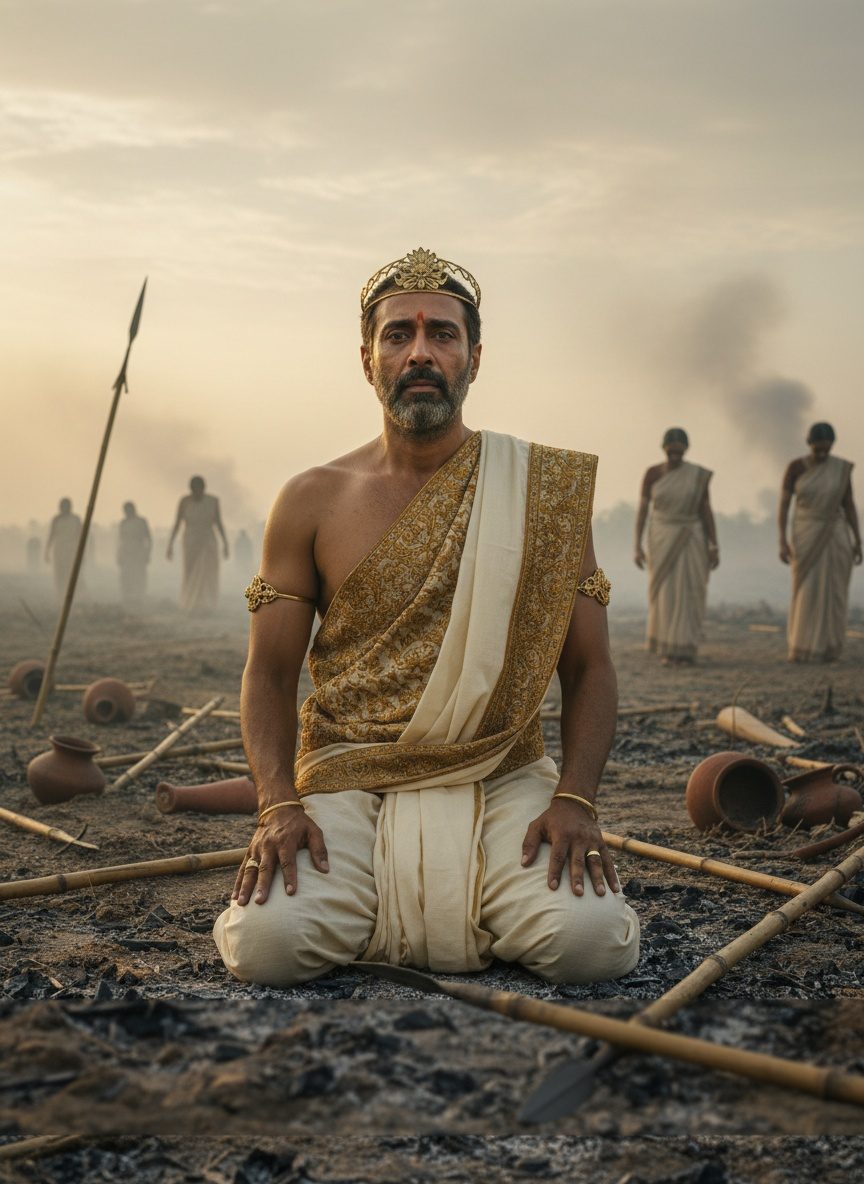
There, on the battlefield, an emperor stood solitary among the dead and the grieving. He watched as the living staggered through the morbid aftermath, women wailing, children searching for kin in a place where no comfort could be found. In that haunting silence, a profound transformation took root. Ashoka, once consumed by imperial expansion, was moved by an awakening of conscience.
The war was won, his goals achieved in theory, yet the victory lay hollow when faced with the human cost. Ashoka knelt in the ashes of what was and reflected on the permanence of his pain. The sight of the funeral pyres and the palpable sorrow etched on survivors' faces were indelible, leaving an imprint on an emperor who had tasted the fruits of power and found them to be acrid. This was the moment history would remember—or perhaps forget, as the victors often do not document their true losses.
From Conqueror to Compassionate Ruler
Haunted by Kalinga, Ashoka resolved to alter the path of his reign. The man who had amassed lands through warfare began to weave a new narrative, one of peace, religion, and moral law. Embracing Buddhist principles, Ashoka renounced violence, adopting a governance approach rooted in Dhamma—the moral code inspired by Buddhist teachings.
He would no longer be the emperor who expanded his realm through violence. Instead, Ashoka became a proponent of nonviolence, seeking to promulgate harmony both within and beyond his borders. He decreed the construction of stupas and pillars etched with edicts that promoted ethical governance, compassion, and tolerance. These relics of stone became testament to a ruler whose transformation would endure as his true legacy.
Ashoka's efforts to apply moral and ethical guidance to governance not only redefined his empire but also echoed through time, leaving a lasting imprint on the Indian subcontinent and the very fabric of history. He never ordered another war, his legacy indelibly tied to the notion that great power should be tempered with even greater responsibility.
The Legacy of Ashoka's Awakening
In a move that defied the logical progression of history, Ashoka's decision to renounce war was not a sign of weakness but a bold declaration of strength. By rejecting the path most traveled by conquerors of old, Ashoka set an example that has resonated through millennia as a testament to the power of human transformation. His name today is not synonymous with slaughter but with introspection, compassion, and humanity's potential for redemption.
As we look back across the vast tapestry of human experience, Ashoka's story stands apart. It is a poignant reminder that the mightiest rulers can not only see the devastating impact of their actions but also choose a path of renewal and peace. Though the remnants of Kalinga within its fiery ruin were once his empire's crown, it serves as the defining chapter of the emperor's conscience, an ode to reform over conquest, to life over dominion. In its silent testament, Ashoka’s story calls to us from history’s shadows, imploring leaders and individuals alike to consider the full cost of our ambitions.