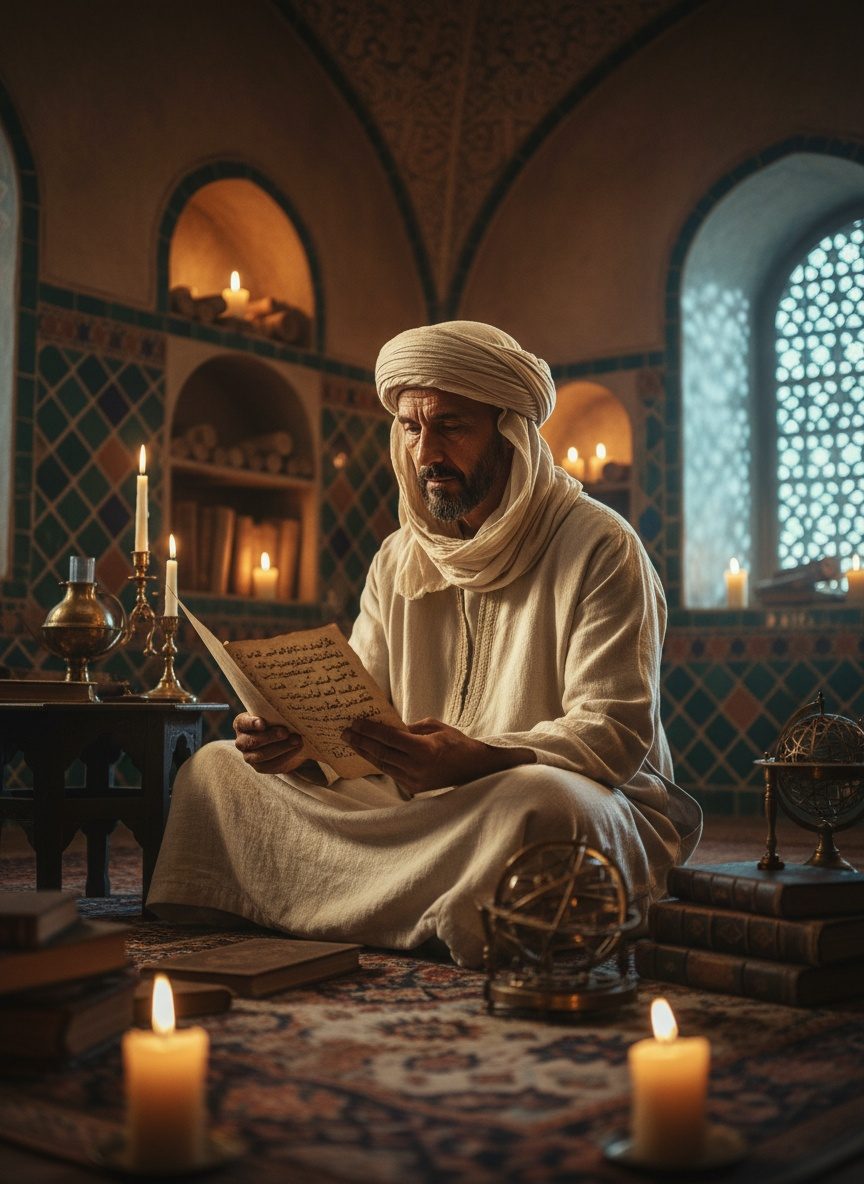
His eyes were nearly blind, and his hands trembled with age. But his mind was a fortress of knowledge, its corridors filled with words that would save the wisdom of empires.
The Beacon of Baghdad
In the ninth and tenth centuries, Baghdad was not merely the heart of the Islamic world; it was the brain of an intellectual revolution. The city hosted the House of Wisdom, a magnificent library and academy where scholars from diverse backgrounds converged, seeking knowledge that transcended cultural and linguistic boundaries. Mathematics, astronomy, medicine, and philosophy — Harper Collins would call it the "greatest repository of knowledge on Earth" — found a home here beneath the merciful shade of palms that swayed just outside its grand entrance.
Imagine the scene: rows upon rows of leather-bound manuscripts, containing works from across the known world. Some texts came from far-flung lands, translated into Arabic by dedicated teams of linguists. The pages whispered secrets from Euclid, Ptolemy, and ancient Indian scholars, secrets that were eagerly absorbed by the keen minds that roamed these halls.
The House of Wisdom’s scholars were not mere librarians. They were scientists and philosophers who pushed the boundaries of human understanding, compiled, debated, and built upon the knowledge they inherited. Their dedication turned Baghdad into a blazing torch of enlightenment, shining its light far beyond the empire's frontiers.
A World Teetering on the Edge
Yet, while Baghdad flourished, the winds of change swept across the earth, threatening the House of Wisdom’s very existence. Wars punctuated this era, with political and religious tensions bubbling just beneath the surface of daily life. Caliphates were tested by conflict and intrigue, each more precarious than the last. The storied library, which had grown so vast and so irreplaceable, became a tempting target for those seeking to extinguish the flame of knowledge.
In the face of potential ruin, one scholar stood resolute amidst this uncertainty. Although his name is lost to the sands of time, his legacy exists within the echoes of history. He understood the fragility of physical texts and knew that valuable knowledge could vanish in the blink of an eye, be it consumed in flames, stolen by rivals, or sunk to the bottom of a turbulent sea.
The scholar embarked on an extraordinary quest, a transformative journey that involved memorizing not just words but entire libraries. This scholar drank deeply from the well of wisdom, committing these treasures to memory, ensuring that they would live on even if the House itself were reduced to ashes.
The Living Library
Consider the immense concentration, the unfathomable discipline required to achieve such a feat. He transformed his mind into a living library, each mental room holding a different subject, each shelf in his consciousness meticulously organized. It was a task that demanded a mental agility that most of us could only dream of attaining.
His mind became a sanctuary for lost works, the last refuge for secrets waiting to resurface in a future free of chaos and destruction. This was an age when oral traditions often preserved culture and knowledge, and under this scholar's watchful stewardship, a bridge was built across ages threatened by oblivion.
As fire and war loomed, those who knew of his gift marveled at the power of one human brain to absorb and retain what the world otherwise might have forgotten. The scholar's efforts weren’t just an intellectual exercise; they were a sublime devotion to safeguarding humanity’s collective accomplishments.
A Legacy Beyond the Flames
His memory endured where quill and parchment might have failed. Just as knowledge once flowed from East to West, seeds of wisdom continued their journey through the testament of remarkable men and women who followed this scholar’s example. In this way, those works he memorized lived on, inspiring future generations wherever the oral traditions managed to survive.
The vision of one scholar ensured that Baghdad's intellectual legacy was not lost entirely to the ages. His tale reminds us of the importance of preserving knowledge in all its forms, and of the resilience required to advance human understanding even against the darkest odds.
Today, as we treasure our digital archives and paper libraries, consider the fragility of our modern endeavors. The story of this forgotten hero conjures images of both ancient wisdom and the continuous ebb and flow of human progress. When faced with adversity, he reminds us that the preservation of knowledge, one of our greatest assets, often rests in the simplest of places: in the minds and hearts of those determined enough to remember.