World War II ended in 1945. But for one man, the war kept fighting right into the 1970s.
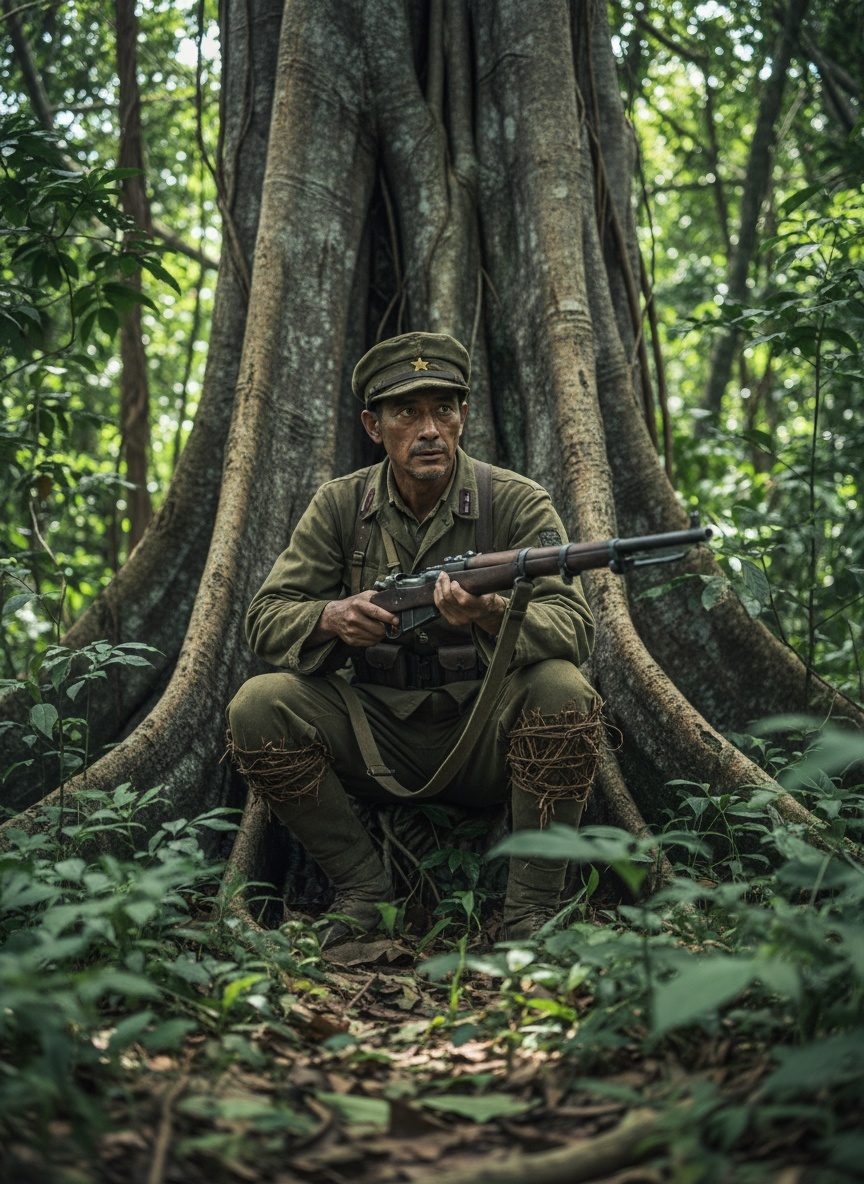
Hiroo Onoda was a name unknown to many, but his story became something of a legend—a testament to unswerving dedication and the extraordinary power of belief shaped by war. This Japanese soldier, once a vibrant young intelligence officer, would emerge from the depths of the Philippine jungle almost three decades after the conflict had ceased, convinced that his country was still at war. The lush, forbidding wilderness of Lubang Island had become Onoda's world, a place where the dense foliage whispered orders and shattered dreams of a victory that was never to be.
Born in the early 1920s, Onoda was inducted into the Imperial Japanese Army as a young man, at a time when Japan’s military forces were entrenched in a bitter global conflict that reshaped the 20th century. As an officer, his mandate was both clear and consuming: Wage guerrilla warfare at all costs, disrupt enemy activities, and never surrender. As he found himself on Lubang, these orders became Onoda's very foundation of survival, dictating his actions and forging his identity deep in the Philippine undergrowth.
When the war's flames were doused in 1945, Onoda did not believe it. Leaflets, dropped by airplane into the jungle where he hid, were read with suspicion, dismissed as cunning enemy propaganda. For Onoda, surrender was synonymous with failure, disgrace—a burden too heavy for an officer who had pledged unwavering allegiance. Thus began years of living on the edge, adapting to the rhythms of jungle life while maintaining a robust watchfulness, scavenging for food, and narrowly eluding capture by local inhabitants who themselves were trying to rebuild in the shadows of conflict.
Life on the island was unyielding. The jungle, a cacophony of life, was both ally and adversary. It provided sustenance, an intricate web of resources from which Onoda derived his most basic needs, yet it was also a labyrinth of uncrossed pathways and dangers. The Japanese soldier’s resolve was tested by the isolating atmosphere—monsoons rolling in with relentless rains, the earthy scent rising from the soil, the chorus of wildlife that became both familiar and foreign. Time became an abstract notion; days repeated themselves, stretching into months and years as Onoda honed his survival skills, focused and undeterred.
Friends and comrades had tried to convince him of the war’s end, more than once. From across skies came voices of loved ones carried by loudspeakers, urging his surrender, attempting to penetrate the thick canopy of doubt enveloping him. Yet each of these attempts met with stalwart denial. It was not the voice of family he needed to hear, but rather the command of a superior. His belief in the infallible obligation to his orders kept him isolated, a singular figure still marching to the drum of a long-quiet conflict.
The world outside was changing rapidly, unwinding itself from the tight brace of global warfare. Countries rebuilt, societies transformed, and new generations emerged unfamiliar with the ravages of war their forebears had endured. In Japan, reconstruction was in full swing, its cities and people vibrating with the hum of modernity and hope. Yet on Lubang, the footprint of a man stuck in time lay nestled amidst the untamed growth.
Finally, in 1974, a young Japanese man named Norio Suzuki ventured into the jungle, driven by an earnest fascination that led him to seek the "wild panda, the abominable snowman, and Lieutenant Onoda, the one nobody believed still existed." Guided by this peculiar curiosity, Suzuki found what others had not—an opportunity to connect and communicate with the resolute soldier who had eluded death yet lived alone, on the run. Their ensuing conversation was a pivotal moment not so much in its outcome but its humanistic connection—Suzuki treated Onoda not as a relic or curiosity but as a man whose life had been dictated by principle and code.
The realization of truth often arrives with the sound of trusted voices. Onoda’s former commanding officer, by then a retired civilian, was summoned and flown to convey the official orders he had never received. The words that he alone could deliver would finally signal the closure of a prolonged, solitary campaign. With a ceremonial release of duty, Onoda's firearm surrendered, the leaf of a faded, individual battle was turned. His return to a civilian life awaited where new realities would confront the steadfast principles he had adhered to for so many years.
Hiroo Onoda's story is not solely of an unyielding soldier caught between duty and peace but rather an exploration of loyalty's extremities and the powerful narratives one lives by. Emerging from the jungle, he carried with him not just tales of survival but reflections on the landscape of obedience, faith, and the shifting sands of time and belief. In a way, Onoda's long wait serves as a stark reminder of how profound identities are intertwined with duty and history. As we delve into war stories and victories, side journeys and quiet vigilance such as Onoda’s challenge and fascinate us. They ask us to consider the cost of conflict on the human spirit and the unseen battles that linger long after battles cease. With the strokes of time’s relentless pen, the ink of Hiroo Onoda’s legacy challenges us to question what we hold as true, and at what lengths we would go to defend it.