Su Wu was just another envoy from Han China. But he became a legend of unyielding resilience in the face of extreme adversity.
The Han Dynasty's Unsung Hero
During the Han Dynasty, a time of cunning diplomacy and ruthless expansion, Su Wu was dispatched as an envoy to the Xiongnu, a powerful confederation of nomadic tribes from the steppes. Tasked with fostering peace, Su Wu encountered treachery; the Xiongnu demanded his submission to their king. They urged him to bow, to recognize their dominance. Su Wu, however, was no ordinary diplomat; he stood his ground, refusing to yield his allegiance to the Han emperor or discard his imperial dignity for the sake of his own safety.
Su Wu’s refusal sparked outrage. It was more than just a defiance; it was a direct challenge to the Xiongnu’s authority. For them, it was a question of power and supremacy, while for Su Wu, it was a matter of honor and duty. His steadfastness in a foreign land, amidst hostile forces, was no small act. It carved his name in history as an emblem of loyalty and integrity.
Exiled to the Edge of the World
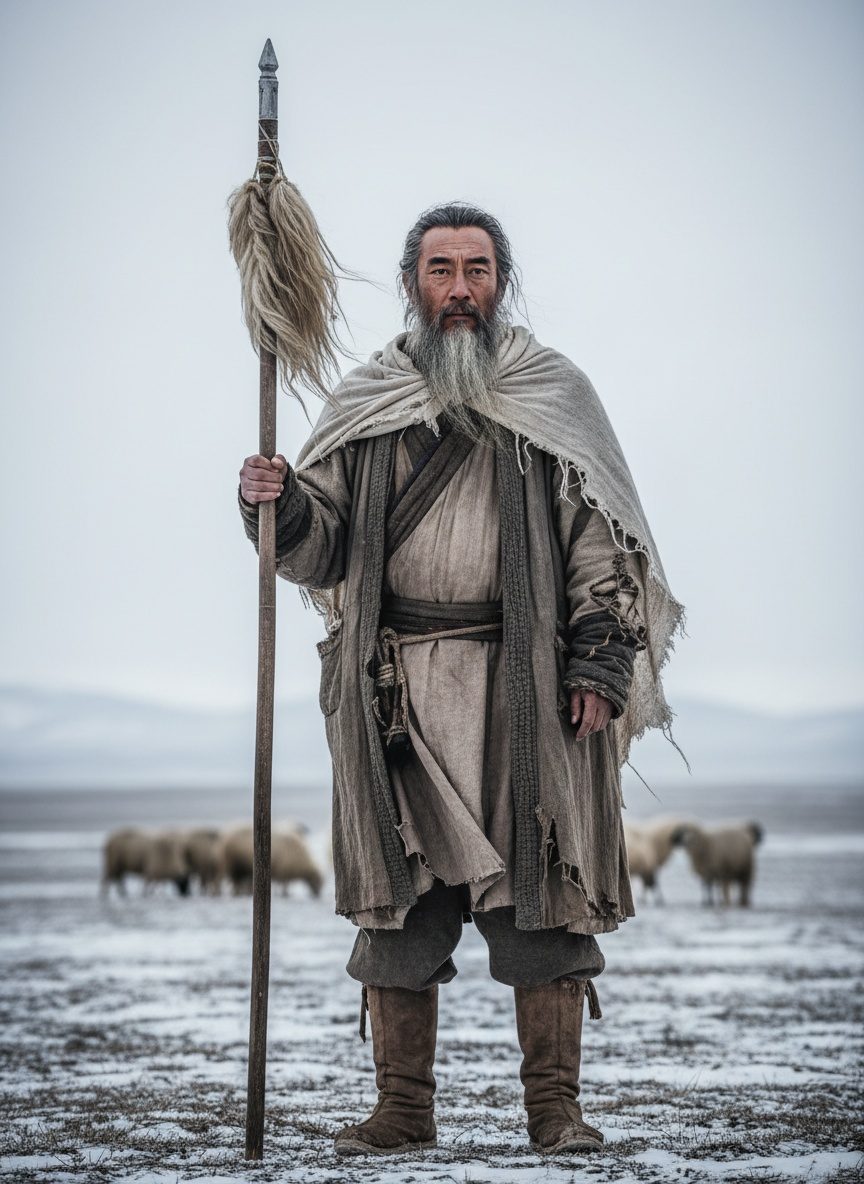
To break Su Wu’s spirit, the Xiongnu exiled him to the icy fringes of Siberia. Sent to the cold, desolate steppe, he was given the solitary task of herding sheep – a far cry from his noble position in the Han court. The isolation was meant to be his undoing, a mental and physical trial intended to coerce compliance. But time and solitude did not break Su Wu.
In the sub-zero temperatures, where survival was uncertain and companionship nonexistent, Su Wu clung to his identity. His surroundings were vast and empty, broken only by the howling winds and endless expanse of snow. Yet, throughout these desolate years, he gripped tightly onto a symbol of hope and loyalty: the imperial staff of his emperor.
Each day was a battle against the elements, against hunger, and perhaps most daunting of all, against despair. But as the seasons came and went, Su Wu’s spirit remained unwavering. His resolve was as constant and enduring as the Arctic winds that howled through the steppe.
The Unseen Struggle
Su Wu’s nineteen-year ordeal was a testament to his inner strength. The Xiongnu believed time would weaken his resolve and that eventually, he would submit and seek their mercy. But even in the face of overwhelming odds and years of exile, Su Wu resisted.
The Xiongnu underestimated the power of human endurance and the depths of Su Wu’s allegiance to his emperor and homeland. Despite the relentless isolation and harsh conditions, Su Wu's will remained a force of nature, unwavering and immovable. His greatest victory was not in battle or negotiation but in maintaining his dignity, a profound personal triumph against the harshest of environments.
The Return Journey
Finally, after nineteen grueling years, the landscape of geopolitics shifted. The Han Dynasty and the Xiongnu reached a new understanding, and Su Wu was granted his return. Weathered but unyielded, Su Wu made the long journey back to the Han capital. His return was not just a physical journey but a triumphant passage that exemplified his resolute spirit.
The tale of his return reverberated throughout the Han court and beyond. Chronicled in history, his story spread, and Su Wu emerged not only as a diplomat but a beacon of resilience. He returned not as a broken envoy but as a living symbol of the enduring spirit of Han China.
The Legacy of Unsurrendered Dignity
Su Wu’s story may not be found in the annals of grand battles or monumental conquests, but it resonates with the silent power of human will. His refusal to kneel, to forsake his emperor for personal safety underlines a profound truth – that the most tenacious victories are often those waged within, away from the eyes of the world.
In an age where diplomacy could be as dangerous as war, Su Wu’s legacy goes beyond the mere recounting of an envoy’s tale. It serves as a stark reminder that history isn’t just shaped by those who wield power openly but also by those who quietly embody unwavering principles. In the frozen landscapes of Siberia, Su Wu stood alone but unbowed, a symbol of the exceptional human capacity for resilience and loyalty that endured far beyond his own era.