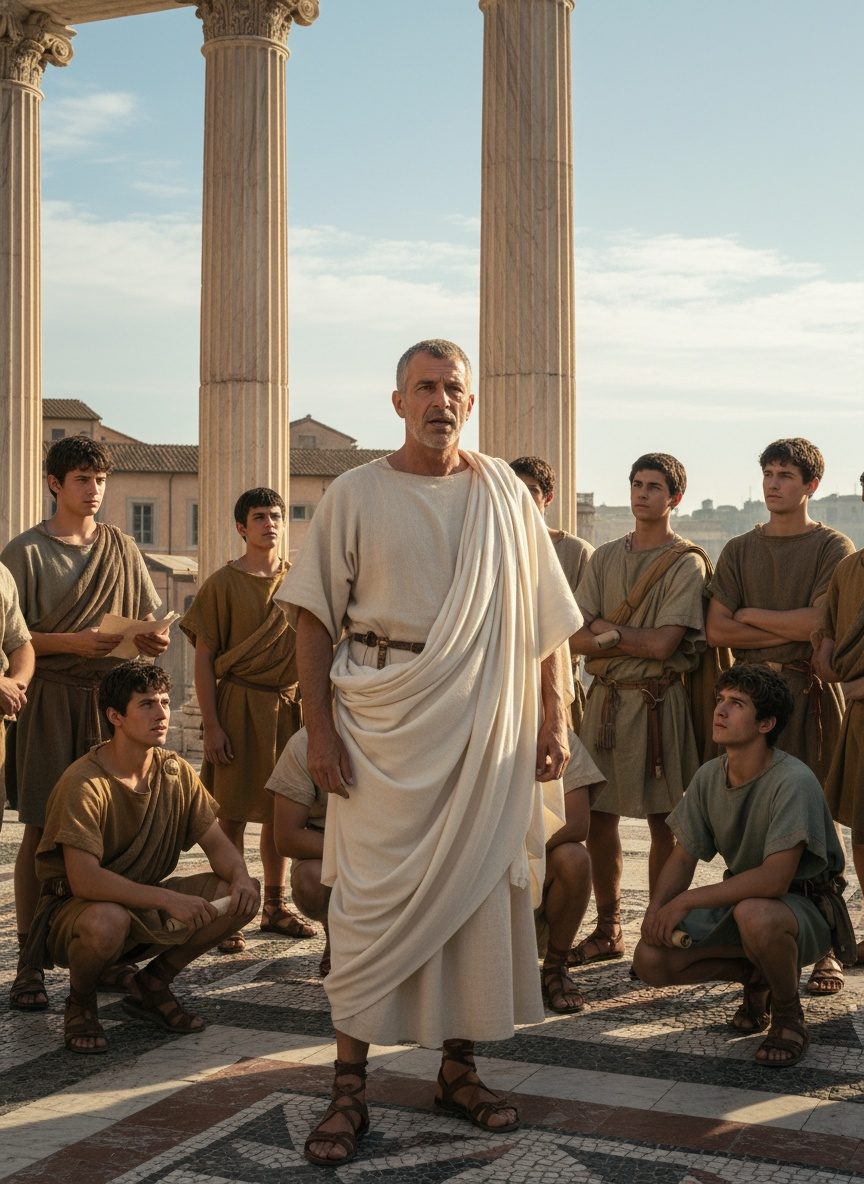
65 AD. The sun cast long shadows across the Roman Forum, the heart of a city pulsating with empire's grandeur and its lurking shadows. Bustling with traders, orators, and citizens, the marble expanse witnessed many days of chatter and commerce. Still, none perhaps as fraught as the days of Emperor Nero's infamous purges. Amongst the hum of the crowd, a lone philosopher stood — Musonius Rufus, defiantly undeterred.
While the skies promised another dazzling Roman dusk, the empire's undercurrents were anything but serene. Nero, driven by paranoia and a thirst for absolute control, targeted philosophers in a sweeping campaign to silence dissent. The philosophers, with their propensity for critical thought and public discourse, posed a threat to his rule. Many fled, seeking refuge in dusty corners of the empire. But Musonius Rufus stood firm, unyielding in his resolve to teach his followers in the open, despite the looming danger.
Musonius Rufus, a Stoic philosopher of considerable renown, earned his reputation not only through lectures but through embodiment of Stoic ideals. For him, philosophy was not an abstract pursuit — it was a way of life deeply rooted in virtue, resilience, and courage. As news of Nero's executions reverberated through the city, many urged Rufus to seek safety, to quiet his teachings until the storm passed. Yet, Rufus, with eyes set on a higher purpose, continued to address those gathered in the busy streets and sun-dappled courtyards of Rome.
To understand Rufus' defiance, one must delve into the Stoic philosophy that guided his resolve. For the Stoics, the highest good was virtue, reason ruled supreme, and emotions were to be mastered. Rufus believed in teaching by example, illustrating the importance of courage and the futility of fear when standing before tyranny. As he stood in the forum, he was surrounded by students hungry for knowledge and awed by his bravery. His public lessons became quiet acts of rebellion, emblems of intellectual freedom amidst waves of repression.
His presence and voice were a beacon in a time where words could swiftly lead to death or exile. Despite the threat of execution, Rufus did not flinch. His teachings on moral fortitude resonated even deeper as he himself was the living testament of his philosophies. His lessons transcended the confines of the texts, as his speeches seamlessly melded with the very fabric of the city's daily life. In doing so, Rufus offered a rallying point for those who valued truth and wisdom over complacency.
The character of Nero, on the other hand, stood in sharp contrast to Rufus' stoic ideals. Known for his artistic ambitions and notorious for his severe methods to maintain power, Nero increasingly became insular and paranoid. He viewed dissent, whether actual or imagined, as direct threats to his autocracy. Hence, philosophers, with their sharp tongues and questioning minds, were seen as seeds of subversion. Nero's decree to quell these dissentious figures, though partially successful, could not snuff out the lasting impacts their words had already ignited.
Rufus' decision to continue teaching reflects the broader struggles between power and philosophy. In a society where the pen, as wielded by the philosophers, could be more potent than the sword, Rufus' steadfast resolve became a powerful manifestation of defiance. His fearless public discourse served not just as education but as a symbolic reminder that thought and freedom, once kindled, are not easily extinguishable by any emperor's whim.
As Rufus carried on his open-air seminars, Rome was not merely a city of bustling trade and political intrigue, but a teeming microcosm at the crossroads of influence and innovation. The forum, alive with the scent of baked bread and laden market stalls, bore witness to his unbroken chain of discourse. His voice mingled with the clamor of street vendors and the persistent rustle of togas, a testament to human endurance amid oppressive authority.
The tale of Musonius Rufus before Nero is not just an episode from antiquity but a reminder of the resilience of dedication to truth in the face of tyranny. His unwavering spirit reflects a universal theme echoed throughout history: courage in the face of unchecked power sparks change. It reminds us that even under the iron grip of fear, the human spirit's longing for knowledge and justice can thrive. Rufus, in his unwavering quest, illustrates how words and wisdom, passed along the ancient Roman stone, informed hearts and minds for centuries to come.