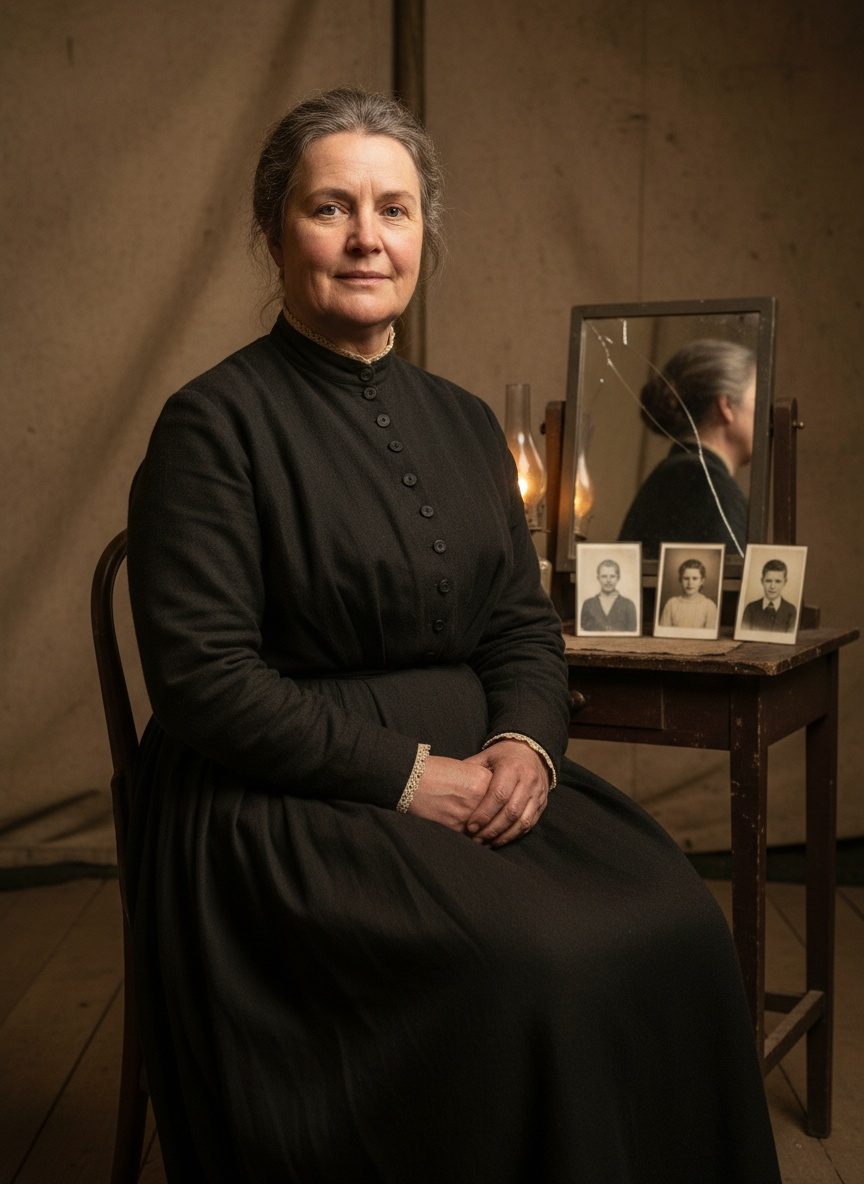
The roar of the crowd was deafening, a chaotic blend of gasps and guffaws echoing through the vibrant tent as Mary Ann Bevan stepped onto the garishly lit stage. The harsh light exaggerated every contour the illness had cast upon her face, yet her eyes, glimmering with quiet resolve, scanned the room filled with curious onlookers. Her heart beat steadily against her ribs, drowned out only by the cacophony of laughter that surrounded her.
It was 1914, and the world, on the cusp of war and technological wonder, reveled with a peculiar pleasure in the spectacle of the bizarre. Mary Ann Bevan stood there as the so-called "Ugliest Woman Alive," a title she never sought — but one she pursued out of sheer necessity. Born in suburban London, Mary Ann had carved a quiet life as a nurse, devoted to caring for others with gentle expertise and a nurturing heart. She was a mother, raising four bright-eyed children with her husband, a man whose sudden death turned her world black.
Their modest income disappeared along with him, leaving a void that grew as the days wore on, deepening with every unpaid bill and unfulfilled need. Reality, harsh and unrelenting, twisted her life into an urgent search for survival. That's when the first cruel whisper of opportunity reached her ears: a competition offering a substantial reward for Britain's "Ugliest Woman." It was a ghastly notion but held a glimmer of hope. Every penny could feed and clothe her children, and that's all Mary Ann needed to know.
A few years after the display of her "title," the medical community had given her condition a name — acromegaly, a rare disorder causing the pituitary gland to overproduce growth hormone. But Mary Ann needed no medical label to understand her reality. It was the reason her face had altered over the years, shifting from the delicate lines of her youth to something more pronounced, more alien. It trapped her inside a body that rendered her foreign in her skin, a stranger in a society that barely recognized her humanity beyond her outward appearance.
London was Mary Ann's battleground, her territory where staunch Edwardian propriety met the unruly underbelly of circus shows and freak exhibitions. When she joined the ring, it wasn't as a performer of skill or artistry but one of ridicule and grotesquerie. Circus life was far from the glamour of London's high society; it was gritty, unpredictable, alive with the scent of sawdust and sweat and the electric buzz of cheap excitement. Yet to Mary Ann, it was a stage set for her family's salvation.
Every night, she transformed. Amidst contortionists, sword swallowers, and animal tamers, Mary Ann became an icon of sacrifice. She stood where her story and science collided, where the human condition met the depths of public ignorance. Audiences reacted with instinctual fascination, wondering how such a visage could exist within their mundane reality. Few considered the tender soul within — a woman who tucked love and hope into every letter she wrote home to her children, every coin she sent to them faithfully counted from her meager earnings.
Her home life, once shielded by love and laughter, now leaned heavily on her sister's help, relatives and friends ensuring the bills got paid, the children schooled. Mary Ann's labor was lonely, the applause less a comfort than a grim reminder of her life behind the curtain. But from this loneliness, she drew strength from a vision of her children's futures — unburdened, educated, free from the limitations wrought by poverty.
This tale was not one of the extraordinary gifted or fortunate but of a woman who chose between indignity and despair, staking her claim to dignity through defiance. Each stage appearance hammered upon the public consciousness, laying bare questions about humanity, evolution, and the essence of beauty. Such tales often slide into obscurity, yet Mary Ann Bevan's refused to silence, etched into records more as curiosity than consequence.
As the war ebbed away into history and the interwar period began with its own insidious challenges, the world's preoccupation with novelty and the macabre became a chilling reflection of broader societal structures. Peering into Mary Ann's legacy is like observing a crucible in which resilience was forged. Her story is relative to every contest waged under unfair conditions, every mother who bears the cost for their family's survival.
Mary Ann Bevan's life could have become a cautionary tale, an admonition against the superficial whims of societal transition periods like Edwardian and Interwar Britain. Instead, it's an invocation to acknowledge the humanity beyond first impressions, the grace found amid adversity. When strangers gathered beneath those colorful, breathless tents, it wasn't just the spectacle they witnessed but the resolve of a woman quietly defining motherhood's radical heart — unyielding, unbroken, infinitely brave.