He was a king who preferred brevity. When asked to lay down his arms, Leonidas, king of Sparta, famously replied: "Come and take them." This response was more than mere bravado; it was an unwavering declaration of defiance at a time when the future of Greece trembled on the edge of annihilation.
In 480 BC, the stifling heat of a Grecian summer bore witness to an epic confrontation between east and west. The Persian army, a vast tide of men, armor, and determination, swept down into Greece under the command of King Xerxes, who sought to crush the Greek city-states standing defiantly in his path. Yet among the phalanx of the immortals and the cavalry at their heels, a seemingly insurmountable defensive barricade rose to greet them at Thermopylae—a narrow pass cradled by the mountains on one side and the waves of the Aegean Sea on the other.
Leonidas was not young; he was a seasoned warrior and strategist. As the leader of the Spartan contingent at Thermopylae, age and wisdom had taught him the brutal calculus of war. Leonidas led a force not just of his Spartans but joined by a ragtag coalition of allied Greek city-states, known to history as the Hellenic League. Theirs was a collective made of differing dialects, customs, and often conflicting interests, all bound for a moment by the desperate need to face the common threat descending upon their lands like a dark cloud.
As the days wore on, news began to sieve through the ranks. The Greeks had lost at Artemisium to the Persians, whose naval superiority seemed as unyielding as their relentless march. With no naval force proficient enough to block the Persian fleet from encircling Thermopylae, the strategic advantage of the pass rapidly diminished. Realizing the inevitable, Leonidas called for council with his allies. His proposal was starkly pragmatic yet gravely poignant—he would remain with his Spartans to hold the pass, to buy precious time for the rest of Greece. But he urged his allies to return to muster forces elsewhere, to fight another day on terms more favorable than those they faced at Thermopylae.
This decision was not a capitulation but a calculated sacrifice. Those who left did so with the understanding that Leonidas and his remaining three hundred would not follow. This selfless act of war, a martyrdom foretold, echoed deeply among those who stayed, illuminating the determination of the Greeks to resist Persian domination. What card of honor or hope did Leonidas play to inspire such heroism?
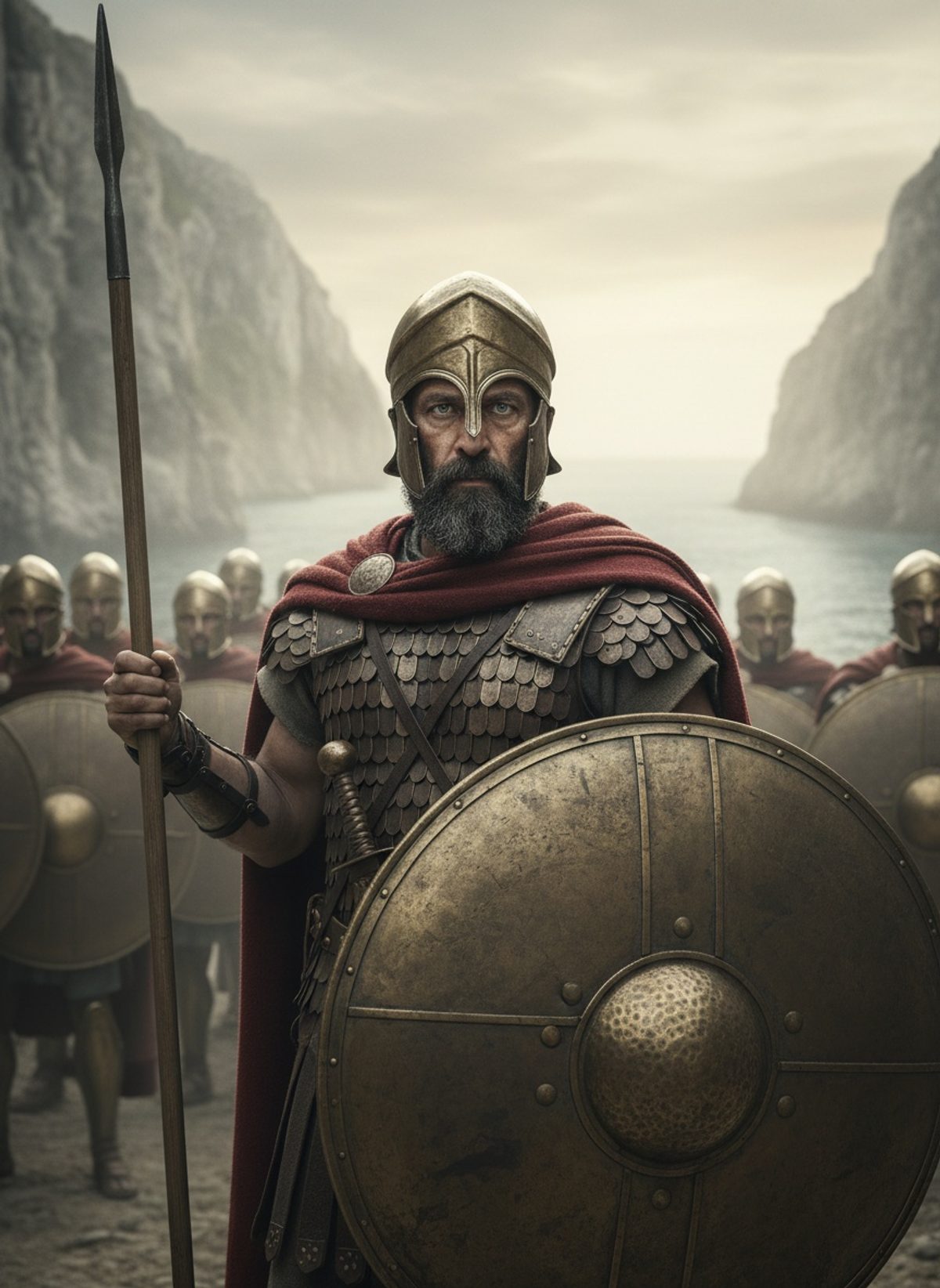
While most Greeks withdrew, Leonidas remained with his Spartans and several hundred Thespians who chose to stay alongside them. Together, they formed an unyielding wall of shields, spears, and resolve against the Persian onslaught. The fighting was brutal and bloody; each Persian surge broke against the Greek line, which met waves of arrows and advancing infantry with a wall of bronze and oak. The disciplined ranks of Spartans moved as a single organism, their scarlet cloaks and shining helmets blending into a single line of iron and will.
Few tales speak so eloquently of the power of human defiance. Critics might dismiss this as foolhardy valor, as an expenditure of lives against the unfathomable odds. However, Leonidas understood deeply that Thermopylae was more than a narrow choke point. It was a symbolic stand, reverberating loud across not just the battlefield but within the hearts of those who heard of their resistance. Such tales would sow seeds of courage throughout Greece, galvanizing a fractured populace with tales of bravery and sacrifice against a juggernaut that appeared undefeatable.
For two days, Leonidas and his band held firm, their steel fortitude denying the flood of Persian power. But betrayal slithered in the shadows. A Greek informant disclosed a hidden mountain track to Xerxes—one that would outflank the valiant defenders and spell an end to their defense. Upon hearing of this treachery, Leonidas faced the dawn with a clear acceptance of his fate. The knowledge of betrayal, yet another burden to bear on top of an unfair fight, did not break him. Instead, it solidified his resolve.
The third morning rose fiery and impatient, the Persians eager to deliver their final stroke. Leonidas positioned his men for one final stand, knowing their sacrifice was imminent. The Spartans fought valorously, their phalanx impenetrable until irresistible momentum shattered their line. As the sun dipped below the horizon for the last time upon those men, the might of Persia had been slowed, bruised, and humbled.
Leonidas' head was severed as a grim trophy for Xerxes’ fury, an attempt to quench the flames of heroism with indignation. And yet, even in defeat, the battle of Thermopylae was a clarion call to all Greece that the fight for their homeland, their culture, and their identity was ongoing. The stand of the three hundred was not in vain; it bought time for the various factions of Greece to unite against the Persian threat and eventually culminate in victories at battles like Salamis and Platea.
Why does the story of Leonidas matter, and why should it be remembered today? It is a narrative of choice amidst inevitability, one that challenges individuals to consider the cost of leadership and the weight of consequence. In facing defeat, Leonidas forged a legacy not of flawless victory but of indomitable spirit. His decision to stay resonates as a universal tale of courage not only in the face of extinction but in the unwavering pursuit of values that transcend the individual. Here, on the battlefield of Thermopylae, history etched a story into the annals of human courage, one that whispers across the chasm of time, inviting us to reflect on the choices that define us.