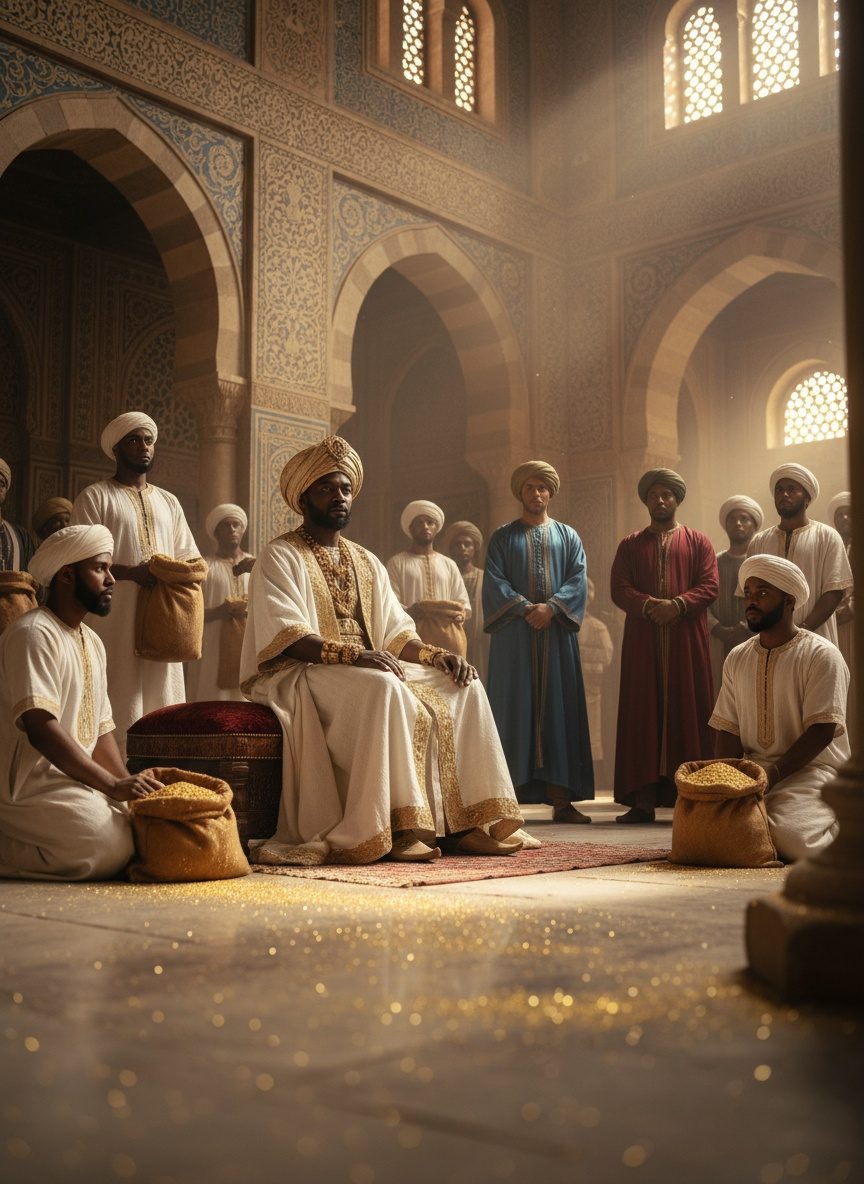
1324. The hot desert wind swept through Cairo, lifting the fine, golden dust that lingered in the air and settling on everything in its path. News had reached the city that a most extraordinary caravan was approaching, one that promised to make a lasting impression on the bustling metropolis. With sixty thousand men in tow, Mansa Musa, the emperor of Mali, led an entourage that shimmered with wealth unimaginable.
As the caravan made its way through the desert, tales of its magnificence preceded it. Mansa Musa was not merely a ruler; he was an enigma wrapped in luxury. The emperor didn’t travel with an army to conquer but with an entourage so vast that its numbers rivaled the populace of entire cities. Alongside a retinue of courtiers, soldiers, and servants, thousands of camels and horses laden with wealth trailed in his wake. Each step forward bore the weight of fortune, with gold dusting the shoulders of attendants and glinting in the sun like a beckoning promise.
The heart of this legendary assemblage, Mansa Musa himself, strode with a presence befitting an emperor of renowned sagacity and boundless generosity. His garments were tailored from the finest silks, their vibrant hues reflecting the richness of his empire. The journey was not a punitive mission but a sacred pilgrimage to Mecca—an act of devotion that resounded with profound piety. Yet, it was this very journey that would inadvertently alter the economic landscape of Egypt for over a decade.
Mansa Musa’s pilgrimage left a trail of wealth behind him. Each gesture of gifting gold was an echo of his vast resources, as he bestowed gifts upon anyone he encountered along the route, regardless of status. Pilgrims, local officials, and dignitaries were beneficiaries of his largesse, showered in gold as if he were sharing the very essence of the Mali Empire's prosperity. In Cairo, his generosity reached an apex. With each offering, the gold markets trembled under the weight of his liberality, saturating the economy to such an extent that its recovery span lasted twelve tumultuous years.
Despite the fiscal disarray left in his wake, Mansa Musa’s sojourn remained a modern marvel of wealth and influence. His journey brought Mali into the wider consciousness of the Islamic and European worlds, igniting imaginations beyond Africa’s shores. Chroniclers of Cairo, struck by the spectacle, never ceased to recount tales of his visit. Mansa Musa's wealth became the stuff of legends, intriguing scholars, and historians for generations to come.
The spectacle was not lost on those who witnessed it. Ordinary citizens and fellow travelers shared accounts that rippled through the bazaars, lending an air of mythos to this incredible cortege. The emperor’s munificence illustrated not just affluence, but also a striking mismatch with conventional economic wisdom. Egypt, for all its own resources, struggled to stabilize its economy against the tidal wave of gold Mansa Musa had introduced. The empire of Mali became synonymous with untold wealth—a beacon of extravagance in the medieval world.
Even as the Egyptian economy faltered, Mansa Musa's legendary pilgrimage became a cultural lodestar. His actions not only encapsulated the spirit of Islamic charity but also demonstrated a pan-African influence over the Islamic world. The shockwave of his generosity extended beyond traditional economic metrics, seeding inspiration and awe in equal measure. No ivory tower could capture the full breadth of Mali’s grandeur under Mansa Musa's reign.
Mansa Musa’s influence and potential rival from his contemporary, Ibn Battuta, were studies in juxtaposition. Where one shared wealth, the other sought knowledge—both inadvertently reshaping perceptions of Africa and Islam. Years hence, when Ibn Battuta embarked on his journeys, tracing routes far from the opulent display of his Malian contemporary, he would help solidify the connections and narratives first exposed by Mansa Musa’s pilgrimage, each step shaping a new tale of exploration and discovery.
Mansa Musa's showcase in Cairo was far more than a display of opulence; it was a tableau vivant of global interconnectedness in medieval times. His pilgrimage underscores the complexities of economic systems' volatility to unexpected inputs and the intricacies of human generosity dictating historical legacies. Herein lies a tale rich with monetary parables and one man's quest for spiritual fulfillment, set against the grand backdrop of a world searching for splendor.
The echoes of Mansa Musa’s journey resound through the centuries, a golden thread interwoven in the tapestry of African and world history. His story is a testament to how the seemingly isolated acts of a single individual can tilt the scales of entire economies and cultures. The gold may have tarnished over time, yet the legend of Mansa Musa’s generosity endures—a reminder that history is less measured by coins in hand than by the impact left on those who hold them next. The ripples from that long-ago pilgrimage flow to this day, encouraging us to consider how the forces of generosity, coupled with wealth, reverberate far beyond their origin, pressing into the realms of both memory and myth.