The chill wind carried the icy scent of the sea, spreading across the bustling port of Nidaros. Above, the sky was a tapestry of grays and blues interwoven with streaks of reluctant sunlight peeking through the clouds. Along the shore, longhouses huddled together like ancient sentinels, their turf roofs indistinguishable from the surrounding hills. It was a land well familiar with myths and change, where legends were woven into the very earth. Yet, the year 996 AD brought more than the Viking tales of old; it heralded a man whose defiance against tides of transformation would soon echo through the halls of history.
The Skald's Stand
In an age where sagas and skaldic poetry breathed life into the deeds of gods and kings, poets were the revered keepers of Norse lore. Among these, Hallfred Ottarsson, known as Hallfred Vandræðaskáld (the Troublesome Poet), stood not just for his skilled verses but for his unwavering loyalty to tradition. Invited to the court of King Olaf Tryggvason, Hallfred was expected, like all others, to align his poetry with the king's new Christian faith. Olaf was not an ordinary monarch; he was a fervent convert to Christianity, bent on converting his kingdom by any means necessary.
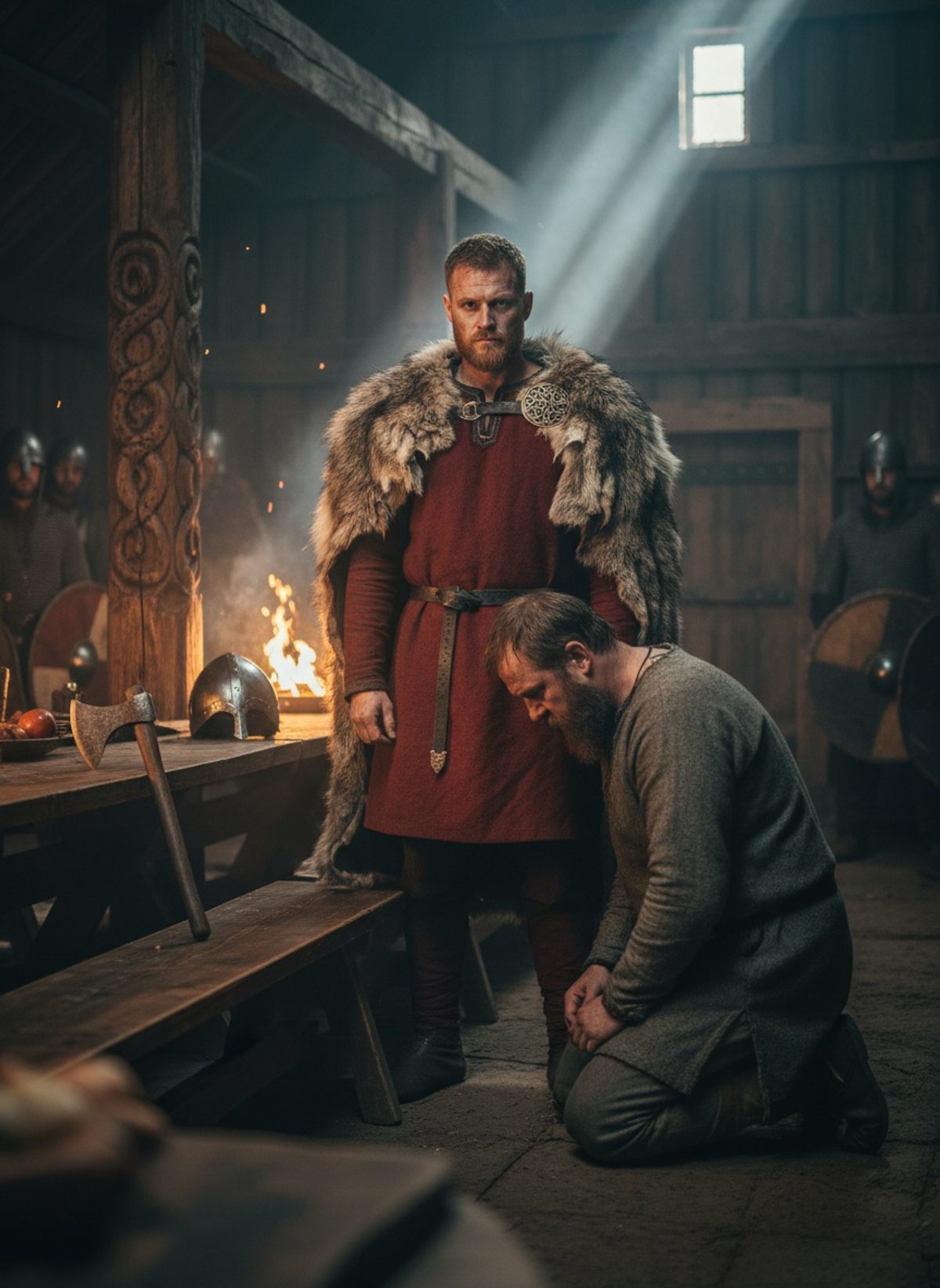
The king's great hall, constructed with sturdy oak and adorned with intricate carvings, reverberated with the sound of waiting. Furs cushioned the long benches, and the flickering of torches cast wavering shadows upon the faces of warriors and courtiers alike. Olaf, with his striking presence and piercing eyes, sat on his throne, a symbol of his relentless authority. Beside him stood his ever-faithful skalds, each having pledged their oaths to create poetry in line with the new religion.
When Hallfred's turn arrived, expectation filled the air like the tightening of a bowstring. Yet, as the hall fell silent, Hallfred's verses spoke not of Christ or new beginnings but of the valor and wisdom of Odin. His refusal to change was a bold defiance of the king’s edict and a potent reminder of the old ways struggling against the encroaching new faith.
Silence reigned, thick and suffocating. A glance from the king could summon terror, yet Hallfred met Olaf’s gaze with quiet defiance. To refuse the king in his own hall was not only rebellion but potentially a death sentence, and everyone present knew it.
The King's Hand
Olaf's command over Norway was unyielding, yet here stood a skald brave enough to refuse him openly. What unfolded next could only surprise those who did not truly know Olaf. The necessity for poets to craft Christian narratives was clear to the king, yet, with a kingdom only recently converted, Olaf's strategy was subtle and profound. His hand, initially lifted as if to pronounce judgment, lowered gently, an uncharacteristic move for a king whose methods often embraced the sword.
The king’s decision to spare Hallfred was less about clemency and more about understanding the power of influence. Olaf, himself a deft influencer, knew that to force compliance would not necessarily earn loyalty. In Hallfred, he saw not just a stubborn Norseman, but a tool. A poet of Hallfred’s skill praising both Odin and, eventually, the Christian God, held the promise of a bridge between the new faith and the old beliefs. Hallfred was spared, given his freedom alongside the expectation that his future verses would subtly accommodate the king's new reality while retaining the grandeur of his ancestors.
This act of mercy—unexpected in a world of often harsh retribution—was not an act of weakness. Instead, Olaf displayed a shrewdness that would mark his reign. He had recognized that Hallfred’s voice was valuable, a conduit through which the Norse and Christian worlds could converge. The king’s forgiveness was a strategic gambit, planting seeds of change with words as potent as swords.
Songs of Continuity and Change
As Hallfred returned to his post, harnessed by new expectations yet unburdened by resentment, he carried the weight of understanding his own significance. His skill lay not merely in his stubborn adherence to the old gods but in possessing a voice that could morph a nation’s foundational myths. The corridors of the king's hall, which once hung heavy with the echoes of both threat and salvation, would resound with Hallfred’s compositions—now dual in nature. His poems would elegantly navigate the ambivalent waters of faith, transcending mere storytelling to become instruments of a culturally rich fusion.
Over time, Hallfred became emblematic of the world he inhabited. Much like the rugged landscape around Nidaros, unwavering yet adaptable, he embodied the era’s dichotomy. His talent and the king’s temperance manifested a poetic and political dialogue that would plant seeds of the new faith amidst the pagan stones that dotted the land. Poised at his writing desk, the poet crafted verses that ensured the survival of stories, both old and new.
In a time defined by crossing currents of belief, Hallfred's experience serves as an enduring narrative of coexistence. Rather than a mere historical footnote, his saga illuminates the timelessness of personal and cultural evolution amid the tides of history. Here, in the crossroads between coercion and artistic freedom, Hallfred's refusal and subsequent redemption highlight not only the complexity of medieval Scandinavia but the universal struggle found in embracing change while cherishing one's roots.