Gunnar of Hlíðarendi breathed in the cold, sharp air of the Icelandic morning as the distant sound of hooves thundered from the horizon. He could see them—warriors armored and armed, sunlight glinting off their swords, riding hard and fast toward his land. Betrayal clung to their approach like mist in the valleys. Yet Gunnar stood alone, resolute, rooted to the ground he loved more than life itself.
The Turning Point
The story of Gunnar begins not in battle, but in a moment of profound defiance. Previously sentenced to exile for breaching the peace enshrined in the laws of Icelandic society, Gunnar set forth with his horse steered toward the sea. The sky, vast and indifferent, stretched out above him as his heart grew heavy with the burden of leaving behind all he had ever known.
As he urged his steed forward, something ineffable pressed upon his soul, forcing him to turn in his saddle for one last wistful glance at the verdant fields and hills that embraced his farm. It was in this silent, solitary communion with the landscape that words took form, a promise whispered to himself but loud enough to be heard by fate: "Fair is the slope, I will not go." This decision, brief yet immeasurable in consequence, bound him eternally to the land—a duty that would soon demand of him everything.
In Iceland's tapestry of turmoil and honor, a man defying exile was not just a breach of the law but a declaration of standing alone against the collective order. Gunnar’s return was an affront, a challenge that could not be left unheeded by those who dictated the rules of kinship and power.
At the Gates
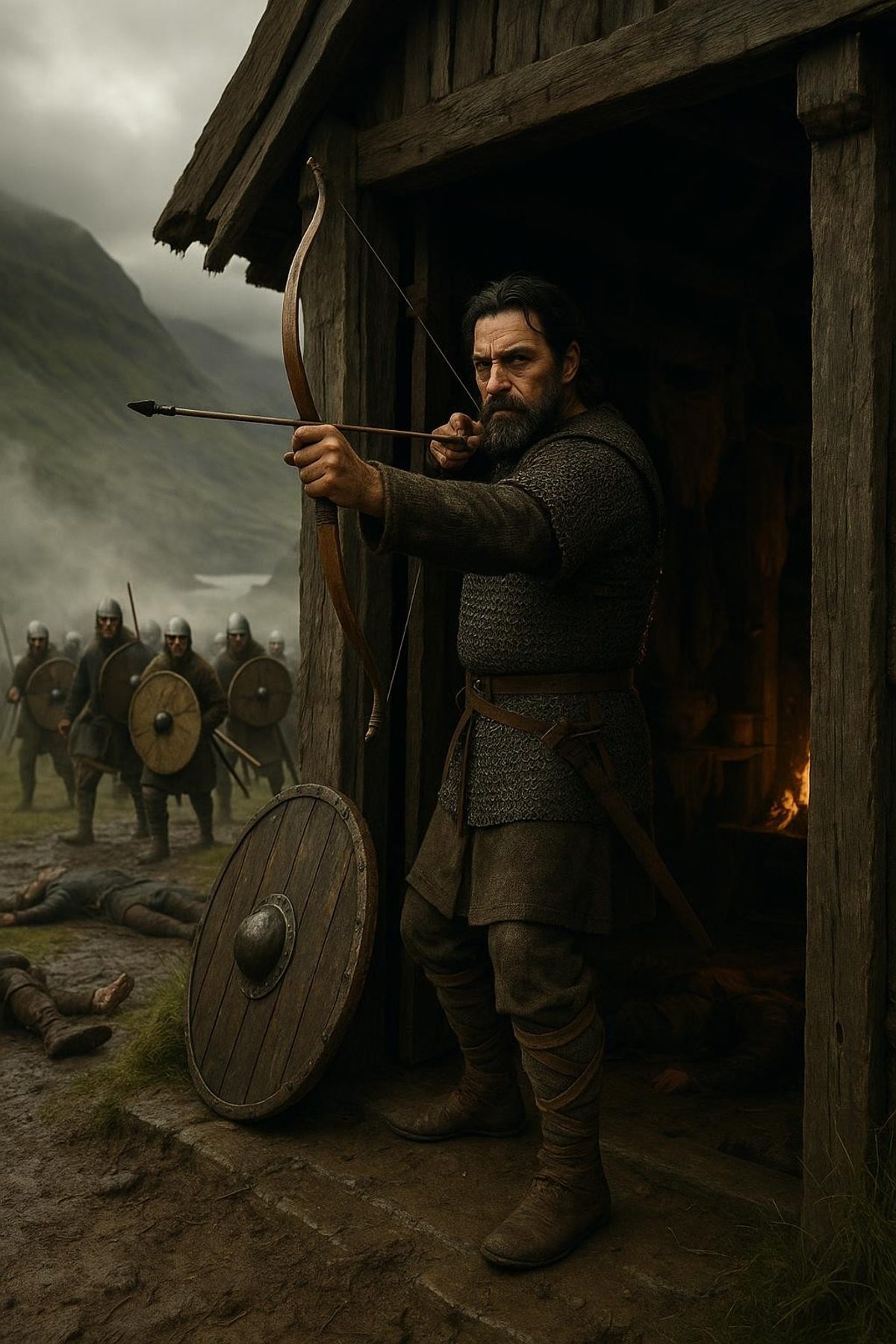
The morning they came for him, the cries of ravens echoed through the chilled air—a somber herald of the violence to come. From his vantage point, Gunnar watched as the figures of well-armed men broke through the soft shroud of mist rising from the earth. These men were no strangers; they were neighbors, kinsmen, individuals he had shared mead and stories with under thatched roofs.
But the time for shared narratives had passed. Words were now weapons, wielded by those who once claimed affection and now played for blood. Gunnar stood alone, a shadow against the coming storm, at the threshold of his home which became, in this fleeting moment, not only a sanctuary but a fortress. The crafted wood strong beneath his grip was like a lifeline to heritage and honor.
As the attackers prepared to breach his sanctuary, Gunnar’s renown as a warrior echoed in their minds—a steadfast champion, unbeatable in single combat. Stories of his past victories danced on the edges of their courage, even as their feet moved reluctantly forward. But Gunnar was not merely a fighter; he was a legend in his own time, wielding a resilience born not solely from mastery over blade and bloodshed, but from a deep, unerring love for the soil beneath his feet.
The Last Stand
Gunnar met them with iron and resolve, the sound of clashing steel ringing through the air—a grim chorus accompanying the shrieks of wind over the highlands. Each encounter bore the weight of inevitable endings, but in the still moments between strikes, there was only the steady beat of Gunnar’s heart, steadfast against the clamor of chaos.
Here he held them at bay, fighting with a strength that no doubt shook the very foundation of the earth they sought to claim. In the swift feast of violence, he danced with his destiny, every movement a testament to his enduring spirit—a sail against the storm, unwavering and pure.
As the sun cast long shadows across the landscape, nature played unwilling witness to a tale that the sagas would immortalize. Gunnar of Hlíðarendi, a man made myth, defended his right to remain on the land that cradled both his beginning and his end. His story, etched into the bones of time, stood in stark contrast to the encroaching night.
Though history remembers Gunnar through the narrative lenses of others, what remains unspoken yet understood is the potency of his choice—a man who, when faced with the path of exile and displacement, chose to pivot back to his roots. In doing so, he crafted a legacy beyond mere survival; he gave voice to a higher calling, a profound bond with the land so powerful, it transcended the temporal, resonating within the echoes of history.
Why should this matter to us? Because within Gunnar's defiance lies the infinite echo of human resistance—a refusal to yield to fate when the heart is anchored to home. It is a story not merely of a singular struggle but of the enduring human spirit's refusal to forsake what it holds dear, no matter the consequence. That quiet yet fiercely burning commitment holds power and pride worth remembering, for it still flickers in our own lives as we tread the line between obligation and the pull of unwavering love. In Gunnar, we find that eternal question vying in our hearts: What would we turn back for?