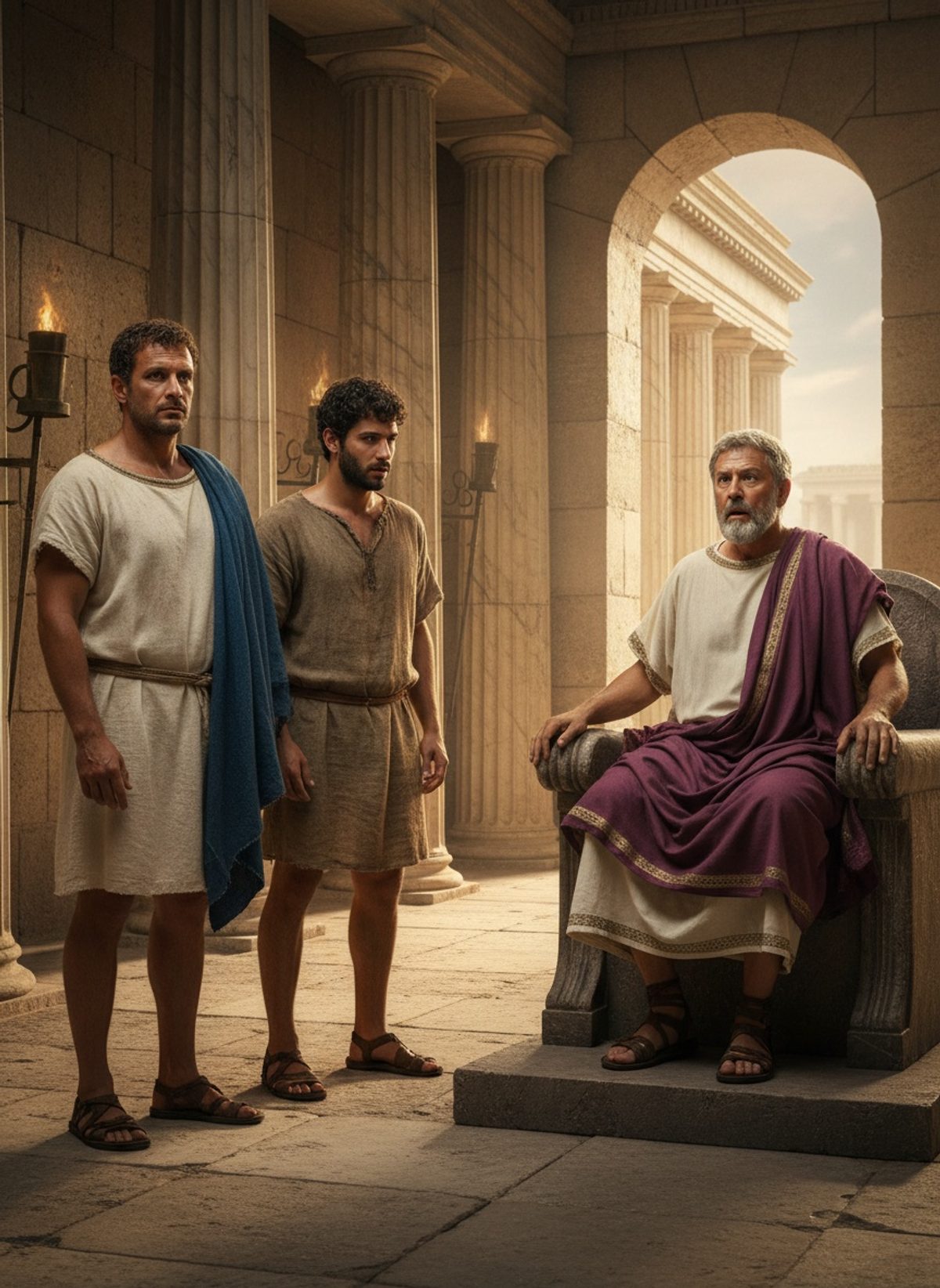
Trust was a rare commodity in the time of Ancient Greece's tyrannical rulers. Yet, even under the shadow of imminent death, two friends created an enduring testament to its power.
The Tyrant of Syracuse
In the 4th century BC, Syracuse was a city gripped by the iron fist of its tyrant, Dionysius. His reign was characterized by an unyielding sense of power and a perpetual fear of betrayal, which perpetuated a regime of suspicion and cruelty. Dionysius's rule was one where mercy was as rare as a calm sea during a storm, and when the dreaded sentence of death was cast, no one expected reprieve. In this chilling environment, a man named Pythias found himself ensnared in the unforgiving jaws of the ruler's wrath.
Pythias, a philosopher known for his adherence to the teachings of Pythagorean ideals, was accused of plotting against Dionysius. The charge alone was enough to seal his fate, ensuring a swift and public execution to deter any would-be dissenters. Yet, Pythias asked for a final wish – to say goodbye to his family and settle his affairs. Dionysius, intrigued perhaps by a challenge to his cynical worldview, agreed but under one condition: Pythias had to find a substitute whose life would be forfeit should he fail to return. Enter Damon, who willingly offered himself as a living testament to the faith he held in his friend's promise.
The stark contrast between the tyranny of Dionysius’s fear-driven governance and the profound trust shared between Damon and Pythias highlighted a fundamental dichotomy of human nature. Dionysius was sure that, like others propelled by self-interest in his experience, Pythias would flee once granted freedom's sweet taste. The pledge between Damon and Pythias was now under the watchful eyes of Syracuse, and in a time and place where tales of loyalty were scarce, few believed Pythias would return.
The Ultimate Test of Friendship
As Damon languished in the grim confines of the prison cell, the city buzzed with anticipation. Each passing moment was a step closer to the death sentence that would befall him should Pythias not return. Whispers among the city folk oscillated between doubt and wonder. Some scoffed at Damon’s foolishness, convinced that his sacrifice would soon prove to be in vain. Others dared to hope, inspired by a rare instance of loyalty that starkly opposed the pervasive mistrust in Dionysius’s Syracuse.
Inside the cell, Damon remained resolute. His unwavering spirit appeared to transcend the oppressive chains of mortality. Here was a man fused by faith in another, a concept almost foreign in a realm ruled by treachery. The absence of his friend asked much of him; yet, Damon held onto hope. Syracuse's citizens watched, waited, and marveled at this quiet rebellion against the certainty of his plight.
Days turned to the eve of Damon's execution, with still no sign of Pythias. Dionysius, both entertained and surprised by such an unfolding story, must have felt an assurance that his perception of human nature would remain unshaken. But just as the candlelight began to wane, as the intensity of uncertainty reached its zenith, Pythias returned. Weary yet determined, he had conquered the pull of self-preservation. Dionysius, the tyrant who personified an unyielding skepticism, was caught off guard by the simple, untainted promise kept by his prisoner.
The Redemption in Trust
Dionysius had intended for this test of trust to affirm his cynical worldview. Instead, he was confronted with a revelation that rippled through time. Witnessing a selfless act that stood tall amidst his court of corruption and deceit, the tyrant was compelled to spare both men. It was a marked deviation from his typical behavior, one forged by a rare display of loyalty and trust.
The story of Damon and Pythias, often retold in the annals of history, challenges the fundamental notions of friendship and integrity even today. Their tale serves as a juxtaposition against the inherent suspicion found within the corridors of power and the human heart. Through their unyielding friendship, they portrayed the possibility of transcending personal gain and depicted an ethical ideal that Greek philosophers often mused about but rarely witnessed.
In Ancient Greece, their act was extraordinary, a shining exception to the rule. It suggested that the bonds of friendship could indeed stand resolute against the corrosive forces of fear and self-preservation. This peculiar moment of redemption in Syracuse hinted at the simmering potential for change—a change capable of reshaping perspectives long held by suspicion and force. The tale of Damon and Pythias is a reminder that trust, once lived, can dispel the shadows cast by tyranny. It endures, a testament to understanding faith in another, a commodity as valuable now as it was thousands of years ago. Their story transcends the forgotten pages of dusty scrolls, whispering that perhaps, in the grand narrative of human history, love and loyalty might just be strong enough to rewrite the rules of power and fear.