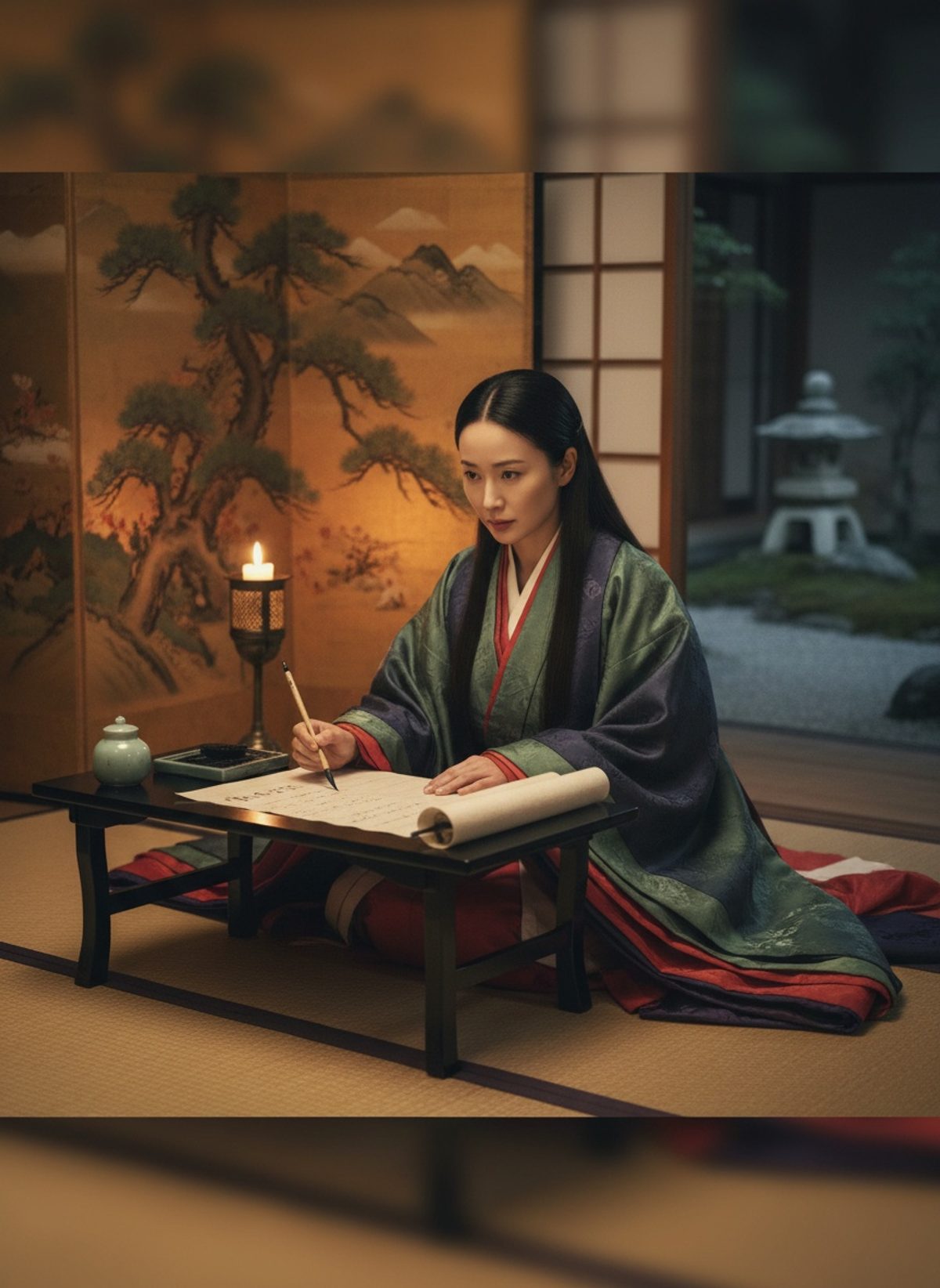
The sound of silk thudding gently against polished floors marked each step Murasaki Shikibu took down the corridors of the Heian court. Intricate patterns of her kimono shifted like waves as she moved through Kyoto's imperial confines. Perhaps it was here, alongside vermilion lacquered walls and sliding paper doors whispering in the autumn breeze, that the first sparks of an extraordinary tale alighted in her mind. For amid this opulent world — a theatre of politics masked behind painted fans — secrets unfolded like the delicate petals of a peony in early spring.
Whispers in a Forbidden World
Enveloped in tranquility, the imperial court of Heian-kyo soared amidst divine landscapes, a realm reserved for the elite. Behind the screen doors and beneath painted ceilings, courtiers spun a web of decorum and duty. Yet, beneath this surface veneer lay a vibrant world teeming with rivalries and alliances. Murasaki Shikibu, a lady-in-waiting through unforeseen circumstances, observed this world with an acumen sharpened by her outsider status.
A widow before her time and an erudite scholar surrounded by noble birth and extravagant show, Murasaki found herself navigating an intricate social tapestry. This setting, glittering and yet perilous, seemed insular and yet bore witness to a universe of whispered secrets and veiled glances. It was here among the soft rustling of silk and the whispers of the wind through the cedar trees that the seeds of her innovation — a novel, vastly ahead of its time — took root.
The Scholar Behind the Brush
Murasaki was an anomaly: a woman well-versed in an education reserved for men, shaped by the classical Chinese texts her father had reluctantly shared with her. The Heian court prized eloquence, and few could rival her in literary finesse. Her brush danced nimbly over paper, capturing the elegant cadence of poetry, a skill that found its resonance in the courtly culture obsessed with aesthetics.
Yet Murasaki's prolific insights into human nature — her acute observations woven into her writings — extended beyond traditional poetry and prose. Her position in court allowed her a unique perch from which to observe the cultural, emotional, and psychological intricacies of those around her. It was here, amidst scrolls and ink, that she sketched a world not merely witnessed but experienced — something never before recorded in such vivid depth.
From Courtroom to Page
Murasaki's creation, "The Tale of Genji," unfolded chapter by chapter, capturing the exquisite yet ephemeral beauty of court life. Her protagonist, the radiant and complex Hikaru Genji, moves through a haunting reflection of Murasaki's world — a drama of engaging and sagacious nuance veiled in metaphor. Love affairs bloom and wither like cherry blossoms, and court intrigues play out with devastating elegance, all captured in her masterful narrative.
This novel is not simply a reflection but a resounding echo of Heian Japan, a canvas painted with the deft strokes of human frailty and strength. Through Genji's fated journeys, Murasaki distills the yearnings and foibles of those cocooned within the court's confines. She brings to life the balance of beauty and impermanence, elements woven into the fabric of Japanese ethos — a foretelling yet innovative medium for the time.
The Courtly Theatre Unveiled
Imagine golden lanterns casting soft shadows over elegantly coiffed figures, their whispers rippling through tapestry-laden halls. Murasaki's pen transformed these visuals into lasting prose, a manifold of intricate details revealing the court's darling vices: affairs shrouded in secrecy, ambitions cloaked in careful diplomacy, and a world where strict hierarchies dictated one's every breath.
As her words flowed, they peeled back the layers of concealment, demystifying a life predicated heavily on ritual and decorum. The very court that might have stifled Murasaki provided her with endless stories to transcribe, unwittingly opening a door to a rich collection of characters, their human depths rendered vibrant by her narrative. Her brilliance lay in capturing not only the majestic endeavors of the elite but the personal struggles hidden beneath their polished exteriors.
An Unseen Legacy
Under a canopy of centuries past, amidst a world now vanished, Murasaki Shikibu's work still whispers of universal truths and emotions that transcend time. The Heian court might not have realized that their stories, draped in silks and shrouded in incense, would reverberate through the ages. Yet Murasaki's novel remains, a testament to her keen intellect and unparalleled insight into the human condition — a vivid chronicle of lives long silenced in parchment and lacquered walls.
In Murasaki, we find a remarkable forebear of modern storytelling — a widow, a scholar, an inquisitive soul who dared to let her voice carry beyond expectations. Her tale, crafted from a time and place immersed in ritual, speaks to us still, for great truths resonate without boundary. The resonance of her work gently nudges us toward our shared humanity, proving that as long as stories spark our imagination, the past holds infinite possibilities for connection.