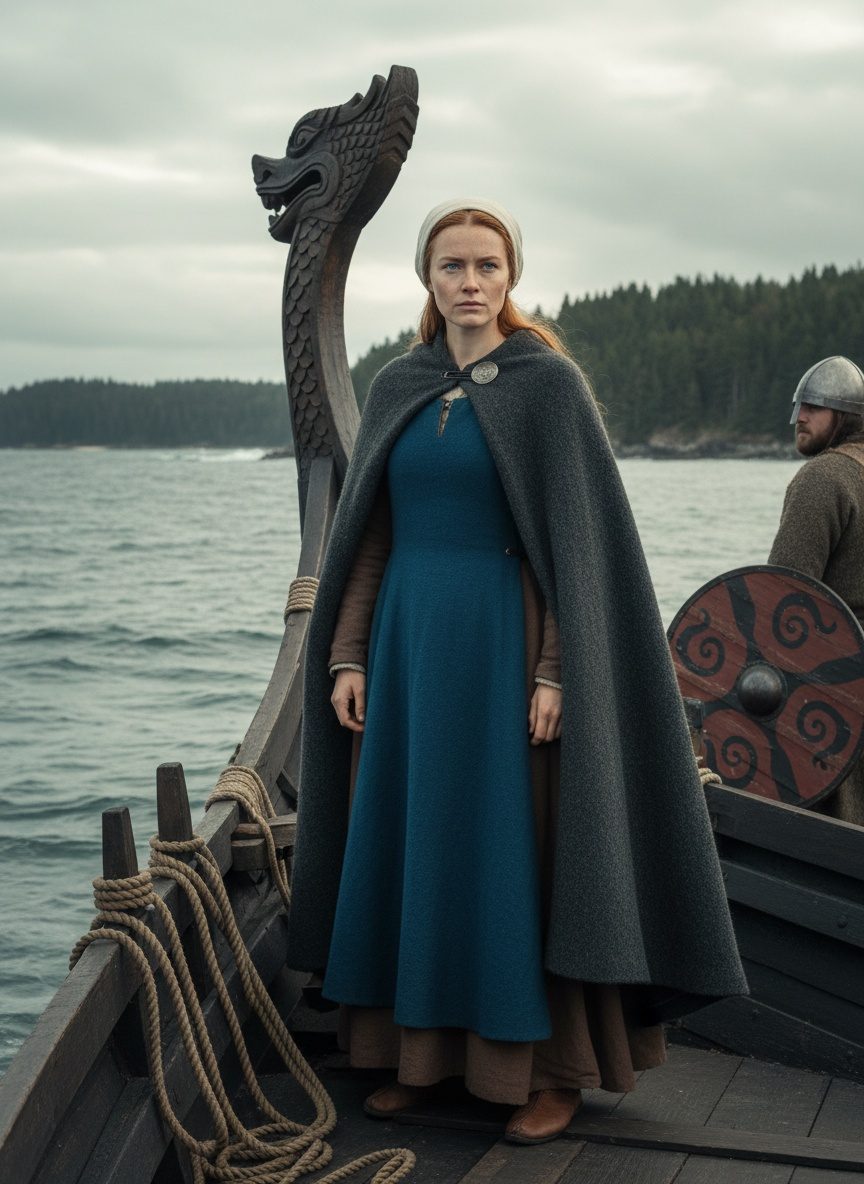
The salty wind tore at her cloak as Gudrid Thorbjarnardóttir gazed across the unfamiliar coastline, the looming trees of Vinland silhouetted against the early morning mist. The ocean behind her whispered farewell, its undulating surface the very barrier she had twice crossed, defying the vast unknown. Ahead, the promise of a continent no European had trod before her. She stood poised between the world she knew and the promise of the new, her heart a drum echoing the relentless surge of adventure.
Into the Wild Unknown
Gudrid's journey began in the cold, rugged landscapes of Norse Greenland, where tales of uncharted lands to the west stirred the imaginations of those around her. As the daughter of Thorbjorn, she was no stranger to stories of exploration, or the fierce wanderlust that characterized her people. Gudrid took to the sea, part of an expedition that would attempt what seemed unthinkable: settling a new world. The passage was grueling, testing their mettle and resolve against the untamed brutality of the North Atlantic.
Upon reaching Vinland, the struggle shifted from survival at sea to survival on land. The Norse faced unknown elements: lush forests that stretched endlessly, strange wildlife, and the presence of Indigenous peoples whose own histories and cultures wove through the very fabric of this land. It was here, at the edge of the world, that Gudrid made her mark on history. She became not only a settler but also a mother, giving birth to Snorri, the first European child known to be born in North America. This new life signaled a bridge between continents, a living testament to the farthest reaches of Norse exploration.
Yet life in Vinland was tenuous. Conflicts with the Native peoples and the challenges of sustaining the settlement in the new world eventually compelled the Norse to return to their familiar northern lands. For Gudrid, this journey was more than just a return; it was the beginning of another path, one led by faith and purpose that would see her relive the grandeur and fury of the Atlantic once more.
The Long Road Home
Back in Iceland, the land of her ancestors, Gudrid's life underwent another transformation. The Norse were a people on the cusp of transformation themselves, experiencing a shift from pagan traditions to the nascent embrace of Christianity. Gudrid, once a pioneer on river and sea, now turned her adventurous spirit inward, adopting Christianity and becoming one of the early converts at the turn of the millennium.
But Gudrid's journey was far from over. In a world where travel was fraught with peril, especially for a woman, she undertook a pilgrimage that would be remarkable even today. With little more than faith and determination as companions, Gudrid walked across Europe to Rome. It was an odyssey few in her world could imagine, let alone achieve. Her presence in Rome signified not just personal devotion, but a sense of global connectivity that was centuries ahead of her time.
Gudrid's travels and the record of her life in the Sagas provide a rare glimpse into a life of extraordinary mobility and experience, one that defies modern assumptions about medieval women and their roles in exploration and religion. As a pilgrim, Gudrid carried with her the stories of the lands and peoples she encountered, proving her capacity to intertwine as easily with the cultural currents of Europe as she had with the ocean swells of her youth.
Legacy of the Sea and Land
Gudrid’s life is inscribed not just in the Sagas but in the essence of a cultural memory that transcended borders and epochs. Her legacy is not one easily encapsulated by monuments or simple stories; it lives in the quiet, unsung bridges her journey built between disparate worlds. In an age when the edges of the map were still shrouded in mystery, Gudrid showed that the horizon was only as distant as one dared to dream.
Her story serves as a testament to the expansiveness of human potential, demonstrating that even in a world constrained by the limits of geography and time, there are no boundaries to curiosity and courage. As one of the first Europeans to set foot in North America, and as a solitary figure of faith on the road to Rome, Gudrid walked a path of untold bravery and relentless exploration — one that challenges and enriches our understanding of the Viking Age and the indomitable spirit of its women.
Gudrid's footsteps traced the outline of a world on the brink of discovery, bridging old worlds and new. As we marvel at her journeys, we are reminded of a simple, enduring truth: The call to explore is woven into the fabric of our humanity, urging us always toward the uncharted, compounding the awe of history with dreams of what might still lie beyond the horizon.