In ancient conquests, the vanquished feared draconian retribution and enslavement. But in 539 BC, Cyrus the Great delivered something unimaginable.
The Gates of Babylon
Standing under the towering walls of Babylon, one might have thought this was the end. Cyrus the Great and his army had just achieved what seemed unthinkable—entry into Babylon, a city renowned for its impenetrable defenses. Following a carefully devised plan, his forces diverted the Euphrates River, allowing them to tread beneath the mighty walls on a path left dry by the retreating waters. This daring maneuver heralded the fall of a city that had defied invaders for centuries.
Babylon, with its fabled Hanging Gardens and immense grandeur, was a prize worthy of any conqueror’s ambition. Yet for its people, the sight of Persian banners signaled fear of the same fate meted out by tyrants of old—displacement, destruction, and despair. Little did they know, however, that a transformation of unparalleled benevolence awaited them.
The Weeping Ruler
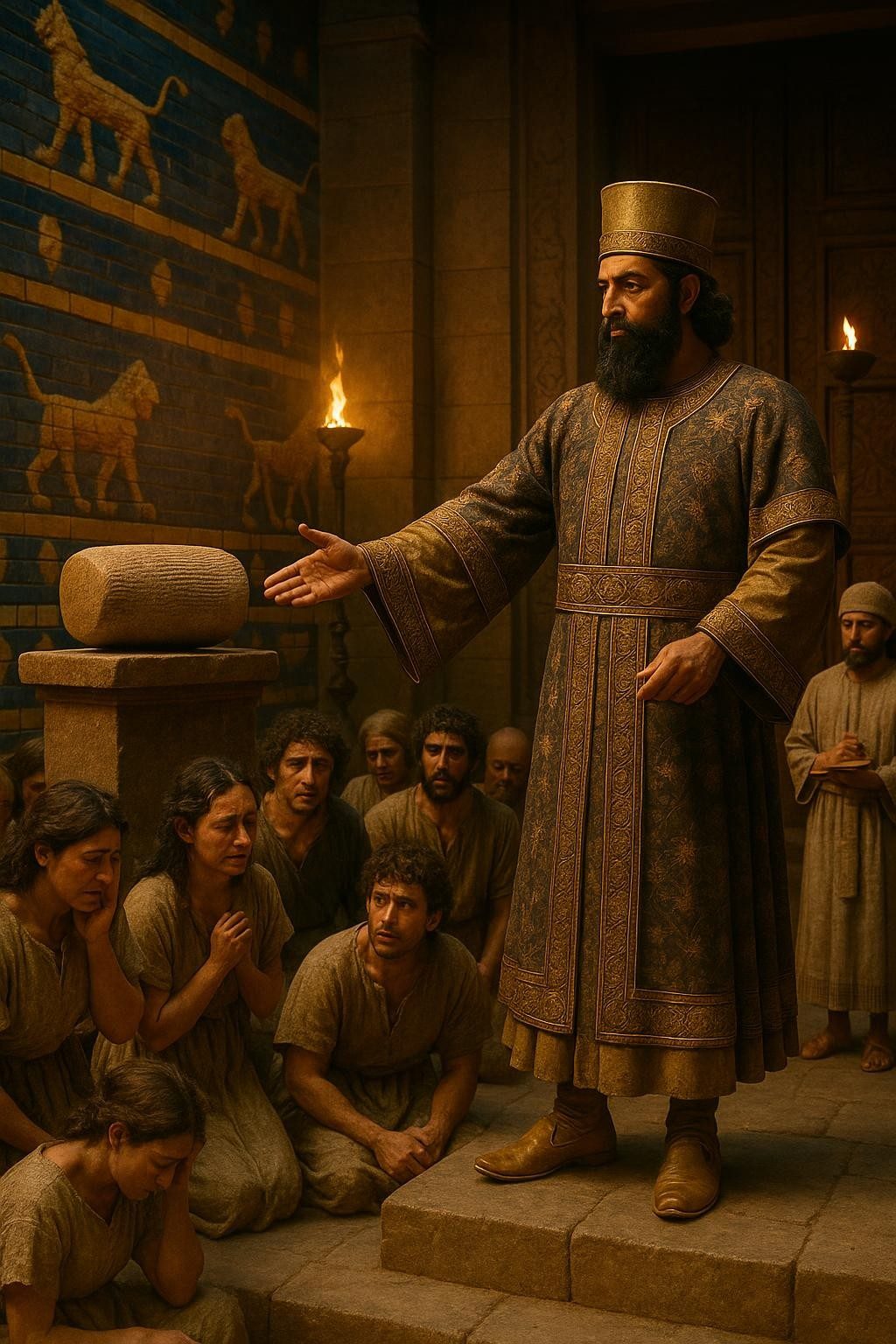
In the annals of history, conquerors rarely pause to reflect on the aftermath of their victories. But Cyrus was not like other conquerors. Before making any proclamation, he stood solemnly at the tombs of Babylon's royalty, a gesture signaling deep reverence and an unexpected humility. Legends suggest he wept—moved not by triumph but by the realization of responsibility now resting upon his shoulders as a ruler of this rich and storied land.
Such a sight—a conqueror shedding tears instead of brandishing weapons or shaking chains—was perhaps the first hint that the age-old script of dominance and subjugation was about to be rewritten. Cyrus understood the power he held, but he wielded it with a restraint that was revolutionary for his era. His disposition set the stage for one of history's most groundbreaking decrees.
A Liberator’s Decree
Cyrus’s approach to rulership was nothing short of revolutionary. After entering Babylon, he did what no ruler had done in the region before: he proclaimed freedom. The peoples of Babylon, long accustomed to the icy grip of disenfranchisement, suddenly found themselves granted liberty and agency. In an era where empires were built on the subjugation of other cultures, Cyrus changed the paradigm. He ordered the cessation of forced displacement and the return of deities to their sacred lands, thereby acknowledging the importance of cultural and spiritual autonomy.
This decree was more than mere political maneuvering; it was an assertion of human values. It likened Cyrus to a liberator, acknowledging the dignity and rights of every culture under his domain. Captives from every corner of the Babylonian realm, each one bearing stories of longing and hope, knew the sweetness of freedom because of this proclamation. This was etched not in paper, but on a clay cylinder, making it clear that these promises were set in stone—or rather, in clay.
The Clay Cylinder
Known today as the Cyrus Cylinder, this artifact stands as a physical testament to Cyrus's enlightened rule. For modern historians, it offers not just a glimpse into the administrative mind of Cyrus but a comprehensive tableau of human rights in antiquity. The cylinder, discovered long after his reign, speaks across millennia, detailing the proclamation of freedom and the return of religious icons to their native sanctuaries. It is often heralded as a precursor, although informal, to later declarations of human rights.
The significance of the Cyrus Cylinder extends beyond its immediate historical context. It serves as a reminder that this visionary set a precedent in governance for future rulers and empires—a foundation built not on subjugation but on mutual respect and restoration. While the world then was carved by conquest, Cyrus imagined a reality wherein diversity was celebrated and enriched under a single banner of unity.
A Legacy of Liberation
Cyrus the Great’s conquest of Babylon, far from being a tale of destruction, is one of unprecedented compassion. He reshaped the very essence of power, transforming it from a tool of oppression into one of reconciliation and hope. His vision was that of a king who saw his subjects not as vanquished peoples to be suppressed but as partners in the growth of a burgeoning empire.
This story of Cyrus the Great exemplifies that even in the throes of conquest, humanity and empathy can prevail. It echoes through the ages that sometimes the greatest victories are not those won by force, but by the courage to change old paradigms. As we gaze back at the ruins of ancient empires, the legacy of Cyrus reminds us that leadership defined by empathy not only shapes kingdoms but also transcends time, inspiring generations yet to come.