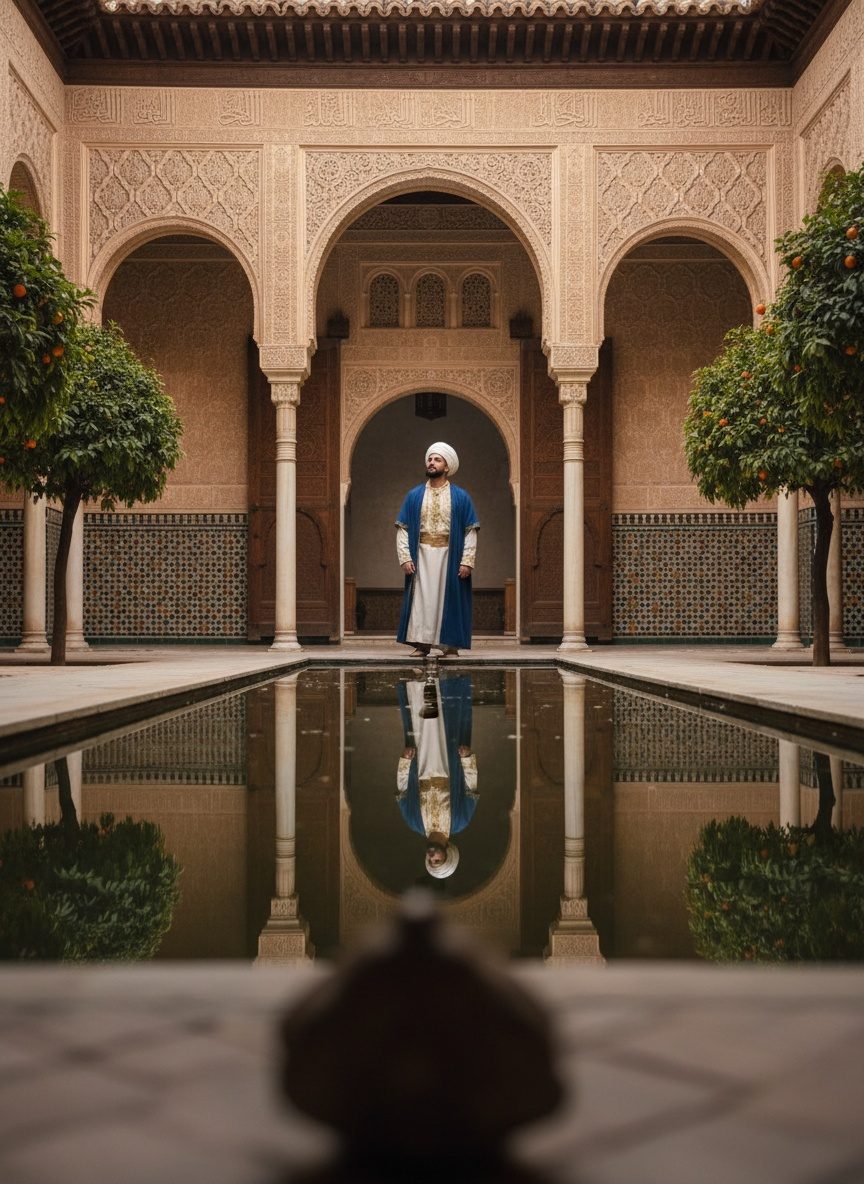
The call to prayer echoed off the red walls of the Alhambra, mingling with the sound of water trickling from a nearby fountain. For a moment, time seemed to stand still as Yusuf I gazed out over the sprawling city of Granada, bathed in the warm glow of the Andalusian sun. Below, the gardens bloomed like an oasis in the desert, a testament to the vision of a young sultan who sought to transform his city from a fortress into a paradise.
The Ascension of a Visionary Sultan
In 1333, Yusuf I assumed the throne of the Nasrid Kingdom of Granada, a realm besieged by external threats and internal strife. Surrounded by enemies, the young sultan faced a choice: fortify his defenses or invest in the arts and architecture. With a maturity that belied his youth, Yusuf opted for the latter, choosing to leave a legacy not of war, but of beauty. His reign marked a turning point in the history of the Alhambra, a palace that would become an enduring symbol of Islamic art and culture.
Yusuf’s decision was daring. At a time when fortifications were increasingly seen as the key to survival, he redirected his resources towards the embellishment and expansion of the Alhambra. In doing so, he not only transformed the physical landscape of Granada but also solidified the cultural and political identity of his kingdom.
Building a Kingdom of Harmony
The Alhambra is often described as a palace of water and light, its architecture a celebration of harmony between nature and humanity. Under Yusuf I, this vision became a reality. He commissioned artisans and architects to transform the stone edifice into a living tapestry, where intricate carvings and vibrant tiles turned walls into woven fabric and dull stone into flowing water.
The Comares Tower, one of the Alhambra’s most iconic features, exemplifies this blend of aesthetic appeal and sophisticated engineering. The tower’s interior was adorned with splendid arabesques and calligraphy, forming a symphony of art that seemed to sing praises to the heavens. The delicate interplay of light and shadow, achieved through the placement of windows and reflective pools, encapsulated the essence of Yusuf’s dream: a paradise on earth.
Strength Through Identity
Yusuf I understood that beauty could be as powerful as any military fortification. By investing in the Alhambra, he fostered a sense of unity and pride among his subjects. The palace was more than just a royal residence; it was a symbol of the Nasrid dynasty’s cultural and religious identity. Amid the political turbulence of the 14th century, Yusuf’s architectural endeavors cultivated a sense of continuity and coherence that transcended the battlefield.
The Alhambra’s walls became canvases for the finest examples of Islamic artistry. Verses from the Quran were inscribed in stucco, celebrating not only the divine but also the intellectual and spiritual pursuits of the people of Granada. Through this fusion of art and architecture, Yusuf I reinforced the narrative of a kingdom resilient in its traditions and unyielding in its quest for beauty.
Echoes of a Bygone Era
While Yusuf I’s reign eventually succumbed to the pressures of history, the echoes of his vision continued to reverberate through the Alhambra’s corridors. Each courtyard, each hall, stands as a testament to his ability to see beyond immediate threats and towards a future secured by culture and creation. The Alhambra is now recognized as one of the finest examples of Islamic architecture in the world, visited by thousands who wish to glimpse the manifestations of Yusuf’s dream.
Through the centuries, the Alhambra has withstood political upheaval, weathered conflicts, and witnessed the rise and fall of empires. Yet, its grace and serenity remain untarnished, a tribute to the foresight of a sultan who understood that walls, no matter how strong, would never outlast the intangible legacy of beauty and aspiration.
The Legacy Unfolds
Yusuf I’s decision to pour resources into the construction of the Alhambra offers a lesson in power that transcends time: that strength need not always be expressed through might and fortresses. In a world rife with conflict and competition, Yusuf chose a path that celebrated cultural prosperity over military supremacy, leaving a legacy far richer than any conquest.
In today’s era of rapid change and constant tension, the story of Yusuf I and the Alhambra serves as a reminder of the enduring power of vision and creativity. It challenges us to consider what legacies we wish to leave behind, urging future generations to seek harmony and beauty in their endeavors, build bridges instead of walls, and find triumph in the unyielding human spirit.