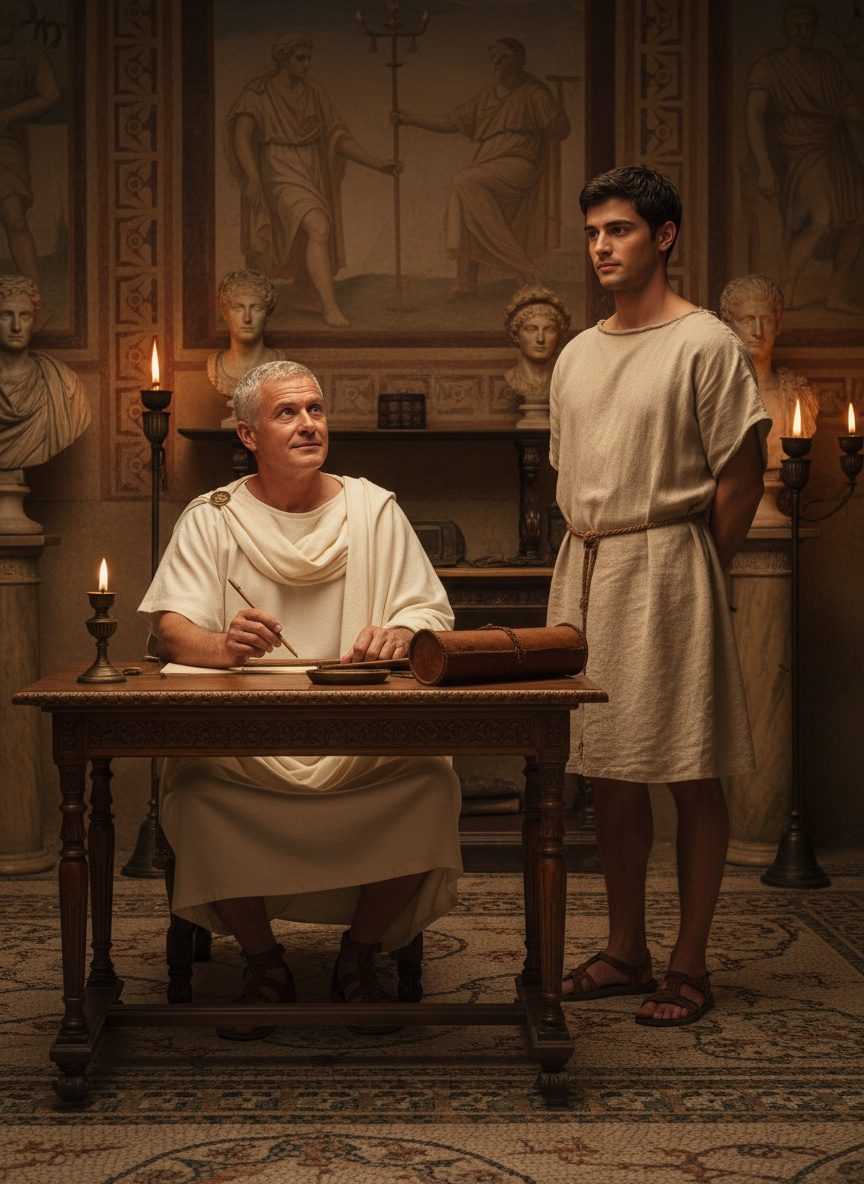
53 BC. The ink sat poised on the cusp of Cicero's pen.
Amid the marbled halls of ancient Rome, a moment of profound significance was unfolding behind closed doors. Marcus Tullius Cicero, Rome's greatest orator and statesman, sat at a desk buried under scrolls and wax tablets. In front of him stood Tiro, a slave who had served him loyally for decades, capturing his words and immortalizing his thoughts. Today, the relentless hum of the city outside seemed distant as the two men confronted a moment that would alter the trajectory of literature and history.
The Secretary’s Ink
Tiro was, by all accounts, no ordinary slave. From his boyhood, he had been given perhaps the greatest education a person in the Roman Republic could hope for. Under Cicero's tutelage, Tiro became more than a mere observer; he became the pen and heart of one of Rome's most influential voices. He was there, always in the shadow, as Cicero gave electrifying speeches in the Forum and masterminded intricate political maneuvers. With nimble fingers, Tiro developed a system of shorthand, allowing him to swiftly capture every nuance of Cicero's orations—a skill that became indispensable in the fast-paced political theater of Rome.
Throughout Cicero's tumultuous career, Tiro was more than a recorder of words; he was a confidant and often a silent partner in his master's formidable intellectual endeavors. Their relationship was emblematic of Rome's complexities—an empire where power, slavery, and intimacy intertwined. Their bond was not purely transactional, and Tiro's devotion was not rendered solely from ownership; it was a deep, mutual respect kindled by shared scholars' minds.
On that fateful day in 53 BC, Cicero's pen finally granted Tiro not just freedom, but a new identity—a Roman citizen. It was a bold decision, but typical of Cicero, who was renowned for bucking the trends of his fellow patricians. To many, this act might seem an ordinary fulfillment of a master's duty, but for Tiro, it signified a new chapter. The signature was not just ink on paper; it was a life-altering liberation that opened doors to worlds he had glimpsed only through the lens of servitude.
The Legacy Keeper
Freed from his servile bondage, Tiro did not retreat into a quiet life. Instead, he cemented his legacy by dedicating himself to preserving his former master's works. It was an endeavor that would shape the future of Latin literature. Cicero, renowned for his linguistic flair and critical contributions to Roman thought, had set the tone for subsequent generations, establishing Latin as more than just the language of the ruling class—Tiro ensured this legacy endured.
With meticulous precision, Tiro edited and published Cicero’s extensive body of work, which included speeches, letters, and philosophical treatises. He expanded on Cicero's ideas while maintaining the integrity of his master's voice. Tiro's editing work was monumental, protecting sentences and paragraphs from the ravages of time that would obliterate so many ancient texts. In doing so, he strengthened the foundational structures of what would become the bedrock of modern Western education in rhetoric and philosophy.
Yet, Tiro's contributions went beyond simple preservation. His comprehensive system of shorthand, though largely lost to us now, underpinned academic and clerical advancements in years to come. His script was an early precursor to modern note-taking methods, streamlining the recording of complex information. So impactful was Tiro's shorthand that references to it abounded in later Roman accounts, attributing to him a level of innovation rarely associated with those born into slavery.
Beyond Chains: An Enduring Impact
As Rome continued its ascendancy, extending its reach throughout the known world, Tiro outlived his contemporaries, including Cicero, who was executed in the purges following Julius Caesar's assassination. Tiro’s lifespan, indelibly etched by his initial years in bondage and his later life of scholarly work, marked him as a figure of resilience in a tumultuous era. His survival and accomplishments after Cicero's death are a testament to the man's intellect and determination. Rising from slavery to claim a place in the annals of history, Tiro represents an intersection of fate, talent, and determination.
And so, Tiro's influence rippled beyond the confines of his time. Generations tutored on Cicero’s philosophies owe their access to Tiro's singular dedication. His hand ensured that the intellectual spirit of the Roman Republic bridged gaps between antiquity and the Renaissance, impacting thinkers such as Petrarch who adored Cicero's letters. The act of manumission that freed Tiro was much more than a personal milestone; it was a gateway through which the eloquence and thought of the past could still reach out to inspire the present.
In reflecting upon Tiro’s journey, one is reminded not only of the phenomenal endurance of words but also of the quiet power inherent in those who dedicate themselves to preserving knowledge. In a world that frequently forgets the unmarked contributors to its greatest achievements, Tiro's life urges us to acknowledge the unseen, unrecorded labor that sustains civilization itself. The ink may have dried on Cicero's letter long ago, yet the stroke of that pen continues to echo throughout history.