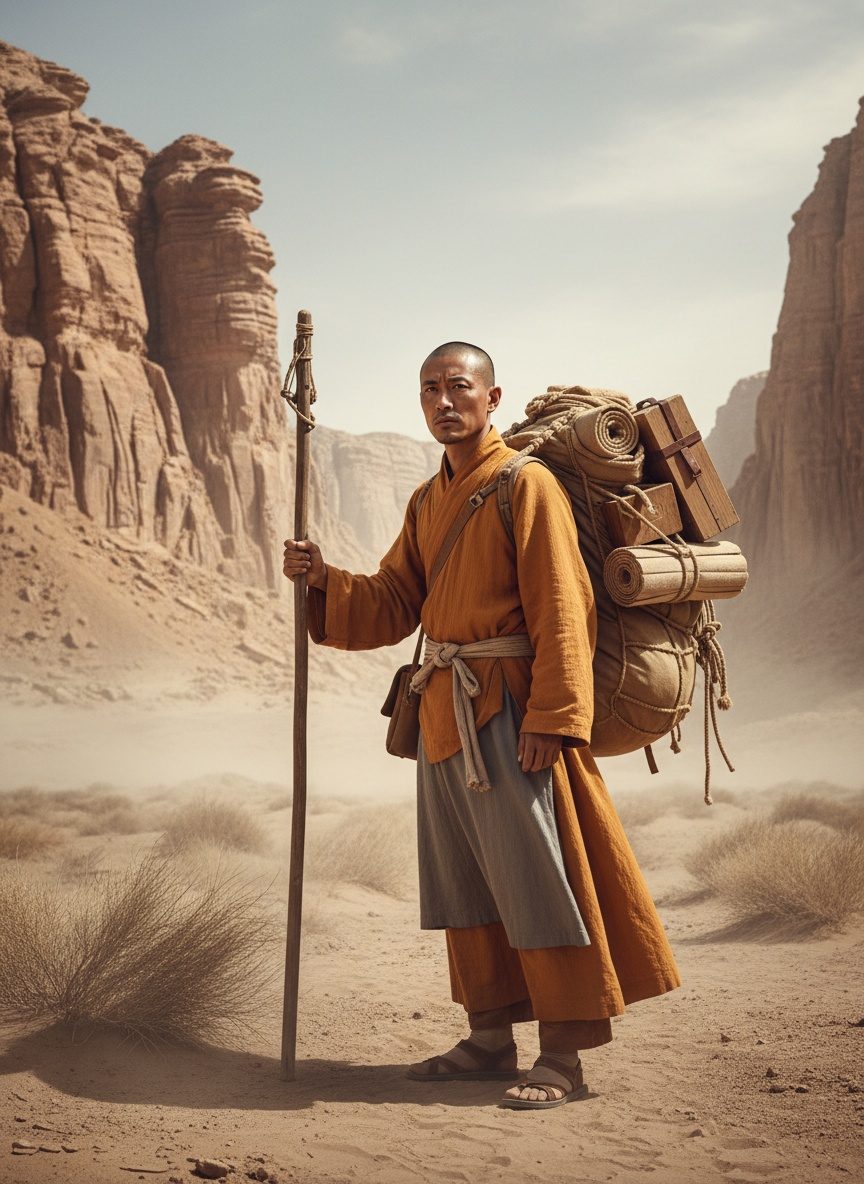
629 AD. The sun blazed mercilessly upon the dusty expanse of the Silk Road.
The Monk Who Defied an Empire
In the year 629 AD, a lone figure slipped through the imposing gates of the westernmost reaches of the Tang Empire. His name was Xuanzang, a 27-year-old Buddhist monk, bound by neither imperial directive nor decree, but by a sacred vow. The Tang Emperor, Taizong, had imposed a strict travel ban on the kingdom's subjects, owing to the political tensions that shadowed China's borders. Yet, Xuanzang was undeterred. With no official papers, he abandoned the safety of the realm, embarking on an arduous pilgrimage that would carve his name into the annals of history.
Xuanzang's mission was propelled by a singular, profound purpose. The Buddhist texts available in China were fraught with interpretations that he found unsatisfactory. Mesmersized by the idea of finding genuine scriptures, he resolved to journey to the very heart of Buddhism—India. His path, however, lay through territories uncharted by Chinese travelers, across the formidable challenges of deserts and mountains, and encroaching the doorstep of hostile entities. But Xuanzang was not merely traversing geographical landscapes; he was navigating through a spiritual voyage that would redefine Buddhism in China.
Trials of the Silk Road
The Silk Road was no ordinary highway; it was a corridor of trade and treachery, stretching over thousands of miles through forbidding terrain. Barely had Xuanzang crossed the threshold of China when he was confronted by the vast, relentless sands of the Gobi Desert. The ordeal of the sun-scorched land was compounded by dwindling water supplies and the perilous threat of bandits, an omnipresence that lurked in the shadows of mirages. Without the protection of state-issued permits, any interaction with border guards or law keepers could have spelled an abrupt end to his quest.
Beyond the sandscapes, Xuanzang faced the towering peaks of the Tian Shan and the Hindu Kush mountain ranges. These were not only physical barriers but psychological ones, demanding unwavering courage and endurance. Each step was fraught with the possibility of a misstep leading into a crevasse or an avalanche cascading down the mountainside. Yet, through sheer tenacity and the kindness of strangers—often Buddhist monks from neighboring monasteries—Xuanzang persisted.
In the Cradle of Buddhism
Xuanzang eventually arrived in the sacred lands of India, following paths that led him to the seminars of Nalanda, one of the greatest Buddhist monastic universities of the age. Here, his scholarly pursuits knew no bounds. Over seventeen years, Xuanzang delved into a plethora of subjects: logic, grammar, Sanskrit, metaphysics, and, of course, the core tenets of Buddhist philosophy. With each scripture he read, each teaching he absorbed, his knowledge of Buddhism expanded exponentially.
He collected a staggering 657 Buddhist texts on his journey—each containing doctrines that had never before graced Chinese eyes. Xuanzang's intellectual voyage was not just solitary; it was rich with dialogues and debates with eminent scholars. The monks of Nalanda embraced him, and the profound exchange of ideas further galvanized Xuanzang's resolve to return home with this newfound treasure trove of wisdom.
The Revered Return
Seventeen years had passed since Xuanzang's departure when he returned to China's gates, not as a renegade traveler but as a cultural hero. The very emperor who had once proscribed his journey, Tang Taizong, personally deigned to greet him—a mark of the profound respect Xuanzang had garnered. With him, Xuanzang brought not just scrolls but stories of enlightenment and a series of relics sacred to Buddhism.
Xuanzang's return marked the dawn of a new era for Buddhism in China. He undertook the formidable task of translating the scriptures, a labor that would consume the remainder of his life but one that he undertook with unwavering devotion. His translations opened up fresh vistas of understanding and helped cement Buddhism's place in Chinese spirituality. Xuanzang's quest was more than a physical expedition; it was an odyssey that transcended boundaries of culture, philosophy, and religion.
The journey of Xuanzang isn't merely a testament to unyielding human spirit; it challenges perceptions of globalization and cultural exchange during an era defined by its insularity. In the face of adversity and in defiance of imperial restrictions, one monk's solitary mission carried the torch of knowledge across continents, illuminating the path for future generations. Xuanzang's story is not just a story of a monk but of an idea that refused to remain confined to geography, sculpturing a legacy that resonates to this day.