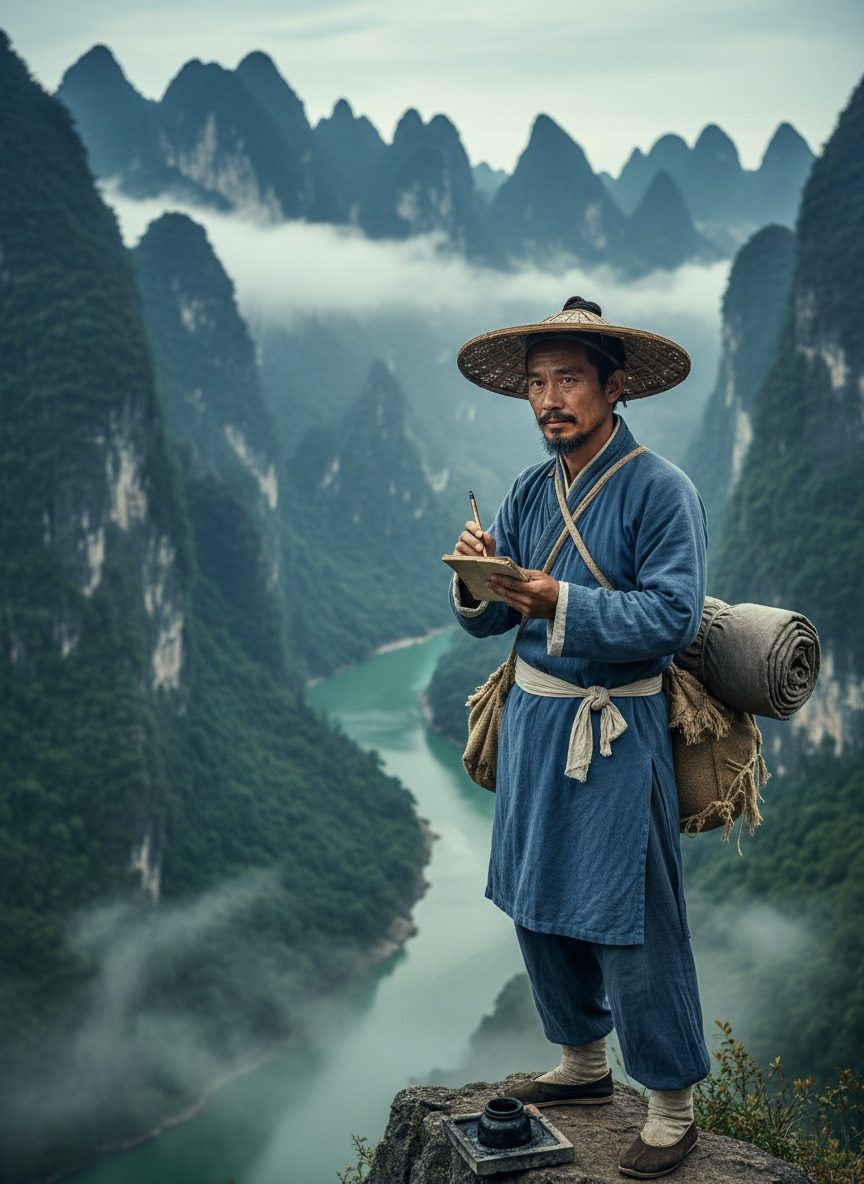
The sun was just beginning to peek over the jagged horizon as mist clung stubbornly to the valley floor. In the distance, the faint, melodic sound of a waterfall harmonized with the chorus of morning birds. Here, amidst the untouched wilderness of Ming Dynasty China, Xu Xiake set out on yet another audacious expedition. For most, these rugged landscapes, hidden beyond the edges of civilization, were mere names on a map — marks that faded into the unknown. But for Xu, they were the uncharted realms waiting to unveil their secrets.
To Walk Unseen Paths
In an era dominated by imperial mandates and scholarly pursuits confined to the rigid frames of scrolls and ink, Xu Xiake was a curious anomaly. Born in 1587 into a family of scholars, he was expected to follow the well-trodden path of academic excellence and serve the empire. Yet, Xu harbored a different passion. Instead of training his eyes on the stern lines of calligraphy and the hollow confines of administrative halls, his gaze stretched past the horizon, drawn to the land's contours and the motion of rivers threading through the earth.
Rejecting the comfort of a scholar’s desk, Xu Xiake ventured into the untamed and unexplored wilderness. His tools were simple: a journal, ink, and an insatiable curiosity. Xu embarked on his first of many journeys without the endorsement or escort of the imperial court, relying instead on the vast tapestry of the land itself as his compass. For thirty years, he traced the courses of rivers to their elusive sources, charted mountains that pierced the skies, and documented caves hiding in shadowy recesses. Each step he took was a defiance of tradition; each map, a testimony to human tenacity.
While others sought advancement through hierarchy, Xu pursued knowledge at the boundaries, where civilization brushed against mystery. It was here, in the loneliness of remote caves and the hush of high-altitude passes, that Xu found both solace and challenge. His journeys into these isolated terrains did more than just fill the blank spaces of maps; they broadened the very scope of what China thought it knew about itself.
A Cartographer's Solitude
The corners of China Xu ventured into were often devoid of paths and people — lands characterized by their raw beauty and daunting hostility. Dense forests cloaked the land with an unease that would intimidate the undetermined. Rivers, in their restless flow, refused to be tamed by man’s designs. The perilous landscapes bore witness to Xu’s solitary trudging, as he forged his path through terrains few had seen and fewer had chronicled.
With no formal recognition from the imperial state, his expeditions were pursued at great personal expense and often incalculable risk. Xu Xiake’s only companions were the shifting landscapes and the nature he embraced. By the grace of local villagers and sheer resourcefulness, he overcame obstacles that deterred even the most intrepid adventurers of his time. Remarkably, Xu documented all he encountered with meticulous precision and unwavering dedication, filling volumes with observations, sketches, and topographical details that illuminated China’s untouched lands.
Xu’s work was not appreciated by traditional scholars of his day, who viewed such endeavors as unnecessary distractions from more 'civilized' pursuits. However, his contributions laid a foundation for understanding the geography and biodiversity of remote China, providing crucial documentation that would endure long after the echoes of his footsteps had faded.
The Legacy of the Compassless Voyager
Xu Xiake's legacy is more than a footnote in the annals of Chinese geographical exploration; it is a profound testament to the spirit of inquiry and the embrace of the unknown. Without an imperial commission or military might at his back, just trust in his instincts and the integrity of his craft, he revealed terrains that even the empire had overlooked. Xu's detailed accounts offered future generations the keys to understanding the stunning, rugged beauty and the geological wonders of China — a tapestry woven with mountains, rivers, and caves that seemed to breathe their own stories.
The paths that he walked, once obscured by mystery and isolation, are now arteries of knowledge, inviting others to explore and understand anew. Xu Xiake’s remarkable journey reminds us that some of history’s greatest achievements are born not from power or privilege but from a relentless quest for understanding. As modern explorers with tools far surpassing the simple ones Xu carried, we can only marvel at his courage and dedication to walk the edges of the world, alone, magnifying the maps and horizons of his time.