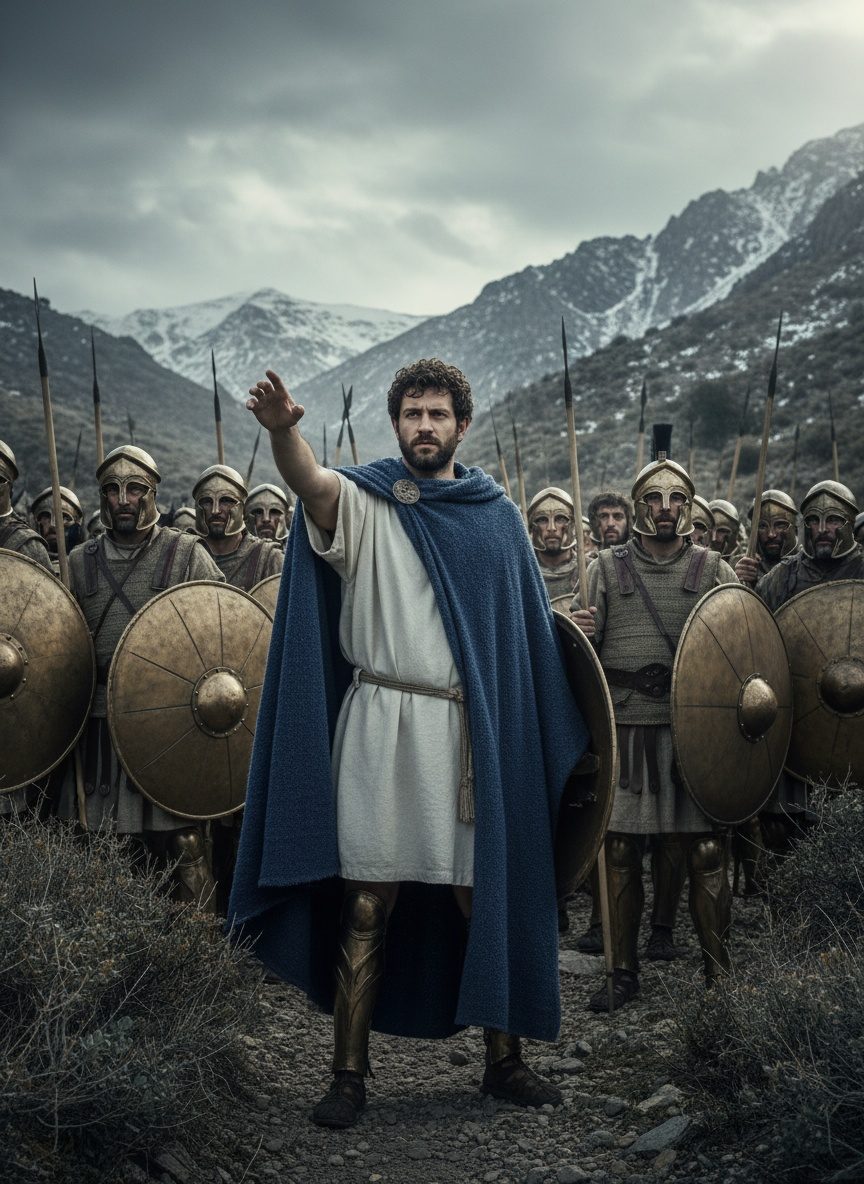
In the echoing silence of a desert plain, surrounded by hostile forces and fading hope, ten thousand Greek soldiers looked to one man. A young Athenian who was neither a general nor a famous politician. Yet, in the throes of despair, Xenophon stepped from the shadows, took a deep breath, and promised them something that seemed impossible — to lead them home.
The March into Uncertainty
In 401 BC, the Persian Empire was the most powerful state in the known world, sprawling over lands conquered with relentless might from Asia Minor to the Indus Valley. Greek mercenaries, hardy and skilled, were prized assets, muscle for the highest bidder, but never more so than during the campaign of Cyrus the Younger, a Persian prince with ambitions to seize the throne from his brother, King Artaxerxes II.
Cyrus recruited a formidable force of ten thousand Greek soldiers, lured by promises of riches and glory. Xenophon, a relative youth and a student of Socrates, joined them not as a soldier, but as a seeker or perhaps a chronicler of the unfolding adventure. He could not have known that this journey, starting with expectations of triumphant return, would quickly devolve into a harrowing test of survival.
The Fall of a Prince
The powerful clash came at Cunaxa, near Babylon. The Greeks, stationed on Cyrus's right flank, overcame the Persian forces before them with ease — their tight phalanx formation an unrivaled force. Yet, Cyrus himself, driven by ambition and hubris, charged into the fray and met his end on the field. When news of Cyrus's death reached the Greeks, a grim silence set in; their employer and the last hope for a friendly haven in a hostile empire was no more.
The aftermath was chaotic. The Greeks, victorious yet leaderless in a foreign land, made matters worse when their generals, under the pretense of peace negotiations with the Persians, were deceitfully invited to a banquet and summarily executed. The Greeks found themselves trapped in an unfamiliar landscape, without leadership, miles away from the safety of Greece, and surrounded by hostile forces eager to extinguish their presence.
Xenophon Steps Forth
In this void of command, Xenophon emerged. Born in Athens around 430 BC, he was no stranger to the complexities of leadership and the martial world, but this was different. Called upon by divine dream or sheer necessity, he rose to rally the demoralized men, offering a glimmer of hope where none seemed possible. Despite his lack of military experience, Xenophon's education and philosophical grounding became his army’s greatest asset.
Xenophon proposed a bold plan — a retreat to the Black Sea, not directly back to Greece but towards safety and potential support. His eloquence and resolve ignited a spark of hope. He instilled in the scattered ranks a sense of purpose so desperately needed, transforming the Greeks’ despair into determination with words that one soldier later recalled: "to die is to fulfill nature’s law, but to die in such shame, with weapons in hand but idle? That is not death; that is a crime.”
The Long and Perilous Journey
And so began the Anabasis, a retreat etched into the annals of Greek history as "The March of the Ten Thousand." Through desolate mountains, frigid passes, and hostile territories, the men followed Xenophon. This retreat was fraught with skirmishes and the perils of an alien landscape. They faced the relentless cold of the Armenian winter — many perished from exposure and hunger — and the unyielding aggression of local tribes, each step testing their unity and resolve.
What this motley band of Greeks faced might astonish us even today. Some accounts suggest that for every step forward, they were beset by a new enemy or treacherous weather. Among their hardships, the camaraderie born from necessity was their salvation. The most remarkable scene perhaps was when, scaling the oppressive heights of the Armenian mountains, they finally spied the glistening waves of the Black Sea. "Thalassa! Thalassa!" — "The sea! The sea!" — went up the cry, an expression of hope and home mingled with tears.
Legacy of Leadership
The significance of Xenophon's achievement didn't end when the Greeks returned to Greek soil. He documented their epic journey in "Anabasis," a work of immense historical and literary value. His accounts informed military strategies and inspired later commanders, including Alexander the Great. His work served as both a testament to the resilience of the human spirit and a lesson in leadership defined not by titles but by actions and bravery.
In time, even far afield, his legacy was honored by a much later nation. Britain's army officer cadets once read "Anabasis," recognizing within its pages not only tactical brilliance but also the virtues of perseverance, unity, and leadership — values transcending any battlefield's immediacy.
The Resounding Relevance Today
Why does the tale of Xenophon and his ten thousand echo through the corridors of history with such enduring clarity? Perhaps it's because, far beyond their ancient struggle, theirs is a story of collective courage, of the human endeavor to find order in chaos and to rise from the depths of despair. Xenophon’s legacy is a beacon across time, a reminder that leadership often emerges not from authority or command but from the willingness to face the daunting unknown and to inspire others to march forward, no matter how dire the circumstances.
In our modern world, where the tests of endurance may not be over foreign terrains but daily life's uncertainties, Xenophon’s voice carries still. The underlying message of resilience, unity, and hope is one as timeless and ever-needed today as it was on the plains of Cunaxa, and on the march through the barren lands of ancient Persia.