The sun blazed fiercely over the arid Sudanese desert, turning the endless expanse of sand into a shimmering mirage. The only sounds carried by the dry, scorching wind were the occasional distant calls of the Dervish warriors and the anxious whispers of the British cavalrymen, their horses snorting restlessly beneath them. The year was 1898, and in this desolate landscape loomed one of the last great cavalry charges of the British Empire. For the twenty-three-year-old Winston Churchill, a young cavalry officer and ambitious war correspondent, this was more than a battle; it was both a perilous rite of passage and a defining moment of imperial history.
The Gathering Storm
The British Empire, in its Victorian-era zenith, viewed Sudan as a vital stretch of land, strategically significant as a buffer and route to the riches of East Africa and the broader dominions. To secure their foothold, the British clashed with the formidable Mahdist forces, known collectively as the Dervish army. These warriors, fervent in their religious zeal and seasoned in the art of desert warfare, had resisted colonial powers fearlessly under the banner of the Mahdi.
British preparations for the campaign against the Dervishes centered on Kitchener’s plan to reclaim and secure the Sudanese capital, Omdurman. The air was thick with tension as the 21st Lancers, a cavalry regiment recognized more for its ceremonial pageantry than for battle-hardened engagement, readied themselves for an advance that would test their mettle against overwhelming odds.
Charging into Destiny
On that fateful day in September 1898, Churchill found himself riding alongside the Lancers, his motivations driven as much by journalistic ambition as by martial pride. He had maneuvered his way to the front, determined to capture the essence of battle firsthand and make a name that would transcend the shadow of his illustrious heritage.
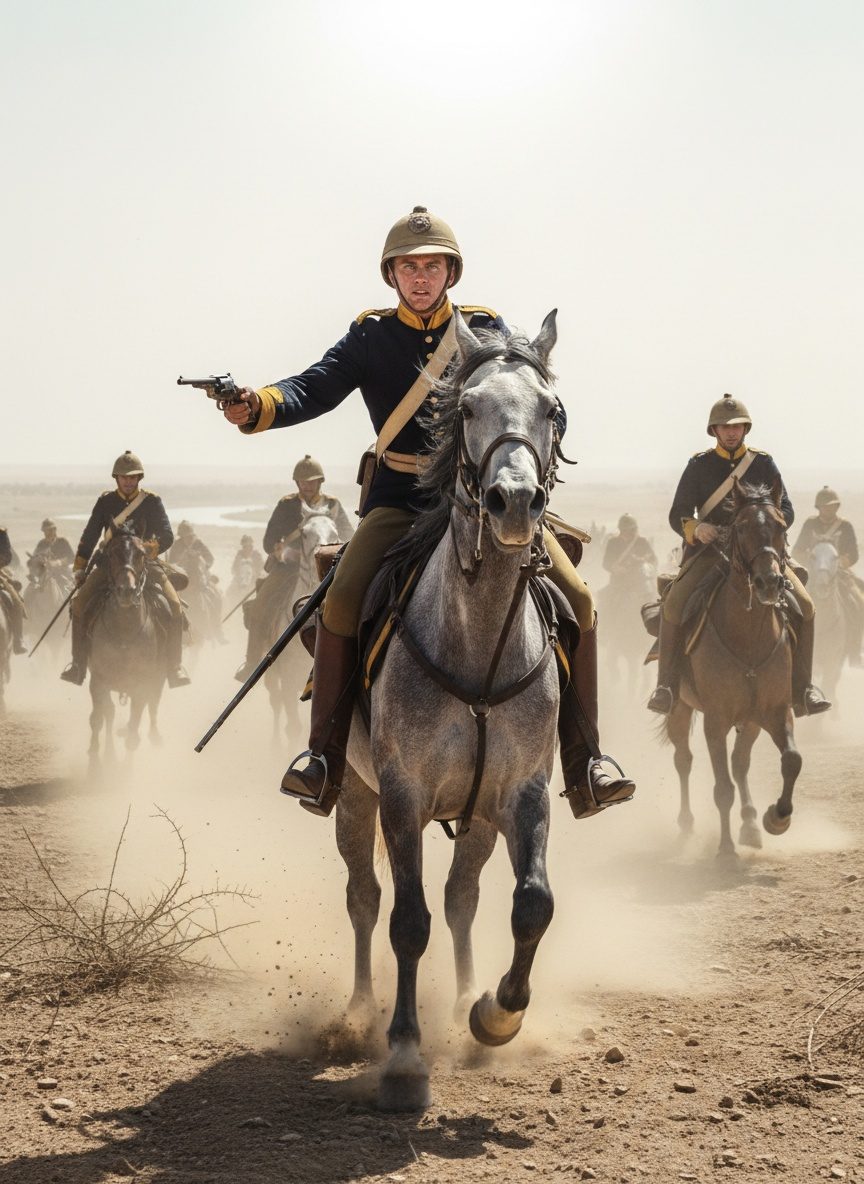
As the Lancers approached the field, the seemingly barren terrain suddenly came alive with the movement of thousands of hidden Dervish warriors. Emerging from the ravines in a cacophony of cries, the warriors unleashed a flurry of spears and rifle fire. The charge transformed from a tactical maneuver into a desperate fight for survival, galloping headlong into a swirling melee of chaos and courage.
Amid the ferocious clash, Churchill gripped his Mauser pistol tightly, its cold metal a reassuring constant. He maneuvered his horse with practiced dexterity, warding off attackers with shot after frantic shot. Even as comrades fell around him, their cries swallowed by the fury of combat, Churchill pressed onward, his resolve steeled by the conviction that survival was synonymous with his burgeoning destiny.
The Aftermath of Valor
The engagement at Omdurman lasted scarcely four minutes, four minutes of unparalleled heroism and horror, marking the bloody epilogue of cavalry warfare. When the dust settled, the Dervish forces lay broken, their once-impregnable aura shattered by the relentless advance of Kitchener’s forces. For the British Empire, the battle claimed victory but left in its wake a sobering reflection on the cost of conquest.
For Churchill, who emerged from the charge unscathed, it was a triumph both personal and existential. The young officer's exploits would soon reach the eager audiences of London’s drawing rooms, cementing his reputation as both soldier and storyteller. The survival of Churchill amidst such odds became the cornerstone of a legacy that would define British leadership during its darkest hours in later decades.
A Turning Point Remembered
The charge at Omdurman is often romanticized in the annals of British military history, reflecting a fading era of imperial ambition and martial tradition. However, it encapsulates more than just the valor of those who fought; it is a reminder of the complex tapestry of motives, marked by the ambitions of individuals like Churchill and the stark realities faced by colonial forces in foreign lands.
The experience forged Churchill's indomitable spirit, offering a glimpse into the tenacity and resolve that would later steer Britain through the crucible of World War II. It serves as a poignant reflection on the enduring allure of war narratives and the human stories interwoven within them. Amidst the celebrated pomp and circumstance, Omdurman stands as a testament not only to a bygone military era but also to the enduring intrigue of history's untold legends.