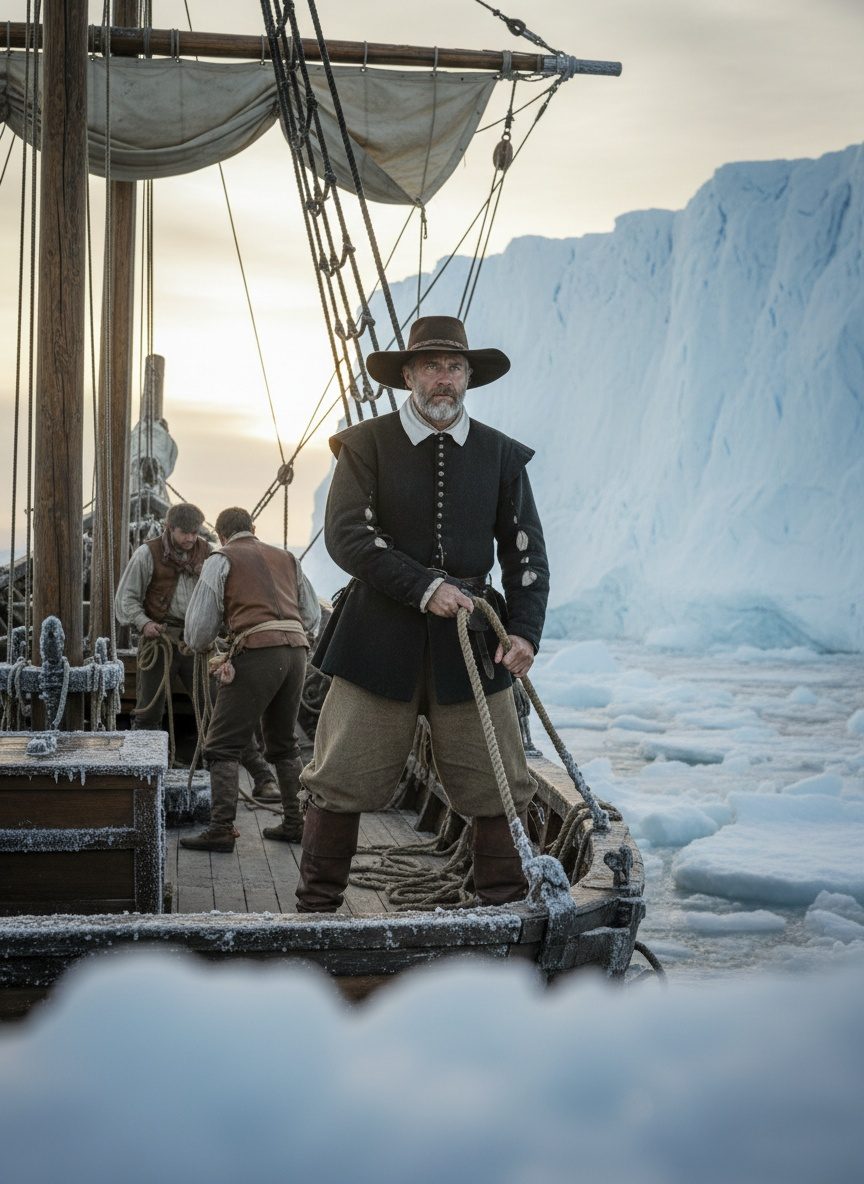
The cold gnawed at their bones as the wind howled through the rigging, sounding like a mournful chorus. The tiny vessel shuddered with each crack of shifting ice. Henry Hudson stood at the helm, eyes squinting against the sharp Arctic glare, resolute as the frozen landscape closed in around them. His crew muttered under their breath, casting anxious glances at the relentless ice, pleading silently for an end to this madness.
The Decision That Changed the Voyage
In the minds of many, it was sheer folly. But to Henry Hudson, it was a calculated gamble. Tasked by the Muscovy Company to find a northern route to China, Hudson faced the daunting challenge of navigating the Arctic's perilous waters. The year was 1607, and while many had ventured into the icy unknown, none had conquered it. Yet, Hudson was determined, even as the odds stacked higher with each advancing floe.
The Muscovy Company, driven by the promise of untapped trade riches, pinned their hopes on Hudson. The past had seen doomed expeditions and lost crews, but with resources scarce and patience thinner, this mission needed a captain of iron resolve. Hudson, with his daring vision, was that man. Some thought him reckless; others saw genius. To Hudson, the line was inseparable—a sliver of warmth between survival and oblivion.
A Sea of Ice and Silence
The relentless Arctic atmosphere closed over them like a vice, its silence a stark contrast to the chaotic pitches and rolls of the sea. As the ship cut further north than any Englishman before them, each degree stolen from the frozen world came at a cost. The men grumbled, their confidence in their captain tested. The sky stretched endlessly white above, broken only by the occasional crack of distant icebergs wandering the open waters.
Hudson's crew, a band of hardy seafarers, shared the captain’s intrepid spirit—at least at first. Their confidence waned as nights stretched longer and supplies dwindled. The euphoria of new horizons had melted, replaced by the bitter chill of reality. Yet, Hudson pushed onward, his sight firmly fixed on distant lands known only in dreams and charts. To retreat meant defeat, and for Hudson, the kingdom of ice held promises yet revealed.
Mapping the Unseen World
The significance of Hudson's voyage lay not only in its bold attempts but in the treasure that came with his return: knowledge. Though the mythical passage to China remained elusive, Hudson and his men returned with maps that redrew the boundaries of European understanding. Their charts detailed coastlines, currents, and vast expanses of an ocean shrouded in whispers and speculation.
Their expedition forged new paths, a beacon for future explorers who would later follow in Hudson’s wake. These fresh lines inked on paper charted a world half-seen through the icy fog of enduring myth. Hudson had not found what he sought, but he had created a legacy of exploration—the defined shape of the earth beneath its frosted shrouds.
The Human Element
Below decks, the toil of Hudson's voyage resonated in the daily life of the crew. Each man carried his own burden: the relentless uncertainty, the cold's clawing persistence, and the haunting echo of the Arctic desolation. Stories exchanged in whispered tones spoke of home, juxtaposed against the relentless cry of seabirds overhead. With every ice-choked mile, camaraderie became as crucial as the ship's timber.
Hudson’s resolve, though iron-forged, was not immune to the human elements of doubt and discord. His decisions weighed on more than just his mind—they burdened the collective spirit of men far from warmth. Trust had to be built and rebuilt amid the clash of salt and frost. Amid this crucible of hardship, each man found himself drawn to Hudson’s dogged dedication, a flickering light in the long polar night.
A Voyage to Remember
As they turned south, their journey a testament of endurance, the Arctic expanse claimed its prize: the knowledge and courage etched forever into the annals of exploration. The ice, often seen as a malevolent specter, revealed itself as a silent teacher. Hudson had not unlocked the treasure chest of Asia, but he had shifted paradigms, blasting open the notion of the possible.
The voyage of 1607, though initially a mission undone by nature’s grip, became a pivotal moment in the Age of Exploration. It was a chapter steeped in resilience and ambition, illustrating the line men like Hudson tread between dream and destruction. For Henry Hudson, the passage was not just a search across a lonely ocean, but a journey within the human spirit—a timeless testament that the courage to push boundaries, to stare down the impossible, mattered as much as the sea itself.