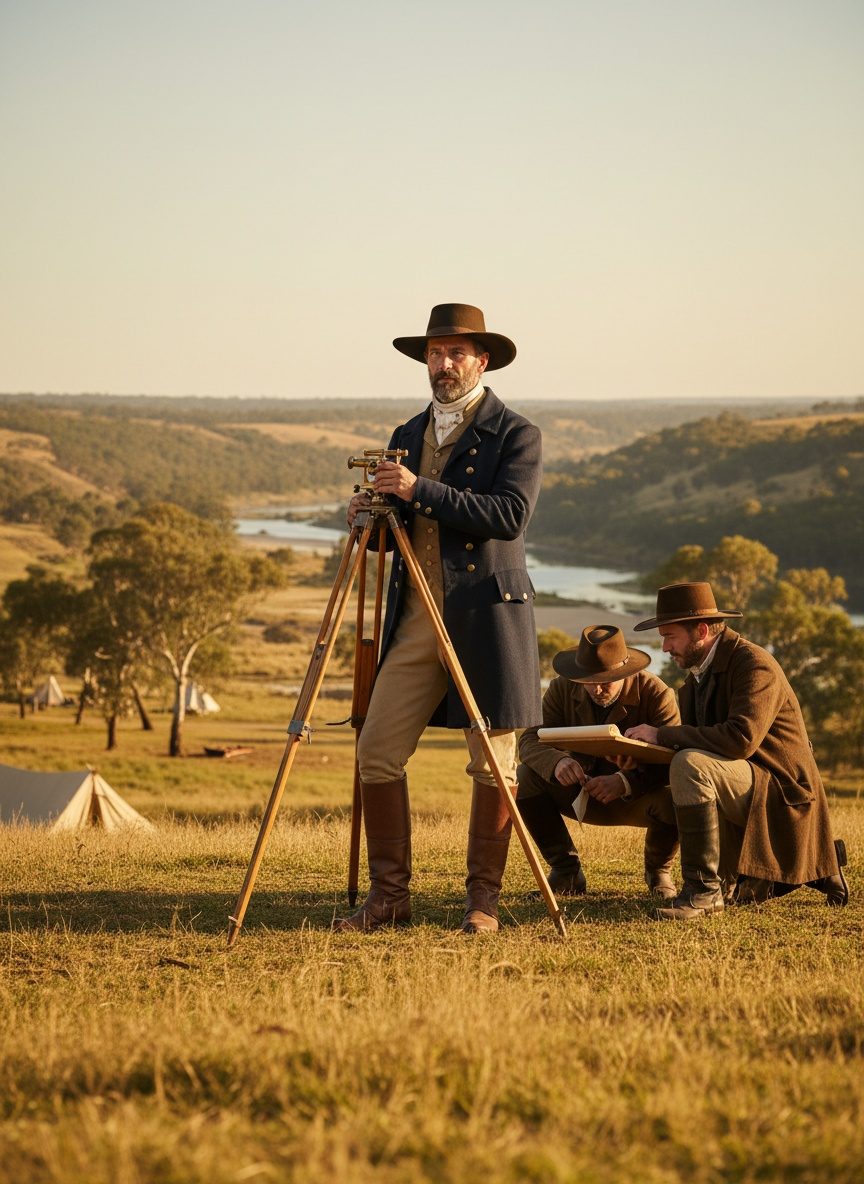
The sun hangs low over the dusty expanse of the South Australian coastline, bathing the landscape in a soft, golden hue. The waves of the Gulf St Vincent nibble at the unmarked shore, murmuring secrets of the untouched land. In the midst of this rugged beauty stands a solitary figure, silhouetted against the dying light—Colonel William Light. With each breath a struggle, but his resolve unwavering, Light faces the wild frontier with a grand task: to map a new city from nothingness.
The Unseen Dreamer
Colonel William Light’s tale begins with an assignment that would test the bounds of human endurance and foresight. Born in 1786, Light was already in the twilight of his life when destiny led him to South Australia's uncharted shores. Those who knew him remember a man whose exterior was all too aware of its frailties. Tuberculosis, slowly sapping his vitality, seemed just a whisper of the raging internal fire that drove him. When others might have wavered, Light leaned into his convictions, guided by a vision few could grasp.
As Colonial Surveyor-General, his mission was immense: choose the site for South Australia’s new capital. But unlike other towns that sprang up haphazardly along pathways of least resistance, Light imagined something different—an ideal city, grounded in equal parts pragmatism and aesthetic fortitude. On this premise, he defied not just nature but also the mighty voices of colonial governance who demanded quick solutions over enduring dreams.
A Canvas of Nothingness
Stepping onto the banks of the River Torrens, Light saw beyond the impenetrable eucalyptus trees and formidable plains. His was a world of potential, a canvas yet to be marred by humanity’s haste. The absence of roads, towns, or detailed maps was neither deterrent nor distraction. For Light, these were not obstacles, but opportunities to mold something truly remarkable.
The task before him was monumental. With little more than a surveying chain and steps guided by instinct, Light covered the terrain meticulously. Each measurement was a dance with destiny, every stake in the ground a promise of a burgeoning metropolis. His detractors saw folly in his stubbornness when he refused to relocate the site north of the Torrens as some suggested. But Light's insistence stemmed from a robust understanding of geography and climate, aiming for a city that thrived in harmony with its environment.
From Vision to Reality
Amidst political storms and personal hardships, Light's determination never wavered. On paper sketched under canvas and candlelight, Adelaide took shape—a city grid of leafy streets and parklands that promised prosperity. His plan would accommodate growth and change, allowing nature and human habitation to coexist seamlessly.
Light's innovative approach was radical. Contrary to traditional settlements that grew organically around a central street, Light envisioned wide avenues and public squares—spaces for the community to gather and grow. Though plagued by illness, he was meticulous in his work; the resulting plan of Adelaide was remarkable not just for its foresight but for its beauty, praised later as a masterpiece of urban planning. This elegance came not from grandeur or excess, but from a deep respect for both the land and the people's need for space and connectivity.
A Battle Worth Win
Governors raged against his decisions, frustrated by delays and costs they attributed to Light's stubbornness. What they saw as immutable whimsy was, in truth, a steadfast guardianship of principles Light refused to compromise. He believed passionately that South Australia deserved a city that reflected more than expedience—a city that embodied the very promise of new beginnings.
While some dismissed his fight as an exercise in vanity, history has vindicated his efforts. The Adelaide we know today, celebrated for its livability and design, stands as testimony to Light’s singular vision. From its verdant parklands to the rhythm of its streets, the city reflects an intricate tapestry woven from ideals and integrity.
In understanding Light’s story, we remember more than the crafting of a place—we see the contours of human spirit etched into the fabric of history. We find inspiration in the truth that resilience, coupled with vision, can reshape reality. It is in this quiet but profound legacy that William Light still speaks, urging us to seek ever-new horizons beyond the immediate, to strive always for the potential that awaits on every unseen shore.