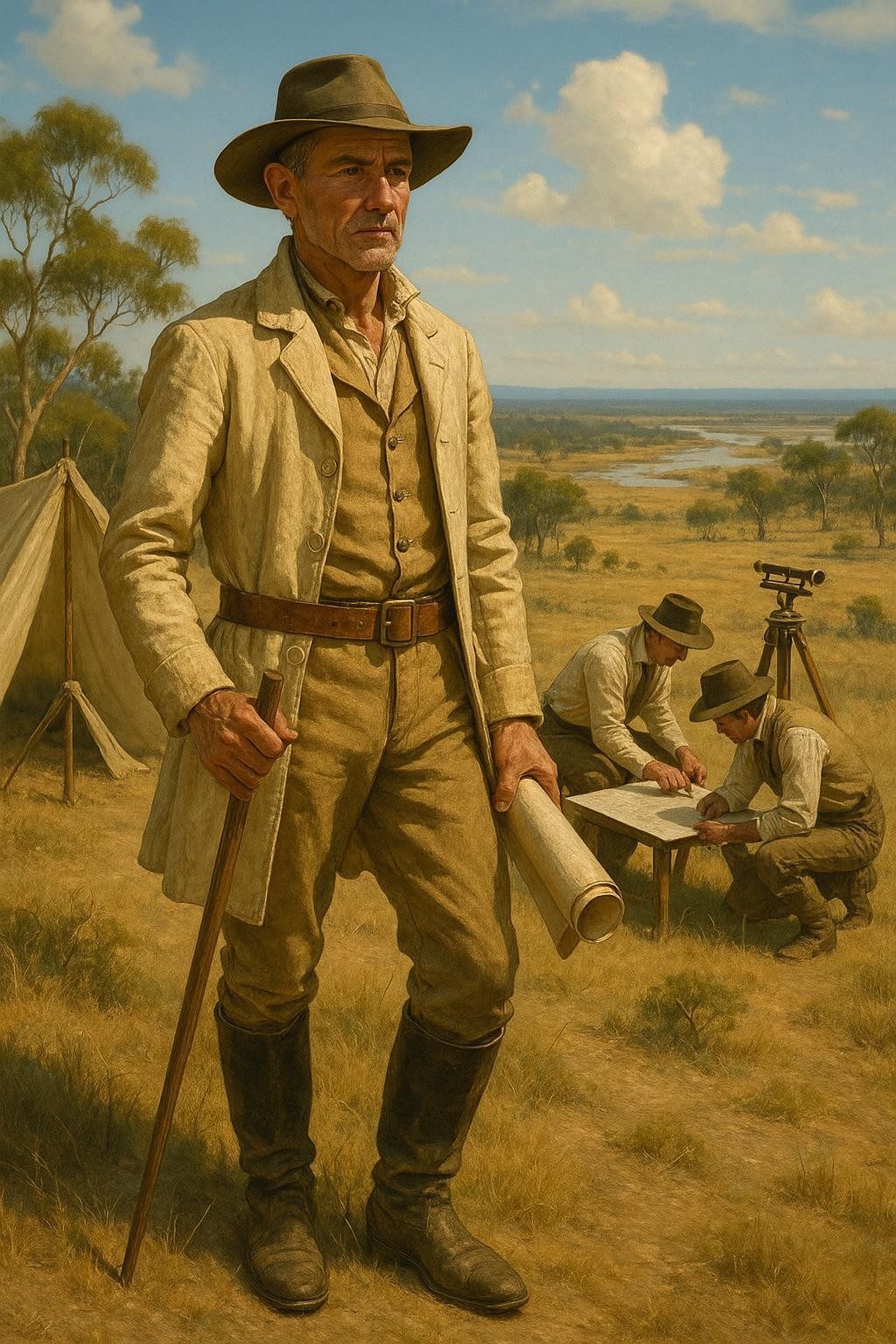
The morning light was gentle upon the undulating plains, casting long shadows from the sparse gum trees that punctuated the landscape. The air held a crispness that promised clarity, with the distant calls of native birds echoing through the stillness. It was this place, under the expansive southern sky, that a city was about to be born—not from consensus or government command, but from one man’s unyielding vision. As the grasses waved in the morning breeze like an ocean of green, Colonel William Light stood resolute, knowing that what lay before him was far more than a stretch of untamed wilderness; it was the backdrop for his legacy. In 1838, this site would become modern-day Adelaide, built exactly where Light had planted his sturdy flag against all opposition.
A Vision Beyond the Sea
Colonel William Light was not a stranger to adversity or ambition. As he surveyed the South Australian plains, his mind was filled with the possibilities of creating a city meticulously designed to fit the natural landscape rather than dominate it. What critics saw as folly—a site far removed from the coastline—he saw as potential. The Governor, Sir John Hindmarsh, along with others in the colony’s administration, argued vehemently that the new capital of South Australia should be closer to the sea, ensuring easy access for trade and supplies. But Light, an experienced military commander and the first Surveyor General of South Australia, knew something they did not.
Light had tramped over every inch of the plain with a surveyor's tools and an artist's eye, examining the land with a dual purpose: practicality and beauty. He understood the area’s topographical advantages, including the Torrens River, which could provide fresh water, fertile land for farming, and a natural drainage system in times of flood—advantageous compared to the marshy coastal areas. Moreover, the hills provided shelter from the harshest winds, creating a more livable climate for future settlers. In essence, Light foresaw a city that nestled into its environment as opposed to imposing itself upon it.
Despite the chorus of dissent that suggested his plans were distant and impractical, Light's commitment never wavered. He was acutely aware that bending to pressure would compromise the vision for Adelaide, a dwelling place that promised to harmonize human lives with the broad sprawling earth it rested upon. His defiance did not stem from obstinacy but from a profound understanding of the possibilities that lay in creating harmony between nature and urban life. After all, what is distance when aligned with vision?
The Hill That Held Firm
Governor Hindmarsh was plain in his sentiments: “Adelaide is madness.” Every authority figure seemed to echo his concerns—except for the settlers themselves. Light's intricate plans found fervent supporters among those who had arrived to build new lives in the colony. It was their collective hope for a prosperous future that would eventually balance the scales of bureaucratic power, lending weight to Light's stubborn resolve. And so Light's metaphorical hill became not just the topographical rise that defined the city's geographical shape, but a symbolic platform from which he launched his dreams.
The surveying work carried out by Light and his team was laborious, requiring precision and an eye for the future. The land lay ready and waiting, and in Light's designs, the city plan emerged. Streets formed a web that took topographical features into account, offering generous parklands that would later become prized aspects of the city. The diversity of zones created within his plan allowed for both residential tranquility and industrial vigor, balancing commerce and daily life in a visionary equilibrium. These choices laid the groundwork for what we now recognize as urban planning, an art still in its infancy in the mid-19th century.
As work progressed, Light's vision began to quietly rise from the soil, much like the sturdy eucalypts that would come to line its streets. He declared his commitment with a simple but profound manifesto: "The City shall stand here." That determination sent ripples back to colonial administrators, whispers of which eventually reached London, forming a sketch of approval that eagerly awaited to follow in the form of formal declaration. Despite the pressures from high offices, Light held firm. He believed a backdown would result in poor selection decisions dictated by immediate needs and profit, rather than the sustainable growth cultivated by time.
From Vision to Reality
The unfolding construction of Adelaide served as a testament to Light’s conviction. With time, the layout proved to benefit trade while also catering to the burgeoning community, fostering a sense of identity and place that was unique to the South Australian capital. The city’s grid pattern, ingeniously interspersed with parklands, predicated a harmony with nature that continues to provide its residents with balance between urban life and natural beauty. Against predictions of failure, settlers found fertile ground here not just for crops, but for culture and commerce too. Their reality steadily validated Light’s ambitious dreams.
Today, light filters through tree-lined boulevards in a metropolis that retains much of William Light’s original plan. Adelaide's design promotes a vibrant urban tapestry, where history and modernity weave tightly. The city continues to benefit from the strategic foresight that considered flood prevention, fire breaks, and even defence advantages long before such concepts were key to urban development. Through his obstinant adherence to principle, Light gifted future generations with more than a city template—he gave them a living model of innovation, daring, and perceptive planning.
Reflecting on Adelaide’s origins invites a contemplation not only of historical defiance but of foresight in the face of opposition. William Light’s story is one of commitment to enduring ideals over yielding to the transient pressures of the day. It reminds us that true visionaries can see past immediate hurdles to create something steadfast and lasting. Ultimately, Adelaide’s journey from concept to vibrant reality speaks to the omnipresent power of vision tied inseparably to the land it seeks to honor. Light's story reiterates the timeless power of courage and conviction to shape destinies, and underscores how the true challenge is not in seeing — but believing and standing firm until others see it too.